Pieter Andreas Rysbrack, a notable Flemish painter of the late Baroque and early Rococo periods, carved a significant niche for himself primarily through his evocative landscapes and meticulously detailed still life compositions. Born into an artistic family in Antwerp, a city then still echoing with the grandeur of Rubens and Van Dyck, Rysbrack's career would see him transition from the artistic heart of Flanders to the burgeoning art scene of Paris, and finally to London, where he made his most lasting contributions, particularly in the depiction of English estates and gardens. His work not only showcases the technical prowess characteristic of Flemish artistic training but also reflects the evolving aesthetic sensibilities of the 18th century, particularly the growing appreciation for nature and the picturesque.
Early Life and Artistic Formation in Antwerp and Paris
The precise birth year of Pieter Andreas Rysbrack is sometimes cited as 1655, leading to confusion with his father, Pieter Rysbrack the Elder (1655–1729), who was also a landscape painter. However, scholarly consensus leans towards Pieter Andreas being born later, around 1684 or 1690, in Antwerp. He was part of a family deeply embedded in the arts; besides his father, his younger brother, John Michael Rysbrack (Michiel Rijsbrack), would go on to become one of the most prominent sculptors in 18th-century England.
Pieter Andreas Rysbrack's initial training likely occurred within his father's workshop. He formally became a master in the Antwerp Guild of Saint Luke in the guild year 1672-1673 if we consider the earlier birth year, or more plausibly around 1708/1709 if we accept the later birth dates, which aligns better with his subsequent career trajectory. The Guild was a crucial institution for artists in the Low Countries, providing training, regulating trade, and upholding standards. His early works would have been steeped in the Flemish landscape tradition, which often combined realistic observation with idealized compositions, a legacy of artists like Jan Brueghel the Elder and Gillis van Coninxloo.
Seeking to broaden his artistic horizons, Rysbrack traveled to Paris. There, he is recorded as having studied under Frans Millet, more accurately Jean François Millet, often called Francisque Millet (1642–1679). If Rysbrack was born in 1655, this tutelage is plausible. However, if born c. 1684/90, Millet would have already passed. It's possible he studied with Millet's son, also named Jean François Millet (Francisque II), or was more generally influenced by the elder Millet's style, which was known for classical, Poussinesque landscapes. This Parisian sojourn exposed Rysbrack to the classical landscape style popularized by French masters like Nicolas Poussin and Claude Lorrain, whose idealized visions of Arcadia, complete with mythological or biblical figures, were highly influential throughout Europe. This classical influence, emphasizing order, harmony, and a certain poetic mood, would temper the more earthy realism of his Flemish roots. His paintings from this period began to exhibit what contemporaries described as a "poetic and melancholic" quality, particularly evident in his sensitive rendering of trees and atmospheric skies.
Relocation to England and the Patronage of Lord Burlington
Around 1720, Pieter Andreas Rysbrack, along with his brother John Michael, relocated to London. This move was part of a broader trend of continental European artists seeking opportunities in England, where a wealthy aristocracy and gentry were increasingly commissioning art, particularly portraits and landscape views of their newly acquired or redesigned estates. While John Michael Rysbrack quickly established himself as a leading sculptor, rivaling figures like Peter Scheemakers and later Louis-François Roubiliac, Pieter Andreas found his métier in landscape painting, specifically the burgeoning genre of estate portraiture.
His most significant patron in England was Richard Boyle, 3rd Earl of Burlington. Lord Burlington was a pivotal figure in the popularization of Palladian architecture in Britain and a key proponent of the new English landscape garden style, which moved away from the rigid formality of earlier French and Dutch gardens towards a more naturalistic, picturesque aesthetic. This new style was heavily influenced by the landscape paintings of Claude Lorrain, Gaspard Dughet, and Salvator Rosa, which English gentlemen encountered on their Grand Tours.
Burlington commissioned Rysbrack to create a series of paintings documenting the development of his influential estate, Chiswick House, and its gardens in Middlesex. William Kent, an architect, landscape gardener, and painter, was Lord Burlington's primary collaborator in designing the gardens at Chiswick. Rysbrack's paintings of Chiswick are invaluable historical documents, capturing the estate's transformation from a more formal layout to one that embraced the emerging ideals of naturalism and irregularity. These views often adopted a slightly elevated, panoramic perspective, allowing for a comprehensive depiction of the grounds, architectural features, and the interplay of light and shadow across the landscape.
The Chiswick House Series: A Landmark in Garden History
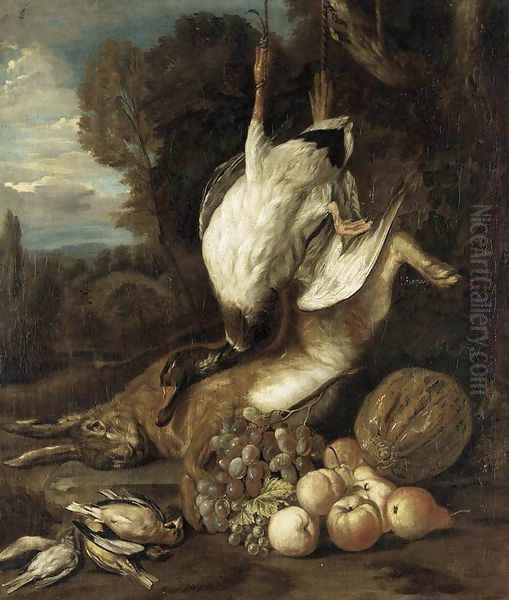
The series of paintings Rysbrack produced for Lord Burlington depicting Chiswick House and its gardens are among his most celebrated and historically important works. These canvases, executed primarily in the 1720s and early 1730s, provide a unique visual record of one of England's most innovative landscape garden projects. They illustrate the gradual shift away from the geometric parterres and avenues inspired by French models, such as those at Versailles designed by André Le Nôtre, towards a style that sought to emulate the idealized landscapes of classical painters.
Rysbrack's views of Chiswick capture various stages of its development, showing features like the iconic Palladian villa itself, the classical temples, obelisks, statues, and the carefully contrived "natural" water features. His paintings allowed Burlington to visualize the ongoing changes and to showcase his estate to a wider audience. These works are not merely topographical records; they are imbued with an atmospheric quality, reflecting Rysbrack's skill in rendering foliage, water, and the distinctive English sky. The compositions often lead the viewer's eye through a series of carefully arranged planes, creating a sense of depth and inviting contemplation of the scene.
These paintings are significant because they document a crucial moment in the evolution of the English landscape garden, a style that would become one of Britain's most influential cultural exports. They predate the more famous landscape paintings of English-born artists like Richard Wilson or Thomas Gainsborough, who would further develop the genre. Rysbrack, along with other immigrant artists like Jan Siberechts and Leonard Knyff, played a vital role in establishing the tradition of estate portraiture in England.
Artistic Style: A Fusion of Traditions
Pieter Andreas Rysbrack's artistic style is a compelling blend of his Flemish heritage and the classical influences he absorbed in Paris and England. From his Flemish training, he retained a meticulous attention to detail, a rich palette, and a love for the textures of the natural world. This is evident in the careful rendering of individual trees, the varied greens of foliage, and the depiction of different times of day and weather conditions. His handling of paint could be both precise and painterly, capturing the essence of his subjects with an assured brush.
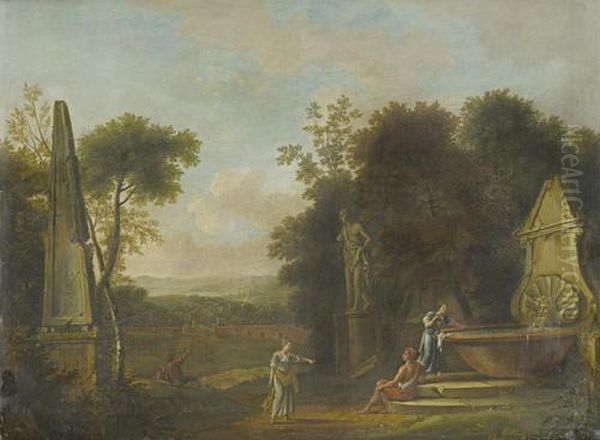
The classical influence, likely reinforced by his association with Lord Burlington and the Palladian movement, manifests in the structured compositions of his landscapes. While depicting real places, his works often possess a sense of order and balance reminiscent of Claude Lorrain or Gaspard Dughet. There's a "poetic" quality, a gentle melancholy that pervades many of his scenes, distinguishing them from purely topographical renderings. His ability to capture the play of light, particularly the soft, diffused light of the English countryside, was a notable strength.
His works often feature expansive views, sometimes with figures that are small in scale, emphasizing the grandeur of the landscape or the estate. This approach was common in topographical painting of the era, where the focus was on the property itself. Artists like Peter Tillemans, another contemporary working in England, also specialized in such views, often including hunting scenes or depictions of country life.
Still Life Paintings: Precision and Composition
While best known for his landscapes, Pieter Andreas Rysbrack was also an accomplished painter of still lifes, particularly game pieces. This genre had a long and distinguished tradition in Flemish art, with masters like Frans Snyders and Jan Fyt setting a high standard. Rysbrack's still lifes, such as the notable "Game Still-Life," demonstrate his mastery in this area.
These works are characterized by their balanced compositions, rich colors, and the skillful depiction of textures – the softness of feathers, the sheen of fur, the coolness of metal hunting horns. He often arranged the elements – dead game birds, hares, hunting equipment – in a seemingly natural yet carefully considered manner, creating a sense of abundance and celebrating the pursuits of the landed gentry. The use of warm earth tones often imbues these paintings with a sense of warmth and intimacy. These works showcase a dynamic balance and an eye for detail that aligns perfectly with the Flemish Baroque tradition. His ability to render the tactile qualities of different materials was exceptional.
Other Notable Works and Commissions
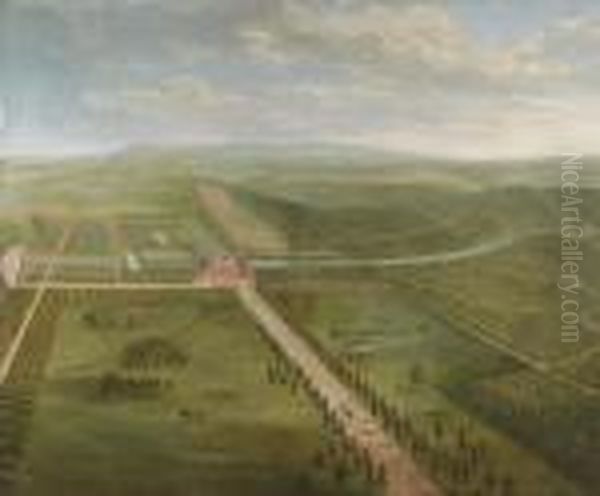
Beyond the Chiswick series, Rysbrack undertook other commissions for estate views. One such example is the "Prospect of Tottenham Park, Wiltshire," which, like the Chiswick paintings, provides a bird's-eye view of a grand English estate, detailing its layout, gardens, and surrounding parkland. These paintings served not only as records but also as status symbols for their owners, celebrating their wealth, taste, and connection to the land.
His works were not as widely disseminated through engravings as those of some contemporaries, which might have limited his broader fame during his lifetime compared to artists whose imagery reached a larger public. However, his original canvases were prized by collectors. The quality of his work ensured that his paintings continued to be valued, appearing in sales and collections long after his death.
The Rysbrack Family: An Artistic Dynasty
It is important to distinguish Pieter Andreas Rysbrack from other artistic members of his family to avoid confusion.
His father, Pieter Rysbrack the Elder (1655–1729), was a landscape painter in Antwerp whose style was more aligned with the Italianate Flemish landscapists like Jan Frans van Bloemen.
His brother, John Michael Rysbrack (1694–1770), achieved greater fame and fortune in England as a sculptor. John Michael Rysbrack became the leading sculptor in England for several decades, producing numerous portrait busts, funerary monuments, and statues of historical and mythological figures. His works, such as the monument to Sir Isaac Newton in Westminster Abbey (designed by William Kent) and his statue of Hercules at Stourhead, are landmarks of 18th-century British sculpture. He competed with other sculptors like Peter Scheemakers and later Louis-François Roubiliac for major commissions. The Alexander Pope portrait bust, sometimes anecdotally linked to Pieter Andreas, was in fact a notable work by John Michael.
The presence of multiple artists named Rysbrack, working in different media but sometimes overlapping in their social and patronage circles (like Lord Burlington, who also patronized John Michael), has occasionally led to confusion in art historical accounts.
Contemporaries, Collaborators, and Competitors
During his time in England, Pieter Andreas Rysbrack operated within a vibrant art world. As mentioned, he collaborated indirectly with William Kent through the Chiswick commissions. Kent himself was a versatile figure, active as a painter, architect, and landscape designer, and a key promoter of the Palladian style and the English landscape garden.
In the field of landscape and topographical painting, Rysbrack's contemporaries and, to some extent, competitors in England included:
Leonard Knyff (1650–1722): A Dutch artist who, with engraver Johannes Kip, produced the influential series of bird's-eye views of British country houses, "Britannia Illustrata."
Jan Siberechts (1627–c. 1703): A Flemish painter who came to England earlier and was one of the first to specialize in views of country houses.
Peter Tillemans (1684–1734): A Flemish painter who, like Rysbrack, came to England and became known for topographical views, country house portraits, battle scenes, and sporting subjects.
George Lambert (1700–1765): An English landscape painter who was a founding member of the Royal Academy. He was influenced by Gaspard Dughet and Salvator Rosa and often collaborated with other artists like William Hogarth, who would paint figures into his landscapes.
The great Venetian view-painters Canaletto (Giovanni Antonio Canal) and Francesco Guardi also had a significant impact on English taste for landscape and cityscape, with Canaletto spending a considerable period working in England. While their focus was urban vedute, their meticulous detail and atmospheric effects set a high bar.
The demand for such paintings was driven by a clientele eager to see their properties immortalized, reflecting a pride in land ownership and the fashionable improvements they were making to their estates.
Anecdotes, Artistic Debates, and Critical Reception
Some of Rysbrack's works, or the projects they depicted, were subject to contemporary discussion. For instance, the "Orange Tree Garden" at Chiswick, which Rysbrack may have painted, was sometimes criticized for being overly ornate or formal, contrasting with the increasingly fashionable "natural" style. This reflects the ongoing debates about taste and aesthetics in garden design during the period.
The occasional misattribution of his works to his teacher Frans Millet (Francisque Millet I) or other artists with similar styles is a common issue for many painters of the era, particularly those whose oeuvres are not exhaustively documented. Art historians continue to refine attributions based on stylistic analysis and documentary evidence.
While his brother John Michael was a dominant figure in sculpture, Pieter Andreas's reputation as a painter was more specialized. His landscapes were praised for their accuracy and pleasantness, though some critics might have found his palette, at times, "slightly gloomy" or subdued, a characteristic perhaps reflecting the English climate as much as artistic choice. However, his ability to capture the specific character of the English landscape was a key element of his success.
Legacy and Art Historical Significance
Pieter Andreas Rysbrack died in London in 1748. His primary legacy lies in his contribution to the development of English landscape painting and, specifically, to the genre of the estate portrait or topographical view. His paintings of Chiswick House are not only beautiful works of art but also invaluable historical documents that illuminate the evolution of one of England's most important gardens.
He was part of a crucial generation of immigrant artists who helped to shape the British art scene in the early 18th century, bringing with them skills and traditions from the continent. While native-born English landscape painters like Richard Wilson and Thomas Gainsborough would later rise to greater prominence, Rysbrack and his contemporaries laid important groundwork. They demonstrated the artistic and commercial potential of depicting the British landscape and its grand estates.
His works continue to be appreciated for their skillful execution, their atmospheric qualities, and their historical importance. They offer a window into the world of the 18th-century English aristocracy, their aesthetic preferences, and their relationship with the land. While perhaps not as revolutionary as some of his contemporaries in other fields, Pieter Andreas Rysbrack remains a significant figure for his sensitive and enduring portrayals of the English scene, viewed through a Flemish lens refined by classical sensibilities. His art serves as a testament to the cross-cultural exchanges that enriched European art during this dynamic period.