Pieter Casteels III: A Flemish Master in Georgian England
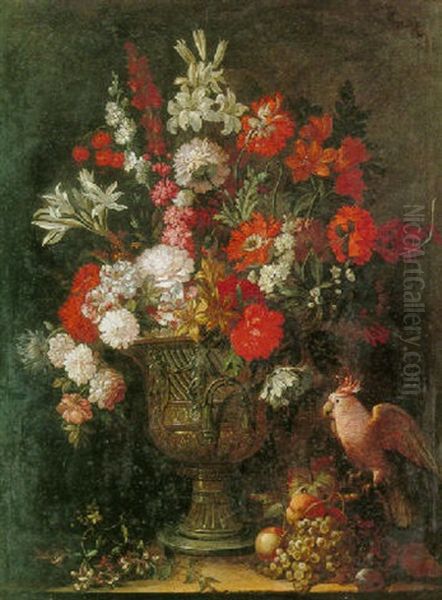
Pieter Casteels III, a name synonymous with vibrant and decorative still life paintings, particularly of flowers and birds, stands as a significant figure in the transition of Flemish artistic traditions into the burgeoning art scene of 18th-century England. His life and work offer a fascinating glimpse into the tastes and patronage of the era, bridging the opulent Baroque sensibilities of his homeland with the evolving aesthetics of Georgian Britain.
Early Life and Artistic Foundations in Antwerp
Born in the historic art city of Antwerp on October 3, 1684, Pieter Casteels III was destined for a career in the arts. He was the son of Pieter Casteels II, also a painter, who provided his initial artistic training. Growing up in Antwerp, a city that had been a powerhouse of European art, particularly during the heyday of masters like Peter Paul Rubens and Anthony van Dyck, would have undoubtedly exposed young Casteels to a rich visual heritage. Though the city's golden age was past, its artistic institutions and traditions remained influential. His father's guidance would have grounded him in the meticulous techniques and thematic concerns of Flemish painting, especially the popular genres of still life and landscape.
The Casteels family had a lineage of artists, which was not uncommon at the time, with skills and studio practices often passed down through generations. This familial immersion in the art world provided a strong foundation for Pieter III's later development. His early works, though not extensively documented, likely reflected the prevailing Antwerp styles, focusing on the detailed rendering of natural subjects, a hallmark of Flemish art.
The Journey to England and Integration into the London Art Scene
In 1708, a pivotal year for the young artist, Pieter Casteels III made the significant decision to move to London. He did not make this journey alone but was accompanied by his brother-in-law, Peter Tillemans, another Flemish painter who would also find success in England, particularly known for his topographical views, sporting scenes, and battle pieces. This move was indicative of a broader trend where artists from the continent, particularly the Low Countries, sought opportunities in England, whose native school of painting was still developing and where foreign talent was often in demand.
Upon arriving in London, Casteels quickly began to integrate himself into the local artistic community. He is recorded as having worked in a picture dealer's gallery, an experience that would have further broadened his understanding of the art market and contemporary tastes. He also became a student, or at least a participating member, of the Great Queen Street Academy. This institution, often referred to as Kneller's Academy after its principal figure Sir Godfrey Kneller, was one of the earliest attempts to establish a formal art academy in London, providing a space for artists to draw from life models and engage with their peers.
Furthermore, Casteels III joined the Rose and Crown Club, a convivial society of artists, connoisseurs, and collectors that met regularly in a London tavern. This club, whose members included prominent figures like George Vertue, the engraver and antiquarian, and potentially William Hogarth in its later years, was an important networking hub. Membership provided opportunities for artistic exchange, discussion, and the forging of professional connections that were crucial for securing commissions and patronage.
A Flourishing Career in London
Although Casteels made a brief return to Antwerp in 1716, where he was registered as a master in the Guild of Saint Luke, the primary association for artists in the city, his future lay in England. He settled permanently in London in 1717, embarking on a prolific career that would see him become a favored painter of decorative compositions.
His specialization lay in flower pieces, bird paintings, and scenes featuring exotic fowl, often set within parkland or garden landscapes. These subjects were highly fashionable, catering to the tastes of an affluent clientele who desired artworks to adorn their newly built or refurbished townhouses and country estates. Casteels' paintings were frequently designed as overmantels or integrated into larger decorative schemes for chimney-pieces, reflecting a demand for art that was both aesthetically pleasing and harmonized with interior design. His style was characterized by bright colours, meticulous detail, and a sense of abundance, aligning with the decorative Rococo tendencies that were gaining traction, though his roots remained firmly in the Flemish Baroque tradition.
Beyond these grander decorative pieces, Casteels III also engaged in copying smaller paintings by Old Masters, a common practice that served both as a learning exercise and a way to meet market demand for more affordable versions of esteemed works. His versatility extended to textile design, indicating an entrepreneurial spirit and an ability to apply his artistic skills across different mediums.
Artistic Style, Influences, and Thematic Concerns
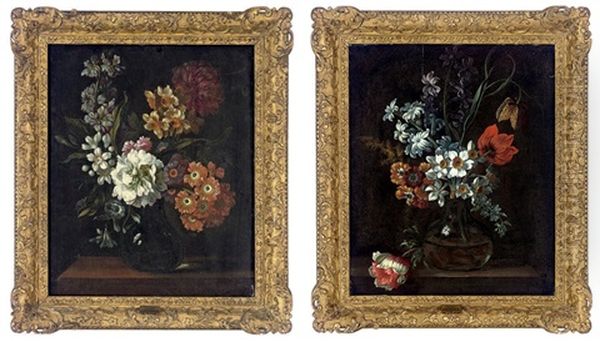
Pieter Casteels III's artistic style was deeply rooted in the Flemish still life tradition, renowned for its rich colours, detailed realism, and often, symbolic content. He excelled in creating compositions that were both visually sumptuous and technically proficient. His flower paintings, for instance, showcased a wide variety of species, rendered with botanical accuracy yet arranged in abundant, often idealized bouquets that defied the natural blooming seasons of the individual flowers. This was a convention inherited from earlier Flemish masters like Jan Brueghel the Elder or Daniel Seghers.
His bird paintings were equally popular, often depicting a vibrant menagerie of domestic and exotic birds, from peacocks and parrots to chickens and songbirds. These were frequently set in elaborate garden landscapes or against classical architectural elements, adding a sense of grandeur and theatricality. These works resonated with the English aristocracy's growing interest in ornithology and the creation of elaborate gardens and aviaries on their estates.
While much of his output was decorative, underlying currents of traditional symbolism can be discerned, particularly the vanitas and memento mori themes prevalent in 17th-century Dutch and Flemish still life. The transient beauty of flowers or the depiction of game could subtly allude to the fleeting nature of life and earthly pleasures. However, in Casteels' English period, the overt moralizing often gave way to a more celebratory depiction of nature's bounty, suiting the optimistic and worldly outlook of his patrons.
In terms of influences, Gaspar Peter Verbruggen the Younger, another Antwerp flower painter known for his flamboyant and decorative compositions, is often cited as a significant predecessor whose style shares affinities with Casteels' work. The broader tradition of Antwerp still life, with figures like Frans Snyders and Jan Fyt known for their dynamic game pieces and animal paintings, also formed part of his artistic inheritance. While in England, he would have been aware of the work of other immigrant artists like Jakob Bogdani, a Hungarian painter who specialized in exotic birds and flower pieces and had established a successful career in England before Casteels' arrival.
His style, particularly in its decorative exuberance, also shows parallels with a broader European trend in still life painting, with some art historians noting similarities to the work of artists in the Rome-Naples sphere, such as Gasparo Lopez, Francesco Lavagna, and Nicola Malinconico, who also specialized in lush, decorative floral and fruit compositions.
"The Twelve Months of Flowers" and Other Notable Works
Among Pieter Casteels III's most celebrated achievements is the series titled "The Twelve Months of Flowers." This ambitious project consisted of twelve paintings, each representing a different month of the year through a carefully composed arrangement of flowers that would typically bloom during that specific month. These paintings served as the basis for a highly successful set of engravings.
The project was a collaboration. The original designs and paintings were by Casteels. The engravings were primarily executed by Henry Fletcher. The series was published by Robert Furber, a prominent nurseryman based in Kensington, London, who issued it in 1730 as a lavish seed catalogue, arguably one of the most beautiful ever produced. Each print featured an elaborate arrangement of flowers in a decorative urn, with each flower numbered and keyed to a list at the bottom, effectively advertising Furber's stock.
The success of "The Twelve Months of Flowers" was immense. The prints were widely disseminated and highly sought after, not only by gardeners but also by those who appreciated them for their artistic merit and decorative qualities. They were often hand-coloured and framed, becoming popular interior decorations. This series perfectly encapsulated Casteels' skill in combining botanical accuracy with artistic flair, creating compositions that were both informative and aesthetically delightful. Similar series, such as "The Twelve Months of Fruit," followed, further cementing his reputation.
Beyond these series, numerous individual paintings of flower arrangements, often in ornate vases or baskets, and lively depictions of birds in garden settings, are characteristic of his oeuvre. Works like "Peacocks, a Hen, Pigeons and a Kingfisher in a park setting" or "A Still Life of Flowers in a Wan-Li Vase" exemplify his ability to create rich, textured compositions brimming with life and colour. His paintings often featured a strong light source, highlighting the textures of petals and feathers, and a meticulous attention to detail that invited close inspection.
Interactions with Contemporaries and Patrons
Pieter Casteels III's career in England was facilitated by his interactions with fellow artists and his ability to secure patronage. His early association with Peter Tillemans was crucial. Tillemans, who became a founding member of the Society of Virtuosi of St Luke, was well-connected and likely helped Casteels navigate the London art world.
His membership in the Kneller Academy and the Rose and Crown Club placed him in the company of leading artists and connoisseurs of the day. Sir Godfrey Kneller himself was the dominant portrait painter in England, and association with his academy lent prestige. The Rose and Crown Club, as mentioned, included figures like George Vertue, whose notebooks are an invaluable source for the history of art in England during this period. Other artists who were part of London's vibrant, cosmopolitan art scene at the time included the Swedish-born portraitist Michael Dahl, a rival to Kneller, and various landscape and marine painters.
A key patron for Casteels was James Stanley, 10th Earl of Derby. The aristocracy and wealthy gentry were the primary commissioners of art, and securing such patronage was essential for an artist's livelihood and reputation. The Earl of Derby commissioned Casteels for various works, likely including decorative paintings for his estates. This kind_of_patronage allowed artists like Casteels to produce large-scale, ambitious works.
The collaboration with Robert Furber and Henry Fletcher on "The Twelve Months of Flowers" is another significant example of his professional interactions. Such collaborative ventures, particularly in the production of prints, were common and allowed artists' work to reach a much wider audience than individual paintings alone could. The English art scene was also populated by other still life and animal painters, such as Luke Cradock, known for his decorative bird paintings, whose work sometimes bears comparison with Casteels.
The Complexities of Attribution
As with many artists from families with multiple painters sharing the same name or working in similar styles, the attribution of works by Pieter Casteels III can sometimes be complex. His father, Pieter Casteels II, was a painter, and there was also another Antwerp artist named Peter Frans Casteels. Distinguishing their hands, especially in unsigned or less documented works, can be challenging for art historians.
Scholarly research, notably by art historian Fred G. Meijer (not Aat as previously mentioned in some summaries, Meijer is a key scholar of Dutch and Flemish still lifes), has been crucial in clarifying the oeuvres of the various Casteels family members and other related artists. Specific works that have been subject to attribution debates or re-attributions include:
"Flowers in a Vase with a Fragment of a Roman Relief": While stylistically plausible for Casteels III, such works require careful comparison with securely attributed pieces.
"A Concert of Birds with Aesop's Fable: The Jay who Borrowed Feathers" and "An Assembly of Birds in a Classical Park": These thematic paintings of birds are typical of his output, but precise attribution can sometimes be debated, especially if workshop participation is suspected or if similar compositions were produced by contemporaries.
"Still Life of Flowers and Fruit": A general category where distinguishing between Casteels III, his father, or other Flemish contemporaries like Gaspar Peeter Verbruggen the Younger or even followers requires expert connoisseurship.
The collaborative nature of projects like "The Twelve Months of Flowers," while primarily designed by Casteels, involved engravers who translated his paintings into print. While the designs are his, the final prints are a product of shared labor. These attribution challenges are common in art history and are resolved through ongoing research, stylistic analysis, and documentary evidence.
Later Years and Lasting Legacy
Pieter Casteels III continued to work productively in England for several decades. His style, while rooted in his Flemish training, adapted well to English tastes, and he enjoyed a sustained period of success. His contributions to textile design, though less well-documented than his paintings, suggest a broad application of his decorative talents, possibly for tapestry or fabric patterns, which were highly valued.
He passed away in Richmond, London, in 1749, at the age of 65, and was buried on May 16th of that year. By the time of his death, he had firmly established himself as one of the leading painters of decorative still lifes and bird subjects in England. His work influenced subsequent painters in these genres and contributed to the enduring popularity of flower and bird painting in British art.
Today, Pieter Casteels III's paintings are held in numerous public and private collections worldwide, including the Fitzwilliam Museum in Cambridge, the Yale Center for British Art, and various National Trust properties in the UK. His works are admired for their vibrant colour, meticulous detail, and decorative charm. "The Twelve Months of Flowers" prints, in particular, remain iconic examples of botanical art and 18th-century design.
He represents an important link in the chain of artistic exchange between the Low Countries and Great Britain, demonstrating how immigrant artists could not only find success but also significantly enrich the artistic landscape of their adopted country. His legacy is that of a skilled and versatile artist who masterfully combined the technical brilliance of the Flemish tradition with the decorative demands of Georgian England, leaving behind a body of work that continues to delight and impress. His paintings serve as beautiful documents of a particular taste for nature, artfully arranged and brought indoors to adorn the lives of the 18th-century elite.