Pietro Domenico Oliviero: A Piedmontese Master of the Bamboccianti Genre
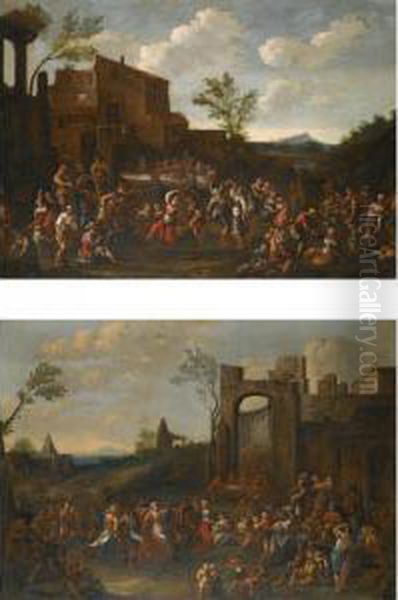
Pietro Domenico Oliviero, a significant yet often regionally-focused figure in Italian art history, carved a unique niche for himself in the vibrant artistic landscape of 18th-century Piedmont. Born in Turin in 1679 and passing away in the same city in 1755, Oliviero's life and career unfolded primarily within the sphere of the Savoyard capital. He became particularly renowned for his adeptness in the "Bamboccianti" style, a genre of painting that focused on the everyday lives of ordinary people, often with a humorous or anecdotal touch. His works serve as invaluable visual documents of the customs, attire, and social interactions of his time, particularly in Turin and the surrounding Piedmontese countryside.
Early Life and Artistic Formation
Pietro Domenico Oliviero's entry into the world was marked by a physical challenge: he was born with a limp. In an era when physical prowess could often influence social standing and opportunity, this might have been a considerable obstacle. However, historical accounts suggest Oliviero possessed a "pleasant and optimistic" disposition, a cheerful spirit that likely endeared him to others and helped him navigate any societal prejudices. This inherent buoyancy seems to have translated into his art, which often exudes a sense of liveliness and good humor.
His initial artistic training is somewhat shrouded in the mists of time, with precise details being scarce. However, it is widely believed, based on records from the Confraternity of San Marco, that his first master was a local Piedmontese painter and architect named Bianco. Further sources, such as those cited by Luigi Lanzi in his "Storia pittorica della Italia," suggest that a figure named San Martino, also an architect and painter, played a role in Oliviero's early artistic education. These early apprenticeships would have grounded him in the foundational techniques of drawing and painting prevalent in the Italian tradition.
Turin, during Oliviero's formative years, was a city undergoing significant transformation under the ambitious House of Savoy. The architectural and artistic patronage of figures like Victor Amadeus II was shaping the city into a notable European capital. This environment, with its blend of local traditions and increasing exposure to broader European artistic currents, would have undoubtedly influenced the young Oliviero.
The Bamboccianti Tradition and Oliviero's Piedmontese Interpretation
To understand Oliviero's primary contribution, one must first appreciate the Bamboccianti. This genre derived its name from the nickname of the Dutch painter Pieter van Laer, "Il Bamboccio" (meaning "ugly doll" or "puppet," possibly referring to his physical appearance), who was active in Rome from 1625 to 1639. Van Laer and his followers, many of whom were also Dutch and Flemish artists working in Rome, specialized in small-scale, naturalistic depictions of everyday Roman life – street scenes, peasant gatherings, markets, and tavern interiors.
These works stood in stark contrast to the grand, idealized history paintings and religious altarpieces favored by the official academies and powerful patrons. Key figures in this Roman school included Michelangelo Cerquozzi, renowned for his battle scenes and lively genre paintings, Jan Miel, who also painted religious and mythological subjects but was celebrated for his Bamboccianti scenes, and Johannes Lingelbach. Their paintings were characterized by a keen observation of reality, often imbued with a sense of humor or pathos, and a focus on the picturesque aspects of common life.
Pietro Domenico Oliviero became a notable exponent of this tradition in Piedmont, adapting its core tenets to the local context. While the original Bamboccianti captured the vibrant, sometimes chaotic, street life of Rome, Oliviero turned his gaze to the markets, festivals, and rural activities of Turin and its environs. He was not merely an imitator; he infused the style with his own personality and a distinctly Piedmontese flavor. His scenes are less about the gritty realism of some Roman Bamboccianti and more about a cheerful, anecdotal portrayal of social life.
Artistic Style and Thematic Concerns
Oliviero's artistic style is a fascinating amalgamation of influences. The meticulous detail and focus on genre subjects clearly point to a Northern European, particularly Flemish, sensibility. One can imagine him studying works or prints by artists like David Teniers the Younger or Adriaen Brouwer, who excelled in depicting peasant life with both realism and character. The influence of Jan Brueghel the Elder, with his crowded, detailed compositions, can also be discerned in Oliviero's busier scenes.
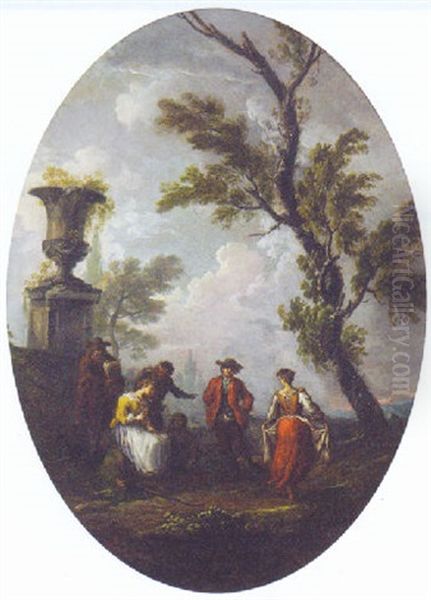
From the Italian tradition, particularly the Roman school, Oliviero likely absorbed lessons in figure composition and perhaps a certain robustness in his forms, though tempered by the smaller scale typical of Bamboccianti. His palette is generally lively, and his brushwork, while capable of rendering detail, often maintains a spirited quality that contributes to the overall vivacity of his compositions.
His thematic concerns were diverse, though he is best remembered for his genre scenes. These include bustling market days, where vendors display their wares and townspeople haggle and socialize; lively street scenes capturing the daily rhythm of urban life; and depictions of rural festivities or agricultural work. These paintings are populated by a cast of recognizable characters – merchants, peasants, artisans, children, and animals – all engaged in activities that offer a window into 18th-century Piedmontese society.
While genre scenes formed the core of his output, Oliviero also tackled historical and religious subjects, though these are less central to his modern reputation. His approach to these more traditional themes would likely have still carried his characteristic attention to human detail and narrative clarity. The very act of painting such scenes indicates his versatility and his engagement with the broader artistic demands of his time, where painters were often expected to work across different genres.
Humor, Observation, and Technical Approach
A defining characteristic of Oliviero's work is its inherent humor and "gioviale" (jovial, cheerful) spirit. He had a knack for capturing amusing incidents, quirky characters, and the lighthearted moments of everyday existence. This was not a satirical or critical humor, but rather an affectionate and understanding portrayal of human nature. His figures are often animated, their gestures and expressions conveying a sense of immediacy and life.
This ability stemmed from his keen powers of observation. Oliviero was clearly a close student of the world around him, noticing the small details of dress, behavior, and environment that lend authenticity to his scenes. His paintings are filled with anecdotal elements that invite the viewer to linger and discover new narratives within the larger composition.
Despite the seemingly spontaneous and lighthearted nature of his finished works, Oliviero's creative process was reportedly quite rigorous. He is known to have produced carefully prepared sketches and drawings, working out his compositions and figures before committing them to canvas. This preparatory work, combined with a study of master paintings, ensured a solid foundation for his seemingly effortless depictions. This methodical approach belies the casual charm of his subjects, indicating a serious and dedicated craftsman.
Representative Works and Commissions
Several works stand out as representative of Oliviero's oeuvre. Among his most celebrated are a series of six paintings depicting scenes of common life, which encapsulate his talent for capturing the vibrant tapestry of Piedmontese society. These likely included market scenes, festivals, or other gatherings, each teeming with figures and anecdotal detail. Another significant group is a set of four paintings representing the Seasons, a traditional theme that allowed artists to explore different aspects of nature and human activity throughout the year. Oliviero would have approached this by depicting seasonal labors and festivities characteristic of the Piedmont region.
A particularly interesting commission involved paintings of the interior of the Teatro Regio (Royal Theatre) in Turin. This prestigious theatre, designed by the renowned architect Filippo Juvarra and later rebuilt by Benedetto Alfieri after a fire, was a focal point of cultural life in the Savoyard capital. Oliviero's depictions of the theatre, likely showing audiences and performances, would have been valuable records of this important social and architectural space. These works demonstrate his ability to handle complex interior scenes with numerous figures, capturing the grandeur and excitement of such occasions.
One specific work mentioned in historical records is "St. Francis of Assisi Turning Water into Wine," a religious painting reportedly created in collaboration with F. Monetti and C. Aifani. Collaborations were not uncommon in this period, especially for larger commissions or when artists specialized in different aspects (e.g., figures versus landscape). This particular work indicates his engagement with religious subject matter, even if his fame rests more securely on his genre scenes.
His paintings were sought after, and many found their way into private collections in Turin and beyond. Today, his works are held in various museums, most notably the Museo Civico d'Arte Antica in Palazzo Madama, Turin, which houses a significant collection of Piedmontese art.
Patronage and Social Connections
Despite his physical impairment, Oliviero's talent and amiable personality evidently attracted significant patronage. He enjoyed the support of Victor Amadeus II, Duke of Savoy and later King of Sicily and Sardinia. Royal patronage was crucial for artists in this period, providing not only financial support but also prestige and access to influential circles.
A particularly notable patron was Carlo Francesco Vincenzo Ferrero, Marchese d'Ormea. The Marchese Ferrero d'Ormea was a highly influential statesman and minister in the Savoyard court, a key figure in the political and cultural life of Piedmont. It is recorded that Oliviero was a regular guest at the Marchese's palace for weekly lunches. This indicates a close and favored relationship, suggesting that the Marchese not only admired Oliviero's art but also enjoyed his company. Such connections were invaluable, providing a steady stream of commissions and further enhancing the artist's reputation.
These relationships with the aristocracy and the court underscore Oliviero's successful integration into the higher echelons of Piedmontese society. His ability to charm and engage such powerful figures speaks volumes about his character and the appeal of his art, which offered a delightful and often amusing reflection of the world his patrons inhabited or observed.
Influences, Contemporaries, and Artistic Milieu
Oliviero's artistic development was shaped by a confluence of influences. As mentioned, the Bamboccianti tradition, originating with Pieter van Laer and continued by artists like Michelangelo Cerquozzi and Jan Miel, provided the foundational framework for his genre scenes. The Flemish attention to detail, seen in the works of artists like Jan Brueghel the Elder and David Teniers the Younger, was another crucial component.
He was also reportedly influenced by the French style, possibly through trips to Granada (though this location seems unusual for French influence; perhaps it refers to exposure to French artists or styles circulating in Italy, or a misattribution of location in some sources). If he did absorb French influences, it might have been the elegance and lighter touch found in the works of artists like Antoine Watteau or his contemporaries, whose "fêtes galantes" shared a certain interest in depicting social interactions, albeit in a more idealized and aristocratic setting. Giuseppe Gambarini, an Italian painter who worked in a style that sometimes emulated French genre painting, is also mentioned as a possible influence in this regard.
Within Italy, the broader Baroque context was inescapable. While Oliviero's work doesn't typically exhibit the high drama of a Caravaggio or the grand theatricality of Pietro da Cortona, the era's emphasis on dynamic composition and expressive figures would have been part of his artistic vocabulary. He was a contemporary of major figures in other Italian centers, such as Giovanni Battista Tiepolo in Venice, whose grand decorative schemes represented a very different artistic path, or Rosalba Carriera, the celebrated Venetian pastellist. In Genoa, Alessandro Magnasco was creating his own highly distinctive, dramatic, and often dark genre scenes, offering a stark contrast to Oliviero's generally sunnier disposition.
In Turin itself, the artistic scene was enlivened by the presence of architects like Filippo Juvarra and Guarino Guarini, whose magnificent buildings were transforming the city's skyline. While their medium was different, their work contributed to a climate of artistic innovation and ambition that would have benefited painters like Oliviero. He would have also interacted with other Piedmontese painters, though many of their names are less widely known today. His collaborators, F. Monetti and C. Aifani, are examples of such local artistic connections.
Later Career, Death, and Legacy
Pietro Domenico Oliviero continued to paint throughout his life, remaining active in Turin. His established reputation and connections likely ensured a steady demand for his work. He passed away in his native city in 1755, at the age of 76, leaving behind a body of work that celebrated the life and spirit of his region.
His legacy is primarily that of a skilled and charming chronicler of 18th-century Piedmontese life. He successfully transplanted the Bamboccianti genre to a new regional context, infusing it with his own unique sensibility. His paintings are more than just quaint depictions of bygone days; they are valuable historical documents, offering insights into the social customs, dress, and daily activities of the period. Art historians and social historians alike can find rich material in his detailed and lively canvases.
While perhaps not achieving the international fame of some of his Italian contemporaries who worked in the "grand manner," Oliviero holds an important place in the history of Piedmontese art and in the broader story of genre painting in Italy. He demonstrated that compelling art could be found in the observation of the ordinary, and that humor and charm could be powerful tools for engaging the viewer.
Collections and Art Historical Significance
Today, the most significant public holdings of Pietro Domenico Oliviero's works are in Turin, particularly at the Museo Civico d'Arte Antica in Palazzo Madama. This institution is dedicated to the art and history of the region, making it a fitting repository for his paintings. Other works may be found in private collections, both in Italy and abroad, occasionally appearing on the art market.
His art historical significance lies in several areas:
1. Regional Exponent of Bamboccianti: He is a key figure in the dissemination and adaptation of the Bamboccianti style outside of Rome, specifically in the Piedmontese context.
2. Social Chronicler: His paintings provide a vivid and detailed visual record of 18th-century life in Turin and Piedmont, making them invaluable for social and cultural historians.
3. Individuality within a Tradition: While working within an established genre, Oliviero developed a personal style characterized by humor, keen observation, and a lively touch.
4. Bridging Artistic Influences: His work demonstrates a successful synthesis of Northern European (Flemish) and Italian (Roman) artistic traditions.
Exhibitions focusing on Piedmontese Baroque art or Italian genre painting sometimes feature his works, helping to bring his contributions to a wider audience. Scholarly articles and catalogues, such as those produced by institutions like Galleria Giamblanco, continue to explore his oeuvre and refine our understanding of his place in art history. Luigi Lanzi's "The History of Painting in Italy" (Storia pittorica della Italia), a foundational text of Italian art history, acknowledged him as an important painter in the Piedmontese school, cementing his place in early art historical accounts.
Conclusion
Pietro Domenico Oliviero stands as a testament to the rich diversity of Italian Baroque art. Moving beyond the monumental religious and mythological paintings that often dominate perceptions of the era, Oliviero found his voice in the depiction of everyday life. His cheerful disposition, overcoming physical adversity, seems to permeate his canvases, which are filled with the bustling energy, humor, and specific character of 18th-century Piedmont. As a skilled practitioner of the Bamboccianti style, he not only captured the world around him with remarkable acuity but also secured a lasting place as one of Turin's most engaging artistic personalities. His works continue to delight viewers and provide a precious window onto a bygone era, affirming the enduring appeal of art that finds its inspiration in the human comedy.