Robert S. Duncanson stands as a pivotal figure in nineteenth-century American art, celebrated not only for his breathtaking landscapes but also for his historic achievement as the first African American artist to gain widespread international recognition. His life and career, set against the turbulent backdrop of antebellum and Civil War America, offer a compelling narrative of talent, perseverance, and the pursuit of beauty in a world fraught with division. Duncanson's art, deeply rooted in the traditions of the Hudson River School yet infused with a unique lyrical sensibility, continues to resonate with audiences today, securing his place as a significant contributor to the American artistic canon.
Early Life and Artistic Awakening
Robert Scott Duncanson was born in 1821 in Fayette, Seneca County, New York. His parentage reflected the complex social fabric of the era: his father was a freeborn African American man, possibly with Scottish-Canadian ancestry, and his mother was also a free African American woman. Some accounts suggest his father was John Dean Duncanson, a free Black tradesman from Virginia, and his mother Lucy Nickles. Due to the prevailing racial prejudices and limited opportunities for Black individuals in the United States, Duncanson's father moved the family to Monroe, Michigan, around 1828, and later, Robert was sent to live with his paternal grandparents in Canada for a period to receive a more formal education than might have been available to him in Michigan.
In his youth, Duncanson initially pursued the family trade of house painting and carpentry. This practical experience with pigments and surfaces may have provided a foundational understanding of materials. However, a burgeoning passion for fine art soon led him down a different path. Largely self-taught in his formative years as a painter, Duncanson honed his skills by meticulously copying prints of European masterworks and by keenly observing the natural world around him. He was driven by an innate talent and an ambition to transcend the limitations imposed by his race and social standing.
By the early 1840s, Duncanson had made the pivotal decision to pursue art professionally. He moved to Cincinnati, Ohio, a burgeoning cultural and economic hub often referred to as the "Athens of the West." This city, with its growing community of artists and patrons, would become the crucible for his early artistic development.
The Cincinnati Scene and Emerging Recognition
Cincinnati in the mid-nineteenth century was a surprisingly fertile ground for an aspiring artist, even an African American one. While racial discrimination was undeniably present, the city also possessed a significant abolitionist movement and a community of individuals open to supporting artistic talent regardless of background. Duncanson began to exhibit his work, initially portraits and genre scenes, which were common entry points for artists seeking commissions. His earliest known dated work is Portrait of a Mother and Daughter from 1841.
However, it was in landscape painting that Duncanson would find his true calling and lasting fame. He was drawn to the majestic beauty of the American wilderness, a subject that was captivating the nation's imagination through the works of the first generation of Hudson River School painters like Thomas Cole and Asher B. Durand. Duncanson quickly absorbed the prevailing aesthetic, which celebrated nature as a divine manifestation and a source of national pride.
In Cincinnati, Duncanson became associated with a circle of prominent local artists. He formed significant professional relationships and friendships with fellow landscape painters such as William Louis Sonntag and Worthington Whittredge. Sonntag, in particular, became a close associate, and the two artists reportedly embarked on sketching trips together, sharing insights and techniques. Whittredge, who later achieved national fame, also acknowledged Duncanson's talent. These interactions provided Duncanson with valuable artistic exchange and helped integrate him into the local art scene.
One of Duncanson's most important early patrons in Cincinnati was Nicholas Longworth, a wealthy horticulturist, winemaker, and arts benefactor with strong abolitionist sympathies. Around 1848, Longworth commissioned Duncanson to paint a series of eight large landscape murals for the entrance hall of his grand residence, "Belmont" (now the Taft Museum of Art). This was a monumental undertaking for a young artist and a significant vote of confidence. The murals, inspired by the romantic landscapes of European masters but depicting American scenery, showcased Duncanson's burgeoning skill in composition and atmospheric effects. They remain some of his most significant early achievements and are a testament to Longworth's progressive patronage.
The Grand Tour and European Influences
A pivotal moment in Duncanson's career came in 1853 when, with the financial support of an abolitionist league and likely patrons like Longworth, he embarked on a "grand tour" of Europe. This journey was a traditional rite of passage for ambitious American artists, allowing them to study firsthand the masterpieces of the Old World. Duncanson traveled with William Louis Sonntag and possibly another artist, visiting England, France, and Italy.
In England, he was particularly captivated by the works of J.M.W. Turner, whose dramatic use of light and color and romantic sensibility resonated deeply with Duncanson's own inclinations. He also studied the classical landscapes of Claude Lorrain, whose idealized compositions and serene, light-filled vistas became a lasting influence. The picturesque ruins and sun-drenched landscapes of Italy further enriched his artistic vocabulary. He spent time in Florence and Rome, sketching and absorbing the artistic heritage.
This European sojourn was transformative. Duncanson returned to America with a refined technique, a broader artistic vision, and an enhanced reputation. His subsequent works demonstrated a greater sophistication in handling light, atmosphere, and composition, blending his American subject matter with a European aesthetic sensibility. He successfully synthesized the detailed naturalism of the Hudson River School with the more poetic and idealized traditions of European Romantic landscape painting.
Artistic Style and Thematic Concerns
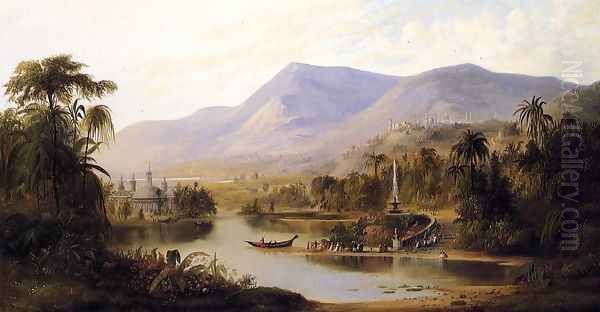
Robert S. Duncanson is primarily classified as a second-generation Hudson River School painter. His work shares the movement's reverence for nature and its detailed depiction of American scenery. However, his style is distinguished by a lyrical, poetic quality and a preference for serene, pastoral landscapes rather than the more rugged or overtly dramatic scenes favored by some of his contemporaries like Albert Bierstadt or Frederic Edwin Church.
Duncanson's landscapes are often characterized by a soft, diffused light, harmonious color palettes, and a sense of tranquility. He masterfully captured the atmospheric effects of different times of day, often favoring the gentle light of dawn or dusk. His compositions are typically well-balanced, leading the viewer's eye through carefully constructed vistas of rolling hills, placid rivers, and lush foliage. While his earlier works show a tighter, more detailed rendering, his style evolved to become more painterly and evocative, particularly after his European travels.
A recurring theme in Duncanson's work is the harmonious coexistence of nature and humanity. Small figures often populate his landscapes, not as dominant elements, but as integral parts of the scene, suggesting a peaceful integration within the natural world. This idyllic vision can be interpreted in various ways. On one level, it reflects the Romantic era's idealization of nature and rural life. On another, particularly given Duncanson's identity as an African American artist in a slaveholding nation, these serene landscapes may have represented a yearning for peace, freedom, and a utopian existence, far removed from the racial strife of his time.
Literary themes also played a significant role in Duncanson's oeuvre. He was well-read and often drew inspiration from poetry and classical literature. This is most famously exemplified in his masterpiece, The Land of the Lotus Eaters.
Masterworks and Notable Paintings
Duncanson produced a significant body of work during his career. Several paintings stand out as particularly representative of his style and achievements:
_View of Asheville, North Carolina_ (c. 1850): An early example of his skill in capturing the specific character of the American landscape, this painting depicts a panoramic view with a focus on atmospheric perspective and the lushness of the Appalachian scenery.
_Blue Hole, Flood Waters, Little Miami River_ (1851): This work, now in the collection of the Cincinnati Art Museum, is considered one of his finest early landscapes. It showcases his ability to render water, foliage, and atmospheric conditions with remarkable fidelity and a sense of poetic calm, despite the "flood waters" in the title. The composition leads the eye gently into the scene, inviting contemplation.
_The Belmont Murals_ (c. 1848-1852): Located in the Taft Museum of Art, these eight large-scale murals are a significant achievement. They demonstrate Duncanson's ambition and his ability to work on a grand scale, creating immersive landscape environments that transform the architectural space. They are among the most important pre-Civil War domestic murals in the United States.
_The Land of the Lotus Eaters_ (1861): Arguably Duncanson's most famous painting, this work was inspired by Alfred, Lord Tennyson's poem of the same name, which itself draws from Homer's Odyssey. The painting depicts a lush, dreamlike tropical paradise where figures recline in languid repose. Created on the eve of the Civil War, the work has been interpreted as an escapist fantasy, a yearning for a world free from conflict and toil. Its rich colors, exotic vegetation, and ethereal atmosphere showcase Duncanson at the height of his powers. The painting was exhibited to great acclaim in Cincinnati, Canada, and Europe. Some scholars also see subtle anti-slavery allegories within its imagery, with the "lotus eaters" perhaps representing an enslaved people dreaming of freedom or, conversely, a critique of a society lulled into complacency regarding injustice.
_Landscape with Rainbow_ (1859): This painting, which gained renewed prominence when chosen by First Lady Dr. Jill Biden for display at the U.S. Capitol during the 2021 presidential inauguration, is a quintessential Duncanson. It depicts a serene pastoral landscape with a hopeful rainbow arching across the sky. The rainbow, a traditional symbol of hope and divine promise, likely held particular significance for Duncanson and his audience in the years leading up to the Civil War.
_Ellen's Isle, Loch Katrine_ (1871): Inspired by Sir Walter Scott's poem "The Lady of the Lake," this painting reflects Duncanson's engagement with British Romantic literature and his travels in Scotland. It depicts a dramatic Scottish landscape imbued with a sense of history and legend, showcasing his mature style and his ability to evoke a specific mood and place.
Other notable works include Vale of Kashmir (1863), Recall to Life (1846), and numerous views of American and Canadian scenery, as well as Scottish and Italian landscapes from his travels.
International Acclaim and Abolitionist Support
Duncanson's talent did not go unnoticed beyond Cincinnati. He actively sought opportunities to exhibit his work more broadly. During the 1850s and 1860s, he spent considerable time in Detroit and also made extended trips to Canada, particularly Montreal, where he found a receptive audience and patrons.
His international reputation was significantly boosted by his travels and exhibitions in Europe. The Land of the Lotus Eaters was exhibited in London and Glasgow, where it was praised by critics. Alfred, Lord Tennyson himself reportedly admired the painting. Duncanson's works were also shown at the Royal Academy in London. He was lauded in British newspapers as one of the finest landscape painters in America, a remarkable achievement for any American artist at the time, let alone an African American one. Queen Victoria was among those who acquired his work, purchasing Loch Long, Scotland.
Throughout his career, Duncanson benefited from the support of the abolitionist movement. Patrons like Nicholas Longworth, as well as various anti-slavery societies and individuals, recognized the power of his art to challenge racial stereotypes and demonstrate the intellectual and creative capacities of African Americans. This network of support was crucial in providing him with commissions, funding for travel, and access to exhibition venues. His success was seen by many abolitionists as a tangible argument against slavery and racial inequality. Duncanson himself was known to be sympathetic to the abolitionist cause, and he donated works to benefit anti-slavery fundraising efforts.
The Civil War Years and Later Career
The outbreak of the Civil War in 1861 created a challenging environment for artists in America. Duncanson, likely seeking to escape the turmoil and perhaps fearing for his safety as a prominent African American, chose to spend several years abroad. From 1863 to around 1866, he resided primarily in Great Britain, with extended stays in Scotland, a land that deeply inspired him and connected with his potential ancestral roots. He continued to paint and exhibit, further solidifying his European reputation. He also visited Canada during this period.
Upon his return to the United States after the war, Duncanson found a changed nation. He continued to paint prolifically, producing some of his most accomplished works. His style remained rooted in the Romantic landscape tradition, even as new artistic trends like the Barbizon School (with artists like Jean-Baptiste-Camille Corot and Jean-François Millet) and Impressionism were beginning to emerge. He remained a respected figure, with his paintings sought after by collectors. He often revisited themes and locations from his earlier career, but with the enriched perspective of his international experiences. Artists like Sanford Robinson Gifford and Jasper Francis Cropsey, fellow Hudson River School painters, were also navigating the post-war art world, each adapting in their own way.
Final Years and Tragic Decline
Despite his artistic successes, Duncanson's later years were marked by tragedy. By the late 1860s or early 1870s, he began to exhibit signs of deteriorating mental health. Accounts from the period describe episodes of erratic behavior, delusions, and paranoia. He reportedly believed that a deceased artist was inhabiting his body and compelling him to paint. Some biographers have speculated that his mental illness may have been exacerbated by lead poisoning from the paints he used, a common affliction among artists of that era. Others suggest a pre-existing condition or the immense pressures he faced throughout his life.
In the autumn of 1872, while preparing for an exhibition of his work in Detroit, Duncanson suffered a seizure and collapsed. He was subsequently institutionalized at the Michigan State Retreat in Kalamazoo. Robert S. Duncanson died there on December 21, 1872, at the age of 51. He was buried in Monroe, Michigan, the town where he had spent part of his youth.
Legacy and Rediscovery
Following his death, Robert S. Duncanson's name and work gradually faded from mainstream art historical narratives, a fate shared by many nineteenth-century artists but perhaps compounded in his case by racial biases in historical record-keeping and art criticism. For much of the early and mid-twentieth century, he was largely a forgotten figure.
The rediscovery and reappraisal of Duncanson's art began in earnest during the Civil Rights era and gained momentum in the 1970s and beyond, as scholars and curators sought to create a more inclusive and accurate history of American art. Art historians like James A. Porter, in his pioneering work Modern Negro Art (1943), had already begun to highlight Duncanson's importance. Subsequent research by scholars such as Joseph D. Ketner significantly deepened the understanding of his life and work, culminating in exhibitions and publications that brought Duncanson back into the public eye.
Today, Robert S. Duncanson is recognized as a major American landscape painter of the nineteenth century. His works are held in the collections of prominent museums across the United States, including the Metropolitan Museum of Art, the Smithsonian American Art Museum, the National Gallery of Art, the Detroit Institute of Arts, and the Cincinnati Art Museum. His paintings are admired for their technical skill, their poetic beauty, and their unique blending of American and European artistic traditions.
Duncanson's legacy extends beyond his artistic achievements. He stands as a trailblazer for African American artists who followed, such as Edward Mitchell Bannister, a contemporary who also achieved recognition as a landscape painter, and later figures like Henry Ossawa Tanner, who also sought and found success in the international art world. Duncanson's ability to achieve international acclaim in an era of profound racial discrimination is a testament to his extraordinary talent and determination. His life story and his art continue to inspire, offering a vision of beauty and hope that transcends the boundaries of race and time. The inclusion of his Landscape with Rainbow at the 2021 presidential inauguration served as a powerful reminder of his enduring relevance and his significant place in the tapestry of American culture.
Conclusion
Robert S. Duncanson's journey from a self-taught painter in the American Midwest to an internationally acclaimed artist is a remarkable chapter in art history. His lyrical and evocative landscapes captured the beauty of the natural world while subtly reflecting the complexities of his era. As the first African American artist to achieve widespread international fame, he not only created a significant body of beautiful work but also broke down barriers and paved the way for future generations. His art, imbued with a sense of peace, poetry, and profound humanity, continues to speak to us today, securing his legacy as a vital and cherished voice in American art.