Sir Samuel Luke Fildes: A Victorian Chronicle in Paint
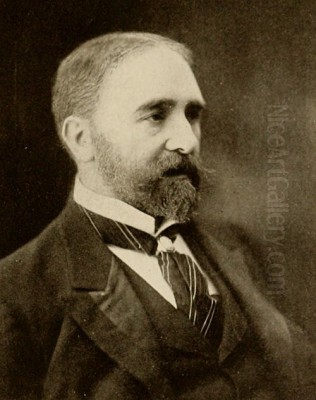
Sir Samuel Luke Fildes KCVO RA (1843-1927) stands as a significant figure in the landscape of British Victorian art. His career, spanning from detailed illustrations capturing the stark realities of urban poverty to grand society portraits and idyllic genre scenes, reflects both the artistic currents and the social conscience of his era. Born in Liverpool, Fildes's journey into the art world was shaped by personal experiences and a keen observational eye, leading him to become one of the most recognized and, at times, debated artists of his generation. His legacy is a complex tapestry, woven with threads of social realism, academic success, and popular appeal.
Early Life and Artistic Awakening
Samuel Luke Fildes was born on October 3, 1843, in Liverpool. A formative influence in his early life was his grandmother, Mary Fildes, a prominent political activist and a figure in the Peterloo Massacre. This connection to social reform likely instilled in the young Fildes an awareness of societal inequities that would later manifest in his art. His formal artistic training began at the age of 17 when he enrolled at the Warrington School of Art. It was here he met Henry Woods, who would become a lifelong friend and fellow artist, and whose sister, Fanny Woods, Fildes would later marry.
Fildes's ambition led him to further his studies in London. He attended the South Kensington Art Schools (now the Royal College of Art) before gaining admission to the prestigious Royal Academy Schools in 1863. During this period, he, like many aspiring artists, absorbed the influences of established masters and contemporary trends. The Pre-Raphaelite Brotherhood, with figures like John Everett Millais and Dante Gabriel Rossetti, had already made a significant impact with their emphasis on detail and truth to nature, while academic painters like Frederic Leighton and Lawrence Alma-Tadema were setting standards for classical and historical subjects. Fildes, however, was increasingly drawn to the burgeoning field of illustration and the power of visual storytelling.
The Illustrator's Eye: The Graphic and Social Commentary
Fildes's career gained significant traction when he began working as an illustrator. In 1869, he joined the staff of The Graphic, a newly founded illustrated weekly newspaper established by William Luson Thomas. The Graphic distinguished itself from competitors like the Illustrated London News by its commitment to social realism and its high-quality wood engravings. Thomas actively encouraged his artists to depict contemporary life with honesty and empathy, particularly the conditions of the urban poor.
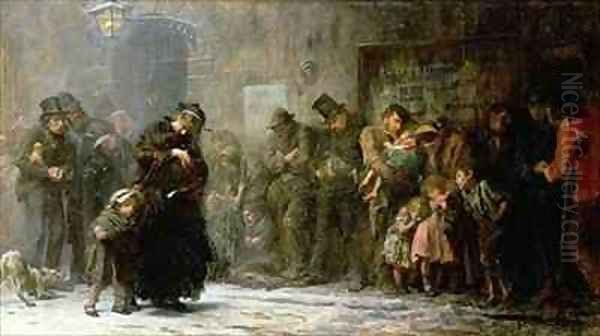
Fildes excelled in this environment. His illustrations for The Graphic were powerful and poignant, drawing attention to the harsh realities faced by many in Victorian London. One of his most impactful early works was Houseless and Hungry (1869), depicting a queue of destitute individuals waiting outside a workhouse. This image, later developed into the oil painting Applicants for Admission to a Casual Ward (1874), resonated deeply with the public and critics alike, including Vincent van Gogh, who admired Fildes's social realist engravings. Van Gogh, in his letters, frequently mentioned English illustrators from The Graphic, including Fildes, Hubert von Herkomer, and Frank Holl, praising their ability to capture the human condition.
Another seminal moment in Fildes's illustration career came through his association with Charles Dickens. Impressed by Fildes's work, Dickens commissioned him to illustrate his final, unfinished novel, The Mystery of Edwin Drood. Fildes had completed several illustrations when Dickens died suddenly in 1870. Following the author's death, Fildes created a poignant image for The Graphic titled The Empty Chair, Gad's Hill – Ninth of June 1870. This simple yet evocative depiction of Dickens's vacant study chair became an iconic representation of national loss and further cemented Fildes's reputation. This work, too, is known to have influenced Van Gogh, particularly in his own paintings of chairs, such as Van Gogh's Chair and Gauguin's Armchair.
Transition to Canvas: Oil Painting and Early Successes
The success and recognition Fildes achieved as an illustrator provided a foundation for his transition into oil painting, a medium that offered greater prestige and artistic scope in the Victorian art world. He began exhibiting at the Royal Academy in the early 1870s. His first major success in oils was Fair, Quiet and Sweet Rest, exhibited at the Royal Academy in 1872. The painting, featuring his future wife Fanny Woods as the model, depicted a serene scene on the Thames, showcasing his skill in rendering figures and capturing a gentle, contemplative mood.

This period saw Fildes increasingly focus on subjects that allowed for narrative and emotional depth. His training as an illustrator, with its emphasis on clear storytelling and character depiction, served him well. He shared this focus on narrative with many contemporaries, including William Powell Frith, whose panoramic scenes of modern life like Derby Day were immensely popular. However, Fildes's social conscience often led him to more somber themes.
The culmination of his early social realist phase in oil painting was Applicants for Admission to a Casual Ward, exhibited at the Royal Academy in 1874. This large-scale work, based on his earlier engraving for The Graphic, was a powerful and unflinching depiction of poverty. Its exhibition caused a sensation, praised for its realism and social commentary, though some critics found its subject matter unsettling. The painting demonstrated Fildes's commitment to using his art to highlight social issues, aligning him with other social realist painters in Britain like Frank Holl and Hubert von Herkomer, and in a broader European context, with artists like Jean-François Millet in France, who depicted peasant life with dignity and pathos.
In 1874, Fildes married Fanny Woods. She remained a frequent model and a supportive partner throughout his career. Their family life, however, was marked by tragedy when their first son, Philip, died on Christmas Day 1877 at the age of one. This profound personal loss would deeply influence Fildes's most famous painting.
The Apex of Social Realism: The Doctor
The death of his son Philip was the catalyst for Fildes's most iconic work, The Doctor. Commissioned by Sir Henry Tate, the sugar magnate and philanthropist, the painting was exhibited at the Royal Academy in 1891. It depicts a physician intently watching over a sick child in a humble cottage, the worried parents in the background. The scene is illuminated by a lamp, casting a dramatic light on the central figures and emphasizing the gravity of the moment.
The Doctor was an immediate and overwhelming success. It struck a chord with the Victorian public for several reasons. It portrayed the physician as a heroic, compassionate figure, a symbol of dedication and scientific progress at a time when the medical profession was gaining increased respect. The painting's emotional intensity and narrative clarity were widely praised. Fildes meticulously constructed the scene, even building a replica of a labourer's cottage in his studio to ensure authenticity. The doctor in the painting was modelled on a professional, while the child was a local girl.
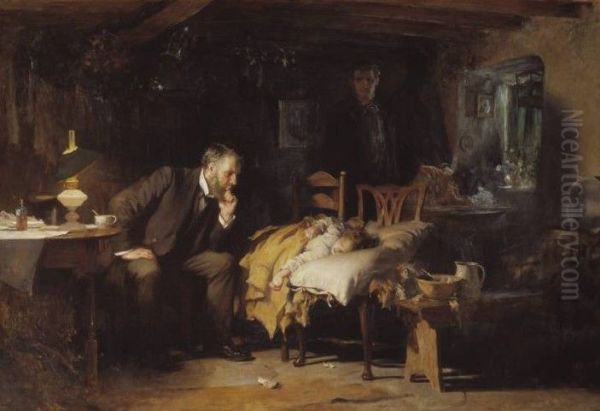
The painting's impact extended far beyond the art world. It became a symbol of the medical profession and was widely reproduced, used in advertisements, and even featured on postage stamps in various countries. Its enduring popularity speaks to its universal themes of compassion, anxiety, and the struggle for life. While artists like Thomas Eakins in America were also exploring medical themes with works like The Gross Clinic, Fildes's The Doctor achieved a level of popular sentimentality and iconic status that was unparalleled. The painting is now housed in the Tate Britain, a testament to its significance in British art.
A Shift in Focus: Portraiture and Venetian Scenes
Following the immense success of The Doctor, Fildes's career took a noticeable turn. While he had always undertaken some portrait work, he increasingly focused on this lucrative genre. The demand for portraits was high among the affluent middle and upper classes, and Fildes's skill in capturing a likeness, combined with his established reputation, made him a sought-after portraitist.
He painted numerous society figures, including members of the Royal Family. His sitters included King Edward VII (when Prince of Wales), Queen Alexandra, and later King George V and Queen Mary. These royal commissions solidified his position as a leading establishment painter. His portrait style was generally academic and flattering, adhering to the conventions expected by his wealthy clientele. This shift was not uncommon among successful Victorian artists; John Everett Millais, for instance, also transitioned from his early Pre-Raphaelite radicalism to become a highly successful society portrait painter.
Alongside portraiture, Fildes also found success with Venetian genre scenes. Like many artists of his time, including his friend Henry Woods who eventually settled in Venice, Fildes was captivated by the beauty and picturesque qualities of the city. His Venetian paintings, often featuring beautifully dressed women in sun-dappled settings, were colourful, charming, and highly popular with the public. Works like An Alfresco Toilette (1889) and The Flower Seller, Venice showcased his skill in rendering textures, light, and vibrant colours. These works were less challenging than his earlier social realist pieces but appealed to a Victorian taste for the exotic and the aesthetically pleasing, much like the works of artists such as Eugene de Blaas or Rubens Santoro who specialized in similar Italianate genre scenes.
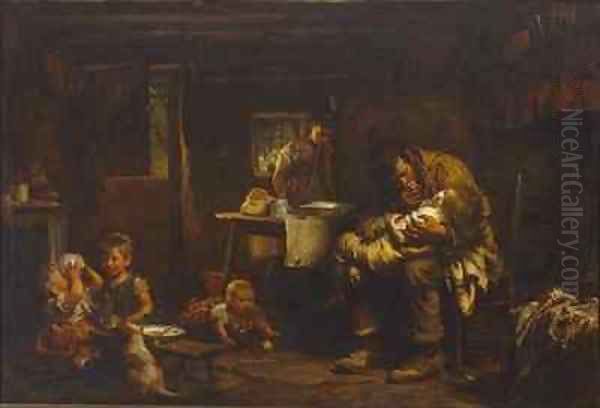
This shift away from social realism towards more commercially viable subjects did not go unnoticed by critics. Some lamented the loss of the powerful social commentator, viewing his later work as less significant. However, Fildes was responding to the demands of the art market and the tastes of his patrons, a common trajectory for many artists seeking sustained professional success. His contemporary, Lawrence Alma-Tadema, built an entire career on meticulously rendered scenes of classical antiquity that were immensely popular but less engaged with contemporary social issues.
The Royal Academy and Later Career
Fildes's standing within the art establishment grew steadily. He was elected an Associate of the Royal Academy (ARA) in 1879 and became a full Royal Academician (RA) in 1887. These accolades were significant markers of success and recognition by his peers. The Royal Academy, under presidents like Sir Frederic Leighton and later Sir Edward Poynter, was the dominant force in the British art world, and membership conferred considerable prestige.
He continued to exhibit regularly at the Royal Academy's annual exhibitions, showcasing his portraits and genre scenes. In 1906, Fildes was knighted by King Edward VII, a further acknowledgment of his contribution to British art. He was later appointed Knight Commander of the Royal Victorian Order (KCVO) in 1918.
In his later years, Fildes lived and worked in his impressive house and studio at 11 Melbury Road in Holland Park, an area popular with successful artists (Frederic Leighton's house, now Leighton House Museum, was nearby). He remained active, though some critics argue that the sheer volume of his output, particularly in portraiture, sometimes led to a decline in the innovative quality seen in his earlier works. This was a criticism also occasionally levelled at other prolific portraitists of the era, such as John Singer Sargent, though Sargent's bravura technique often transcended such concerns.
Style, Technique, and Artistic Influences
Fildes's artistic style evolved throughout his career but was generally rooted in realism. His early illustrations and social realist paintings are characterized by meticulous attention to detail, strong draughtsmanship, and a powerful sense of narrative. He had a remarkable ability to convey emotion and character through facial expression and body language. His compositions were carefully constructed to guide the viewer's eye and emphasize the central message of the work.
His use of chiaroscuro, evident in works like Applicants for Admission to a Casual Ward and The Doctor, added drama and emotional weight to his scenes. In his Venetian paintings, his palette became brighter and more vibrant, reflecting the sunlit atmosphere of the city. His brushwork in these later pieces could be looser and more painterly, though he always maintained a high degree of finish, characteristic of academic painting.
Fildes was influenced by various artistic currents. The British tradition of narrative painting, exemplified by artists like William Hogarth and later David Wilkie, provided a historical precedent for his storytelling approach. The social realism of French artists like Gustave Courbet and Jean-François Millet, as well as the work of his British contemporaries in The Graphic school, such as Herkomer and Holl, clearly informed his early work. The meticulous detail of the Pre-Raphaelites may also have had an indirect influence on his commitment to verisimilitude. For his portraiture, he would have looked to the grand manner tradition of artists like Sir Thomas Lawrence and the contemporary successes of painters like Millais and George Frederic Watts.
Legacy and Influence
Sir Samuel Luke Fildes died on February 27, 1927, at his home in London, at the age of 83. He left behind a significant body of work that reflects the diverse artistic tastes and social concerns of the Victorian and Edwardian eras. His legacy is multifaceted.
Firstly, he is remembered as a key figure in the British social realist movement of the late 19th century. His early illustrations and paintings, particularly Applicants for Admission to a Casual Ward and The Doctor, brought the plight of the urban poor and the realities of sickness and healthcare to a wide audience. These works had a tangible social impact, fostering empathy and contributing to discussions about social reform.
Secondly, his illustration The Empty Chair not only became an iconic image of mourning for Charles Dickens but also demonstrably influenced Vincent van Gogh, highlighting the international reach and artistic significance of British illustration during this period. This connection underscores the cross-pollination of ideas in European art.
Thirdly, The Doctor remains one of the most beloved and recognizable paintings in British art. Its enduring appeal lies in its powerful emotional narrative and its idealization of the medical profession, making it a cultural touchstone that transcends its original Victorian context.
Finally, as a successful portrait and genre painter, Fildes catered to the tastes of his time, achieving considerable fame and fortune. While this later work may be viewed by some critics as less artistically innovative than his earlier social realist pieces, it nonetheless provides a valuable record of Edwardian society and demonstrates his technical skill and versatility. Artists like James McNeill Whistler or Walter Sickert, who pursued more avant-garde paths, offered a different vision, but Fildes represented a powerful and popular strand of academic art.
Conclusion: A Victorian Chronicle
Sir Samuel Luke Fildes's career offers a fascinating window into the art world of late Victorian and Edwardian Britain. From his gritty depictions of London's underclass to his polished portraits of royalty and his sun-drenched Venetian scenes, his work captures the complexities and contradictions of an era of great change, industrial progress, and persistent social inequality. He navigated the demands of public taste, critical reception, and personal conviction to create a body of work that, at its best, possessed profound emotional power and a keen social conscience. While his fame today rests largely on a few key images, his broader oeuvre reveals an artist of considerable talent and adaptability, a chronicler in paint of the world he inhabited. His contribution to British art, particularly in the realm of social realism and narrative painting, ensures his place in its history.