Theude Grönland (1817-1876) stands as a significant, if sometimes overlooked, figure in the rich tapestry of 19th-century European art. A painter renowned for his exquisite still lifes, particularly of flowers and fruit, Grönland's career traversed several major artistic centers, absorbing and reflecting various influences while maintaining a distinct, meticulous style. His works, often characterized by vibrant colors, intricate detail, and a subtle luminosity, found favor with collectors across the continent, securing him a place among the notable still life specialists of his era.
Early Life and Formative Years in Altona and Copenhagen
Theude Grönland was born in 1817 in Altona, a town then under Danish administration, adjacent to the city of Hamburg. This geographical and political context is crucial, as Altona, while culturally Germanic, was part of the Danish realm for a significant period, contributing to Grönland's Danish-German identity. His early exposure to the bustling port environment of the Hamburg-Altona region, a hub of trade and diverse cultural exchanges, may have subtly influenced his later appreciation for the exotic and the beautiful in nature's bounty, which he so masterfully depicted.
The young Grönland's artistic inclinations led him to seek formal training. In 1833, he enrolled at the prestigious Royal Danish Academy of Fine Arts in Copenhagen. This institution was a cornerstone of the Danish Golden Age of painting, a period that saw an incredible flourishing of artistic talent. At the Academy, Grönland studied under Johan Ludwig Lund (1777-1867), a prominent painter of historical subjects and portraits, who himself had trained under Jacques-Louis David in Paris. Lund, along with Christoffer Wilhelm Eckersberg, was a leading professor at the Academy, shaping a generation of Danish artists. While Lund was not primarily a still life painter, the rigorous academic training emphasizing drawing, composition, and color theory would have provided Grönland with a solid foundation for any specialization he chose to pursue.
The environment in Copenhagen during this period was vibrant. Artists like Christen Købke, Martinus Rørbye, and Wilhelm Bendz were active, focusing on everyday life, portraiture, and landscapes with a characteristic Danish clarity and sensitivity to light. Though Grönland would eventually specialize in a different genre, the prevailing artistic atmosphere of meticulous observation and refined technique undoubtedly left its mark.
The Parisian Sojourn: A Career Forged in the Art Capital
After his studies in Copenhagen, Grönland, like many ambitious artists of his time, was drawn to Paris, the undisputed art capital of Europe. He arrived in the French capital around 1842 and would reside there for a significant portion of his career, approximately twenty-five years, until about 1868 or 1869. This long Parisian period was pivotal in shaping his artistic identity and establishing his reputation.
Paris in the mid-19th century was a crucible of artistic innovation and debate. The official art world was dominated by the Académie des Beaux-Arts and the annual Salon, the premier exhibition venue. Grönland actively participated in the Salon, and his talent was recognized. A significant achievement came in 1848 when he was awarded a first-class medal at the Paris Salon, a prestigious honor that would have greatly enhanced his visibility and marketability. He continued to exhibit, and his success was further cemented when he received a second-class medal at the Exposition Universelle (World's Fair) in Paris in 1855. These accolades underscore the high regard in which his work was held.
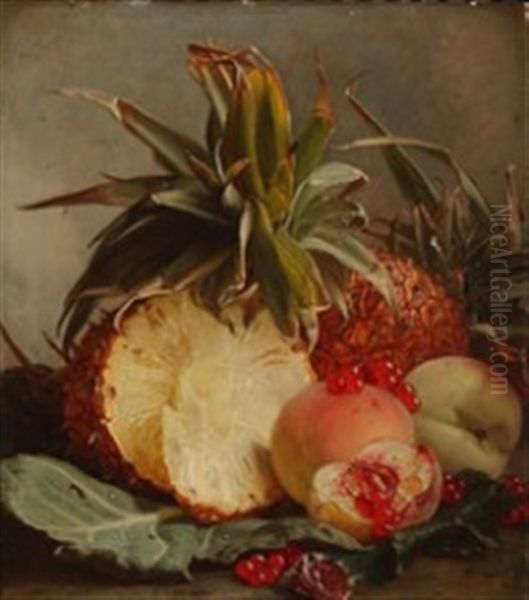
During his time in Paris, Grönland specialized in still life painting, focusing predominantly on elaborate compositions of flowers and fruit. His style was characterized by a high degree of finish, rich, jewel-like colors, and an almost tangible rendering of textures – the velvety skin of a peach, the dewy freshness of a rose, the translucent gleam of grapes. His works often featured an abundance of elements, carefully arranged to create a sense of opulence and natural beauty. Some sources note that his still lifes occasionally incorporated landscape backgrounds, a less common feature that added depth and a unique context to his arrangements.
The French art scene offered a rich context. While the grand historical and mythological paintings often took center stage at the Salon, there was a strong tradition of still life painting in France, tracing back to artists like Jean-Baptiste-Siméon Chardin in the 18th century. In Grönland's own time, artists like Henri Fantin-Latour (though slightly younger) would also become celebrated for their flower paintings. Other prominent figures in Paris during Grönland's stay included Eugène Delacroix, the titan of Romanticism, and Gustave Courbet, the champion of Realism. While Grönland's genre was different, the overall artistic ferment and the high standards of execution prevalent in Paris would have spurred him on.
It was also in Paris that Grönland took on students. One notable pupil was the Norwegian painter Frants Diderik Bøe (1820-1891), who moved to Paris in 1849 and studied under Grönland. Bøe himself became known for his still lifes, particularly of flowers and birds, suggesting Grönland's direct influence as a teacher in this specialized genre.
Travels and Broadening Horizons: Italy and England
Grönland's artistic journey was not confined to Copenhagen and Paris. The available information indicates that he spent periods in both Italy and England, each for approximately three years. While the exact chronology of these stays in relation to his long Parisian residency is not always precisely detailed, these travels would have further enriched his artistic vision.
A sojourn in Italy was almost a rite of passage for many Northern European artists. The allure of classical antiquity, the masterpieces of the Renaissance, and the vibrant Italian light drew painters and sculptors south. For a still life painter, Italy offered an abundance of inspiration: lush Mediterranean fruits and flowers, and a rich tradition of still life painting, particularly from the Baroque period. Artists like Caravaggio, with his dramatic use of light, had produced powerful still life elements, and later Italian painters continued the tradition. Exposure to this environment could have influenced Grönland's palette and his appreciation for dramatic compositions.
His time in England would have exposed him to a different artistic milieu. Victorian England had a strong market for detailed, narrative, and sentimental art. There was also a significant tradition of botanical illustration and flower painting, often characterized by meticulous accuracy. Artists like William Henry Hunt were renowned for their highly detailed still lifes of fruit and flowers. Grönland's own precision and love for natural detail would have found resonance in the British art scene, and his works were reportedly popular with English collectors.
These periods of travel, combined with his foundational training and his long immersion in the Parisian art world, contributed to the cosmopolitan nature of Grönland's art. He was not an artist of a single national school but rather a European painter whose work appealed to a broad international audience.
Artistic Style, Themes, and Representative Works
Theude Grönland's oeuvre is primarily defined by his dedication to still life, with a particular emphasis on floral and fruit arrangements. His style is often compared to the great Dutch Golden Age still life painters of the 17th century, such as Jan van Huysum or Rachel Ruysch, who were celebrated for their intricate detail, brilliant coloring, and illusionistic realism. Grönland revived this tradition of meticulous rendering but infused it with a 19th-century sensibility.
His paintings typically display a profusion of natural elements, often overflowing from baskets or arranged on ledges. He had a remarkable ability to capture the varied textures of his subjects: the delicate petals of roses, lilies, and tulips; the fuzzy skin of peaches; the smooth, reflective surfaces of plums and cherries; and the intricate patterns of pineapple skin. His color palettes were rich and harmonious, often employing deep jewel tones contrasted with softer hues, creating a sense of vibrancy and life. Light played a crucial role in his compositions, illuminating the arrangements to highlight their forms and colors, often with a soft, diffused glow that added to their allure.
One of the distinguishing features sometimes noted in Grönland's work is the inclusion of landscape settings or backgrounds for his still lifes. This was not typical for the genre, which traditionally favored neutral or dark, undefined backgrounds to emphasize the primary subject. By placing his arrangements within a suggestion of an outdoor or landscape context, Grönland added a layer of naturalism and perhaps a narrative element, suggesting the origins of the fruits and flowers depicted.
Several works are cited as representative of his talent:
"Fleurs et fruits" (Flowers and Fruits) from 1845: An early example from his Parisian period, this work would likely showcase the meticulous detail and rich coloration that became his hallmark. The title itself is indicative of his primary subject matter.
"Still life with flowers and fruit" (1846): Following closely on the previous example, this painting would continue to demonstrate his developing mastery in composing complex arrangements and rendering natural textures with precision.
"Still life with pineapples and peaches": This title highlights his interest in depicting both common and more exotic fruits. Pineapples, in particular, were a symbol of luxury and were challenging to paint due to their complex texture, making them a subject favored by artists wishing to display their technical skill.
His works were highly sought after by collectors in France, Germany, and England, a testament to their appeal and his established reputation. The demand was apparently so high that it was difficult to secure enough pieces for exhibitions in his native Denmark, indicating his international success.
The Berlin Years: Teaching and Final Chapter
Around 1868 or 1869, after his extensive period in Paris, Theude Grönland relocated to Berlin. The Prussian capital was rapidly growing in importance, both politically and culturally, and was developing into a major artistic center. Here, Grönland continued his career as a painter and also became an influential teacher.
In Berlin, he attracted a circle of students, eager to learn his refined techniques in still life painting. One such student was Clara Lobedan (1840-1918), a German painter who became known for her flower and still life works. Lobedan studied with Grönland and also with Professor Karl Gussow (1843-1907), a prominent academic painter and influential teacher at the Berlin Academy. Gussow himself was known for his portraits and genre scenes, but his association with Lobedan alongside Grönland points to the interconnectedness of the Berlin art scene. The fact that Grönland, a specialist in still life, was a sought-after teacher in Berlin speaks to his esteemed reputation in the genre.
Berlin's art world at this time included major figures like Adolph Menzel, known for his historical paintings and depictions of modern life, and Anton von Werner, who would become a dominant figure in official art circles, particularly after the unification of Germany in 1871. While Grönland's specialization differed, his presence contributed to the diversity and richness of Berlin's artistic offerings.
Theude Grönland passed away in Berlin in 1876, leaving behind a significant body of work that celebrated the beauty of the natural world with remarkable skill and dedication.
Legacy and Contemporaries: Grönland in Context
Theude Grönland's legacy lies in his contribution to the tradition of still life painting in the 19th century. He successfully navigated the art worlds of Copenhagen, Paris, and Berlin, achieving international recognition for his meticulously crafted and visually sumptuous works. His paintings are a testament to the enduring appeal of still life, a genre that allows for intense observation, technical virtuosity, and the creation of beauty from the everyday.
When considering his contemporaries, it's useful to look at artists working in similar veins or in the same artistic centers:
Johan Ludwig Lund (1777-1867): His teacher in Copenhagen, a key figure in the Danish Golden Age.
Christoffer Wilhelm Eckersberg (1783-1853): Alongside Lund, a pillar of the Copenhagen Academy.
Frants Diderik Bøe (1820-1891): His Norwegian student in Paris, who also specialized in still life.
Henri Fantin-Latour (1836-1904): A renowned French contemporary, also celebrated for his exquisite flower paintings.
Antoine Vollon (1833-1900): Another prominent French still life and genre painter active during Grönland's time in Paris.
Gustave Courbet (1819-1877) and Eugène Delacroix (1798-1863): Major figures in French painting whose careers overlapped significantly with Grönland's Parisian period, representing different dominant artistic movements.
Jan van Huysum (1682-1749) and Rachel Ruysch (1664-1750): Though from an earlier era, these Dutch Golden Age masters set a standard for flower and fruit painting to which Grönland's work is often compared.
Clara Lobedan (1840-1918): His student in Berlin, who carried on the tradition of flower painting.
Karl Gussow (1843-1907): An influential academic painter in Berlin, with whom Lobedan also studied.
Adolph Menzel (1815-1905) and Anton von Werner (1843-1915): Leading figures in the Berlin art scene during Grönland's later years.
Theude Grönland's art, with its blend of Northern European precision, French elegance, and a universal appreciation for nature's bounty, continues to be admired in collections and at auctions. He remains a fine example of a dedicated specialist who achieved mastery within his chosen genre, leaving behind a legacy of beauty that transcends the passage of time. His international career underscores the interconnectedness of European art in the 19th century and highlights the enduring appeal of meticulously rendered still life.