Paul Theodor van Brussel stands as a significant, if sometimes overlooked, figure in the rich tapestry of Dutch art, particularly within the specialized genre of flower and fruit still life painting during the latter half of the 18th century. His works, characterized by their vibrant palettes, meticulous detail, and elegant compositions, offer a captivating window into the enduring Dutch fascination with nature's bounty and the artistic prowess required to capture its ephemeral beauty. While operating in the shadow of earlier Golden Age giants, van Brussel carved out a distinct niche, contributing to the continuity and evolution of a beloved artistic tradition.
Early Life and Artistic Genesis
Paul Theodor van Brussel was born on January 16, 1754, in Zuid-Polsbroek, a small village in the province of Utrecht, Netherlands. His father, Theodorus van Brussel, was a respected Baptist minister in the local community, serving from 1748 to 1765. This upbringing within a religious household might suggest a disciplined and perhaps introspective early environment, though direct details of his childhood remain scarce. What is clear is that young Paul Theodor developed an inclination towards the visual arts, a path that would lead him away from his pastoral birthplace.
His formal artistic training commenced in The Hague, a prominent artistic center in the Netherlands. There, he apprenticed under Jean Augustin and Hendrik Meyer, both of whom were practitioners of decorative painting. This form of art, often encompassing large-scale works like wall hangings, overdoor panels, and other architectural embellishments, would have instilled in van Brussel a strong sense of design, composition, and the skillful application of paint to create visually pleasing effects. The emphasis on ornamentation and the faithful rendering of natural elements, common in decorative schemes, likely laid a crucial foundation for his later specialization in still life.
A Career Blossoms in Amsterdam
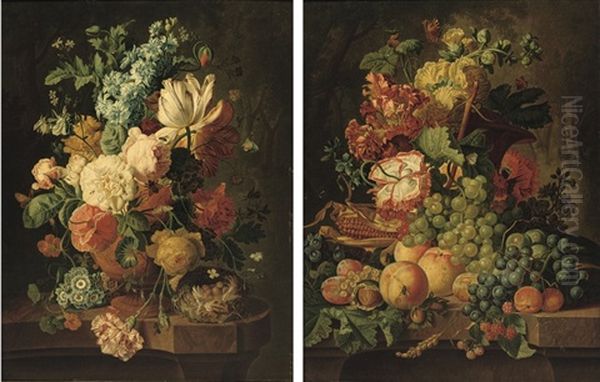
In 1784, seeking broader opportunities and a more dynamic artistic environment, Paul Theodor van Brussel relocated to Amsterdam. This city, though past the zenith of its 17th-century Golden Age, remained a vital hub for commerce, culture, and the arts. It was in Amsterdam that van Brussel would spend the remainder of his life, dedicating himself almost exclusively to the meticulous and demanding art of still life painting, with a particular focus on fruit and flowers. His most productive and artistically mature period is generally considered to be between 1774 and his death in 1795, with some sources extending this to 1798, possibly accounting for posthumous studio attributions or works completed just before his passing.
Van Brussel quickly established a reputation for his ability to render natural subjects with remarkable fidelity and an appealing aesthetic sensibility. His paintings were sought after for their vibrant colors, the luxurious textures he imparted to petals and fruit skins, and the overall elegance of his arrangements. He was not merely a copyist of nature but an arranger, a composer who brought together elements to create harmonious and often opulent visual statements.
Artistic Style: Precision, Elegance, and Naturalism
Paul Theodor van Brussel’s style is deeply rooted in the Dutch tradition of still life painting, yet it bears the hallmarks of his own artistic personality and the tastes of the late 18th century. His works are characterized by several key features:
Meticulous Detail and Realism: True to the Dutch heritage, van Brussel paid extraordinary attention to detail. Each petal, leaf, insect, and dewdrop was rendered with painstaking precision. This verisimilitude was highly prized and demonstrated not only the artist's technical skill but also a profound observation of the natural world. Artists like Willem van Aelst in the 17th century had set a high bar for such detailed realism in fruit and flower pieces, a standard van Brussel clearly aspired to.
Vibrant Color Palettes: Van Brussel’s paintings are often alive with rich, luminous colors. He skillfully used a broad palette to capture the varied hues of different flowers and fruits, from the deep reds of roses and cherries to the delicate pinks of carnations and the translucent greens of grapes. This vibrancy contributed to the decorative appeal of his works, making them attractive additions to the homes of prosperous patrons.
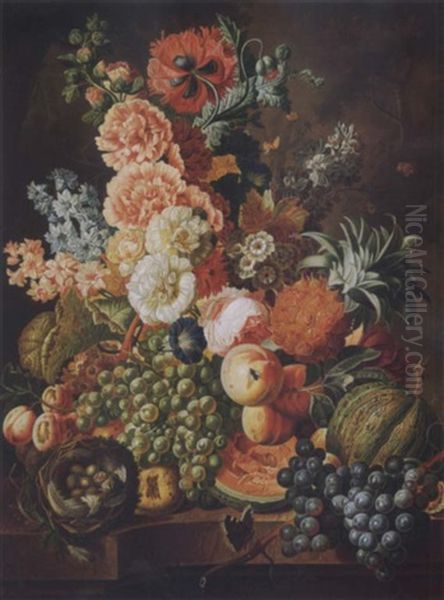
Elegant and Balanced Compositions: While his arrangements could be abundant, they were rarely chaotic. Van Brussel typically organized his subjects in a pyramidal or S-curved composition, creating a sense of balance and visual flow. Flowers and fruits were often depicted in ornate vases or on marble ledges, sometimes accompanied by other elements like bird’s nests or insects, adding layers of interest and symbolic meaning, a practice seen in the works of earlier masters like Ambrosius Bosschaert the Elder or Jan Davidsz. de Heem.
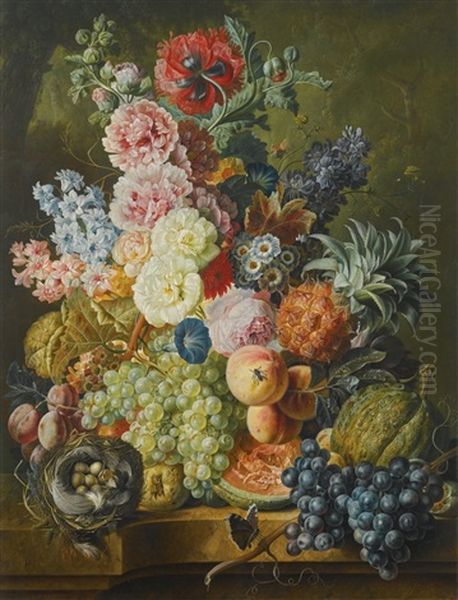
Combination of Flora: A distinctive aspect of van Brussel's work, and indeed a common conceit in Dutch flower painting since the time of Jan Brueghel the Elder, was the depiction of flowers from different seasons blooming simultaneously in a single bouquet. This was an artistic license that allowed painters to showcase a wider variety of prized blooms, creating an idealized vision of nature's perfection that transcended the limitations of actual seasons. Van Brussel excelled at this, often combining expensive, exotic flowers like tulips and roses with more common, local varieties such as morning glories or marigolds. This practice required artists to make individual studies of flowers as they came into season, later assembling them into a composite, imagined arrangement.
Play of Light and Texture: Van Brussel was adept at rendering different textures – the velvety softness of a rose petal, the waxy sheen of a grape, the cool hardness of a marble tabletop, or the delicate transparency of an insect's wing. His use of light was crucial in achieving these effects, with highlights and shadows carefully placed to model forms and enhance their three-dimensionality. This sensitivity to light and texture was a hallmark of the finest Dutch still life painters, including the celebrated female artist Rachel Ruysch, a contemporary of Jan van Huysum.
Representative Works and Achievements
While a comprehensive catalogue raisonné might be extensive, several works and projects highlight Paul Theodor van Brussel’s artistic contributions.
Flowers in a Vase (1792): This painting, specifically mentioned in historical accounts, is exemplary of his style. It reportedly showcased a rich assortment of blooms, likely featuring the characteristic mix of costly and common flowers arranged in an elegant vase. The composition would have emphasized the varied colors, shapes, and textures of the individual flowers, creating a harmonious and visually splendid whole. Such pieces were highly desirable, continuing a tradition perfected by artists like Jan van Huysum, whose flower pieces were renowned for their brilliance and detail.
Fruit and Flowers (National Gallery, London): The National Gallery in London holds at least one, possibly two, significant works by van Brussel, often titled Fruit and Flowers or similar. These paintings demonstrate his skill in combining both floral and fruit elements, creating lush, abundant displays. The inclusion of fruit allowed for an even greater variety of textures and forms, from the fuzzy skin of peaches to the smooth gleam of plums. The presence of his work in such a prestigious collection underscores his historical importance.
Nederlandsch Bloemwerk (1794): Perhaps one of van Brussel’s most significant contributions was his involvement with Nederlandsch Bloemwerk ("Dutch Flower Work"), a lavishly illustrated botanical book published in Amsterdam in 1794 by H.L. Myling. This publication featured 51 (or 53, according to some sources) hand-colored engraved plates depicting a wide array of flowers, particularly tulips and hyacinths, which were still horticultural treasures in the Netherlands. Van Brussel is credited with designing and drawing the title page and likely contributed to many of the individual plates, even if not all are signed by him.
This work stands in the tradition of great botanical illustrators like Maria Sibylla Merian, whose meticulous renderings of plants and insects in the late 17th and early 18th centuries were groundbreaking. Nederlandsch Bloemwerk served not only as an artistic showcase but also as a botanical record, reflecting the ongoing Dutch passion for horticulture. The hand-coloring of each plate made every copy a unique work of art, highly prized by collectors and botanists. Van Brussel's involvement highlights his reputation as a skilled draftsman and an expert in floral representation. The style of these illustrations is often compared to the great Dutch masters, indicating a conscious effort to uphold a high standard of artistic excellence.
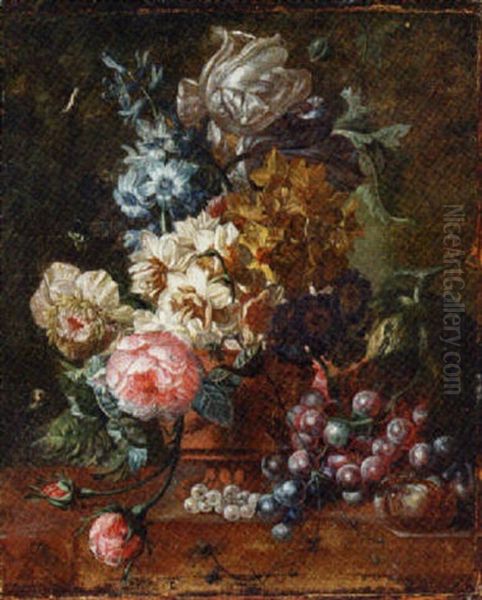
Still life: met Rosen, Blumen und Weintrauben (Still life with Roses, Flowers, and Grapes): This title, associated with a work that appeared at auction (e.g., Dorotheum), describes a typical subject for van Brussel. Measuring approximately 22 x 27 cm, it would be a cabinet-sized piece, intimate yet richly detailed. The combination of roses, other flowers, and grapes is classic, offering a delightful interplay of colors and textures. Auction records for such pieces, with estimates in the range of €4,500-€5,000 in recent years, provide a glimpse into his market value, though this can fluctuate based on quality, condition, and provenance.
The Artistic Milieu: Contemporaries, Influences, and Legacy
Paul Theodor van Brussel operated within a well-established artistic tradition. The 17th-century Dutch Golden Age had seen still life painting, particularly flower pieces (bloemstukken) and fruit pieces (fruitstukken), rise to unprecedented heights of popularity and technical mastery. Artists like Ambrosius Bosschaert the Elder, Balthasar van der Ast, Jan Davidsz. de Heem, and later Willem Kalf (known for his sumptuous pronkstilleven) and Abraham Mignon, had created a legacy that 18th-century painters inherited.
By the 18th century, the towering figure in Dutch flower painting was Jan van Huysum (1682-1749). Van Huysum’s works, with their light-filled backgrounds, incredibly detailed execution, and complex, airy bouquets, set a new standard. His influence, along with that of Rachel Ruysch (1664-1750), another highly successful flower painter known for her dynamic compositions and dark backgrounds, was profound. Van Brussel, working a generation after van Huysum’s peak, would have been acutely aware of these masters. His style, while distinct, shows an assimilation of their achievements in terms of detail, color, and compositional elegance. He is often seen as continuing their tradition, adapting it to the slightly more Rococo sensibilities of the later 18th century, which favored grace and charm.
Other contemporaries or near-contemporaries in the broader field of still life and botanical art include Gerard van Spaendonck (1746-1822), a Dutch painter who found great success in Paris as a flower painter and professor of botanical iconography, and his brother Cornelis van Spaendonck (1756-1839). While their careers largely unfolded in France, their Dutch roots connect them to the same artistic lineage. The French artist Pierre-Joseph Redouté (1759-1840), "the Raphael of flowers," though slightly younger and working primarily in France, also became immensely influential in botanical illustration, and his work shares the precision and beauty seen in projects like Nederlandsch Bloemwerk.
In terms of direct collaboration, his work on Nederlandsch Bloemwerk with the publisher H.L. Myling is the most evident. It's also plausible he collaborated with other engravers or artists on such illustrated projects, as was common practice. The competitive landscape would have been shaped by the enduring demand for high-quality still lifes. Patrons, both Dutch and international, sought these works for their decorative qualities and as symbols of wealth and refined taste. Van Brussel’s success indicates he was able to compete effectively in this market.
Anecdotes and Personal Life: Glimpses of the Artist
Detailed personal anecdotes about Paul Theodor van Brussel are not abundant in historical records, which often focused more on an artist's public career and works than their private life. However, we can infer certain aspects. His move from Zuid-Polsbroek to The Hague and then to Amsterdam suggests ambition and a desire to be at the center of artistic activity. His dedication to the highly specialized and labor-intensive genre of still life painting speaks to a patient, meticulous, and disciplined temperament.
The very nature of his work – accurately depicting flowers that bloomed at different times of the year within a single composition – implies a methodical working process. He would have needed to create numerous detailed studies of individual flowers and fruits when they were in season. These studies, likely sketches or oil studies, would then serve as references in his studio when composing the final, often idealized, painting. This practice, common among flower painters, required foresight, organization, and a deep familiarity with botanical forms.
His background as the son of a minister is interesting, though it's difficult to say how directly it influenced his art. Some art historians have explored religious symbolism in Dutch still lifes (e.g., vanitas themes of transience), but by the late 18th century, the emphasis was often more on aesthetic beauty and the celebration of nature's abundance, though subtle moral or symbolic undertones could still be present. The inclusion of insects like butterflies (symbolizing resurrection or the soul) or caterpillars and flies (symbolizing decay or earthly concerns) was a long-standing tradition that van Brussel continued, adding layers of meaning and visual interest.
Academic Evaluation and Enduring Influence
Academically, Paul Theodor van Brussel is recognized as a skilled and accomplished practitioner of late 18th-century Dutch still life painting. He is seen as a worthy successor to the great masters of the Golden Age, upholding the high technical standards of the genre while infusing his work with the refined elegance characteristic of his era. His contributions to Nederlandsch Bloemwerk also secure him a place in the history of botanical illustration.
His influence on subsequent artists is perhaps more subtle than that of the 17th-century giants or Jan van Huysum. However, by continuing the tradition of high-quality flower and fruit painting, he helped to ensure its vitality into the 19th century. Artists specializing in still life in the following decades, both in the Netherlands and elsewhere in Europe, would have looked to the established masters, including those of van Brussel's generation, for inspiration and technical guidance. For instance, the Danish painter Johan Laurentz Jensen (1800-1856), who became renowned for his flower paintings in the 19th century, worked in a tradition that ultimately descended from these Dutch antecedents.
While he may not have instigated a major stylistic shift or founded a new school, van Brussel's impact lies in his consistent production of beautiful, technically proficient works that delighted his contemporaries and continue to be appreciated today. His paintings serve as important examples of the enduring appeal of still life and the specific character of Dutch art in the period leading up to the significant societal and artistic changes of the 19th century.
Collections and Market Presence Today
Works by Paul Theodor van Brussel are found in various public and private collections. As mentioned, the National Gallery in London holds significant examples. Other museums in the Netherlands and internationally that specialize in Dutch art may also have his paintings. His contributions to Nederlandsch Bloemwerk mean that copies of this important illustrated book are held in the rare book collections of major libraries and botanical institutions worldwide, such as the library of the Missouri Botanical Garden or the Dumbarton Oaks Research Library.
On the art market, van Brussel's paintings appear periodically at auctions specializing in Old Master paintings. Prices can vary considerably based on factors such as size, complexity, condition, provenance, and the prevailing market demand for 18th-century still lifes. While not commanding the astronomical sums of some earlier Golden Age masters, his works are nevertheless valued by collectors for their beauty and historical significance. The auction of Still life: met Rosen, Blumen und Weintrauben at Dorotheum is one such example of his market presence.
Conclusion: A Legacy in Bloom
Paul Theodor van Brussel died in Amsterdam in 1795, at the relatively young age of 41. Despite his comparatively short career, he left behind a body of work that testifies to his skill, dedication, and artistic vision. He successfully navigated the rich tradition of Dutch still life, creating paintings that are both a continuation of that legacy and a reflection of his own time. His meticulous renderings of flowers and fruits, arranged with elegance and brought to life with vibrant color and subtle light, celebrate the beauty of the natural world. As an artist who captured the ephemeral splendor of blooms and the luscious appeal of fruit, Paul Theodor van Brussel ensured his own lasting place in the annals of art history, his legacy continuing to bloom for connoisseurs and art lovers alike. His work reminds us of the enduring power of nature as an artistic muse and the remarkable ability of Dutch painters to transform the ordinary into the extraordinary.