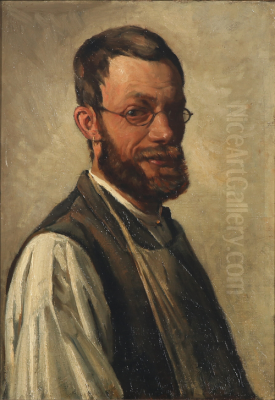
Valdemar Henrik Nicolaj Irminger (1850-1938) stands as a significant, if sometimes overlooked, figure in the landscape of Danish art during the late 19th and early 20th centuries. A dedicated painter and influential professor, Irminger carved a niche for himself primarily through his evocative animal paintings, detailed genre scenes, and compelling landscapes. His work reflects a deep engagement with the natural world and the daily lives of Danish people, rendered with a keen eye for detail and a commitment to realistic representation that characterized much of the art of his era, while also subtly evolving with the changing artistic currents.
Early Life and Academic Foundations
Born in the vibrant city of Copenhagen in 1850, Valdemar Irminger was immersed in a cultural environment that was experiencing a rich artistic heritage, still feeling the echoes of the Danish Golden Age. His brother, Johan Otto Irminger, also pursued artistic endeavors, suggesting a familial inclination towards the arts. Valdemar's formal artistic training commenced at the prestigious Royal Danish Academy of Fine Arts (Det Kongelige Danske Kunstakademi) in Copenhagen, an institution that had nurtured generations of Danish artists.
He graduated from the Academy in 1873, having studied under some of the prominent figures of Danish art. While specific records of all his tutors might be extensive, the Academy at that time was home to influential artists who continued the traditions of the Golden Age masters like Christoffer Wilhelm Eckersberg and Christen Købke. Figures such as Wilhelm Marstrand, a master of historical and genre scenes, Jørgen Roed, known for his portraits and architectural paintings, and Frederik Vermehren, a key figure in national romanticism and genre painting, were influential professors whose teachings would have shaped the young Irminger. The emphasis on meticulous observation, strong draughtsmanship, and a faithful depiction of reality were hallmarks of the Academy's curriculum.
Artistic Style and Thematic Concerns
Irminger's primary artistic identity is rooted in his skill as an animal painter and a portrayer of landscapes and genre scenes. His approach was largely naturalistic, focusing on the accurate depiction of his subjects, whether they were farm animals, wild creatures, or the human figures populating his canvases. This dedication to realism aligned him with a broader European trend that moved away from the idealized romanticism of earlier decades towards a more direct and unembellished representation of the world.
His animal paintings were not mere anatomical studies; they often conveyed a sense of the creature's character and its place within its environment. Whether depicting domestic animals in a farmyard setting or more exotic creatures, Irminger imbued them with life and presence. This focus on animal art was shared by other notable painters of the period, both in Denmark and internationally, such as the French artist Rosa Bonheur, renowned for her powerful depictions of animals, or in Denmark, Theodor Philipsen, who would later embrace Impressionistic techniques in his animal and landscape works.
Landscape painting also formed a significant part of Irminger's oeuvre. His landscapes often captured the specific light and atmosphere of the Danish countryside, reflecting a deep connection to his native land. These works can be seen in the tradition of Danish landscape painters like P.C. Skovgaard, though Irminger's generation was also beginning to explore new ways of seeing and representing nature, influenced by broader European movements.
Genre painting, depicting scenes of everyday life, particularly rural life, was another forte. These works offer valuable insights into the customs, labor, and social fabric of Denmark during his time. They often feature ordinary people engaged in their daily tasks, rendered with empathy and a focus on narrative detail. This aligns with the work of artists like L.A. Ring, a contemporary who became a leading figure in Danish Realism and Symbolism, known for his poignant depictions of rural life and laborers.
Notable Works and Their Significance
Several key works highlight Valdemar Irminger's artistic contributions and thematic interests.
"Det gamle Baest vil skIFTES" (The Old Beast Will Be Moved), painted in 1901 and housed in the Charlottenborg Museum, Copenhagen, is a prime example of his genre and animal painting. The artwork, measuring 86 x 68 cm, depicts a small boy and girl struggling to move a heavy tethering post, likely for an animal. The title itself suggests a narrative of change or transition. The painting captures a moment of childhood effort and rural life, showcasing Irminger's ability to combine storytelling with detailed observation of his subjects and their environment. The careful rendering of the figures and the rustic setting are characteristic of his style.
"En Billedhugger i sit Værksted i Rom" (A Sculptor in his Studio in Rome), created in 1890, is a larger piece (160 x 128 cm) that portrays the sculptor Theodor Lund (1852-1926) at work. This painting indicates Irminger's connection to the broader artistic community and the tradition of Danish artists traveling to Italy, particularly Rome, for inspiration and study – a practice that had been central since the Golden Age. The work is not only a portrait of a fellow artist but also a depiction of the creative process and the atmosphere of an artist's studio, a popular theme in 19th-century art. One might draw parallels with French academic painters like Jean-Léon Gérôme, who also depicted artists in their studios, though Gérôme was more known for his historical and Orientalist scenes.
"A roaring lion in the Colosseum" (Løve i Colosseum, Rom), dated 1886, further underscores his time in Rome and his interest in animal subjects, even exotic ones. This painting places a powerful lion within the iconic setting of the Roman Colosseum, a theme that resonated with the 19th-century fascination with history and the grandeur of antiquity. Such subjects allowed artists to explore dramatic compositions and the raw power of nature. The work would have appealed to the academic tastes of the time, which valued historical and classical themes.
"Die Kiekeby" (1870), a landscape painting exhibited in the Statens Museum for Kunst (National Gallery of Denmark) in Copenhagen, demonstrates his early engagement with landscape. While details of this specific work are less prominent in the provided summary, its inclusion in the national collection signifies its importance. It would likely reflect the prevailing trends in Danish landscape painting of the period, perhaps showing influences from the late Golden Age masters or the emerging Realist sensibilities.
Another mentioned work, "Jydsk Tyr" (Jutland Bull), points directly to his specialization in animal portraiture, focusing on a specific Danish breed. Such paintings celebrated the agricultural heritage of Denmark and showcased the artist's skill in capturing the form and character of domestic livestock, a subject also explored by contemporaries like Theodor Philipsen, though Philipsen's later work would be more impressionistic.
Academic Career and Influence as an Educator
Valdemar Irminger's contributions to Danish art extended beyond his own creative output. He became a professor at the Royal Danish Academy of Fine Arts, the very institution where he had received his training. This position allowed him to shape and influence a new generation of Danish artists. His teaching would have likely emphasized the strong foundational skills in drawing and observation that were central to his own practice and the Academy's tradition.
Among the students he taught were figures such as Carls Mannscol (the name appears potentially corrupted in some records but is listed as a student), Agnete Ring Schultz, and Asta Ring Schultz. The impact of a professor can be seen not only in the direct stylistic emulation by students but also in the broader artistic principles and work ethic they impart.
Significantly, Irminger was involved in efforts to promote co-education for men and women at the Academy. In the late 19th century, access to formal art education for women was often limited or segregated. His advocacy for joint teaching was a progressive stance and contributed to the evolving landscape of art education in Denmark, making it more inclusive. This aligns with broader social changes occurring across Europe regarding women's rights and opportunities. His wife, Ingeborg Plockert Irminger, was also deeply involved in art education, further highlighting the couple's commitment to this field.
Personal Life and Artistic Circles
Valdemar Irminger was married to Ingeborg Plockert Irminger (1872-1962), who was herself an accomplished artist – a sculptor specializing in depictions of children and animals. Her artistic interests complemented Valdemar's own focus on animal subjects. Ingeborg was also a significant figure in art education reform, notably founding a new school in Hellerup. Their shared artistic and educational pursuits suggest a dynamic partnership.
As a professor at the Academy and an established painter, Irminger would have been part of Copenhagen's active artistic circles. The provided information notes his correspondence with Amalie Ibsen, the wife of the famed Norwegian playwright Henrik Ibsen. This indicates his engagement with broader Scandinavian cultural figures. His participation in the Danish Artists' Association (likely referring to activities connected with the Academy or related exhibition societies like Charlottenborg) would have further embedded him within the contemporary art scene.
He would have been a contemporary of the Skagen Painters, such as P.S. Krøyer, Michael Ancher, and Anna Ancher, who were revolutionizing Danish art with their plein-air techniques and depictions of light and life in Skagen. While Irminger's style was generally more traditional and academic, he operated within this vibrant and evolving artistic milieu. Other important contemporaries included Laurits Tuxen, known for his royal portraits and historical scenes, and Vilhelm Hammershøi, whose quiet, enigmatic interiors offered a very different artistic vision. Kristian Zahrtmann, another influential teacher and historical painter, was also a key figure during this period, known for his bold use of color and unconventional historical interpretations.
Context within Danish Art History
Irminger's career spanned a period of significant transition in Danish art. He emerged after the Golden Age (roughly 1800-1850), a period defined by artists like Eckersberg, Købke, Lundbye, and Marstrand, who established a distinct national style characterized by meticulous realism, harmonious compositions, and often, an idealized vision of Denmark.
By the time Irminger was active, Realism and Naturalism had taken stronger hold, influenced by international trends, particularly from France (Courbet, Millet). Danish artists began to depict everyday life with greater objectivity, often focusing on social issues or the unvarnished realities of rural and urban existence. L.A. Ring is a preeminent example of this trend, often imbuing his realism with symbolic undertones.
While Irminger's work was rooted in academic tradition and realism, the late 19th century also saw the arrival of Impressionism and Symbolism in Denmark. Theodor Philipsen is considered one of Denmark's foremost Impressionists, particularly in his later animal and landscape paintings. Symbolism found expression in the works of artists like Jens Ferdinand Willumsen and Ejnar Nielsen, who explored more subjective and psychological themes.
Irminger's position seems to be that of a skilled academic realist, maintaining a high standard of craftsmanship and focusing on established genres like animal, landscape, and genre painting. He may not have been at the avant-garde forefront like the Skagen painters in their use of light, or the Symbolists in their thematic explorations, but he represented a strong continuation of representational painting, adapting it to contemporary sensibilities. His role as an educator also ensured the transmission of these skills to younger artists.
Travels and Broader Influences
The mention of works like "En Billedhugger i sit Værksted i Rom" and "A roaring lion in the Colosseum" clearly indicates that Irminger, like many artists of his time, undertook the customary pilgrimage to Italy. Rome, in particular, had been a magnet for artists for centuries, offering a wealth of classical and Renaissance art to study, as well as a vibrant international artistic community.
Such travels would have exposed Irminger to a wider range of artistic influences beyond Denmark. He would have seen firsthand the masterpieces of Italian art, as well as the work of contemporary artists from other European countries who congregated in Rome. This experience often broadened an artist's perspective, refined their technique, and sometimes introduced new thematic interests. His depictions of Roman scenes suggest that this period was productive and left a mark on his oeuvre.
Legacy and Reception
Valdemar Henrik Nicolaj Irminger's legacy is that of a dedicated and skilled painter who contributed significantly to Danish art in the late 19th and early 20th centuries, particularly in the realms of animal and genre painting. His works are valued for their meticulous detail, their honest portrayal of Danish life and nature, and their embodiment of the academic artistic values of his time.
His long tenure as a professor at the Royal Danish Academy of Fine Arts also forms a crucial part of his legacy. Through his teaching, he influenced a generation of artists, imparting technical skills and artistic knowledge. His advocacy for co-education further marks him as a progressive figure within the institutional art world of his day.
While perhaps not as widely known internationally as some of his Danish contemporaries like P.S. Krøyer or Vilhelm Hammershøi, Irminger's paintings are held in important Danish collections, including the Statens Museum for Kunst and the Charlottenborg Museum. His work continues to be appreciated for its artistic merit and as a valuable record of Danish culture and society during a period of significant change. The auction market for his works, while not detailed here, would reflect a steady appreciation among collectors of traditional Danish art.
Conclusion
Valdemar Henrik Nicolaj Irminger was a steadfast presence in Danish art for several decades. His commitment to realism, his mastery in depicting animals and scenes of everyday life, and his influential role as an educator secure his place in the narrative of Danish art history. He navigated a period of artistic evolution, maintaining a strong connection to the representational traditions while contributing to the cultural fabric of his nation. His paintings offer a window into the Denmark of his time, rendered with skill, empathy, and an enduring appreciation for the subjects he chose to portray. His life and work reflect a deep dedication to the craft of painting and to the artistic life of his country.