Willem Johannes Oppenoorth: A Dutch Painter of Light and Landscape
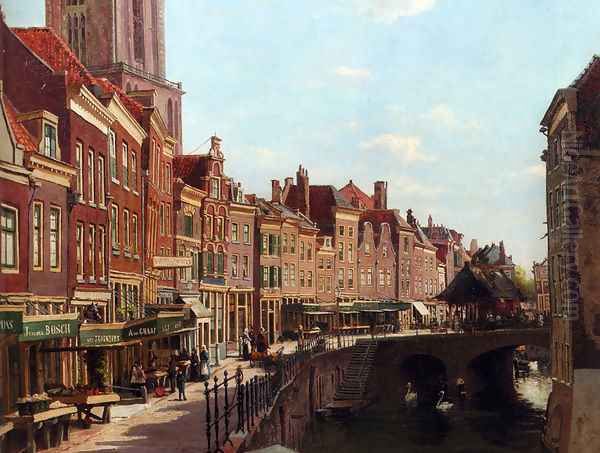
Willem Johannes Oppenoorth (1847-1905) was a Dutch artist who dedicated his career to capturing the quintessential beauty and tranquil charm of the Netherlands' landscapes. Active during the latter half of the 19th century and the dawn of the 20th, Oppenoorth's work reflects a deep appreciation for his native scenery, from its iconic windmills and waterways to its bustling village life. While perhaps not as globally renowned as some of his contemporaries from the Hague School, his contributions to Dutch landscape painting offer a valuable window into the artistic currents and visual culture of his time.
The Artist's Life and Times
Born in the Netherlands in 1847, Willem Johannes Oppenoorth emerged as an artist during a period of significant artistic evolution in Europe. The mid-to-late 19th century saw a shift away from the strictures of academic art towards more naturalistic and impressionistic approaches. In the Netherlands, this was particularly embodied by the Hague School, a movement characterized by its moody, atmospheric depictions of Dutch landscapes, coastal scenes, and rural life. While detailed records of Oppenoorth's formal training or specific mentors are not extensively documented in the provided information, his stylistic choices and subject matter place him firmly within this broader tradition of Dutch realism and plein-air inspired painting.
It is crucial to distinguish Willem Johannes Oppenoorth, the painter, from another Dutch individual with a similar name, Willem Frederik Oppenoorth. The latter was an archaeologist and anthropologist noted for his significant paleoanthropological discoveries in Java, Indonesia, particularly in the Solo River valley near Ngandong. Willem Johannes Oppenoorth, the artist, focused his endeavors within the Netherlands, drawing inspiration from its unique geography and cultural tapestry. His life, spanning from 1847 to 1905, coincided with a flourishing of Dutch art that sought to redefine national identity through depictions of its own environment.
Artistic Focus: The Dutch Landscape
The core of Willem Johannes Oppenoorth's oeuvre lies in landscape painting. He was particularly drawn to scenes that epitomized the Dutch countryside: tranquil canals reflecting the expansive skies, windmills standing as silent sentinels over flat polderlands, and the intimate charm of village life. His works often convey a sense of serenity and an appreciation for the everyday beauty of his surroundings. This focus was shared by many Dutch artists of his generation, who found endless inspiration in the interplay of light, water, and land that defines the Netherlands.
The Dutch landscape, with its low horizons and dominant skies, presented unique challenges and opportunities for painters. Artists like Oppenoorth learned to master the depiction of atmospheric effects – the soft haze of a summer morning, the dramatic cloud formations, or the gentle light of a setting sun. These elements were not mere backdrops but active components of the composition, imbuing the scenes with mood and emotion. Oppenoorth's dedication to these subjects suggests a kinship with painters who valued direct observation and a truthful representation of nature, albeit often filtered through a romantic or picturesque sensibility.
Signature Works and Stylistic Elements
Several works by Willem Johannes Oppenoorth provide insight into his artistic style and thematic preferences. "Langs de vaart" (Along the Canal), a piece measuring 39 x 59 cm, is a prime example. While the exact location is speculated to be near Bussum, the title itself evokes a classic Dutch scene. One can imagine a composition featuring a waterway, perhaps lined with trees or houses, under a characteristic Dutch sky. Such paintings often captured the slow pace of life along the canals, which were vital arteries for transport and commerce, as well as integral parts of the landscape. This particular painting was once part of the A.J. Muller Art Gallery collection, indicating its circulation within the art market of the time.
Another notable work is "Windmill in a polder landscape," a watercolor measuring 25 x 34 cm. The choice of watercolor, a medium that allows for delicate washes and luminous effects, is well-suited to capturing the often-misty atmosphere of the Dutch lowlands. Windmills are, of course, an iconic symbol of the Netherlands, historically crucial for land reclamation and water management. In art, they often represent a harmonious blend of human ingenuity and the natural environment. Oppenoorth's depiction would likely have emphasized the windmill's integration into the expansive polder – the reclaimed land below sea level – highlighting the unique character of this man-made yet profoundly natural-feeling landscape.
The painting titled "Townsfolk shopping along" suggests a foray into genre scenes, or landscapes animated by human activity. This work would likely depict a village or town street, perhaps with market stalls or shops, and figures engaged in daily errands. Such scenes allowed artists to explore not only the physical environment but also the social fabric of their communities. The inclusion of figures, often children, added a narrative element and a sense of life to the landscapes. This interest in portraying everyday life aligns with the broader Realist tendencies of 19th-century European art.
Oppenoorth's artistic period, the late 19th to early 20th century, was a time when artists were increasingly experimenting with light and color. While he may not have been a radical innovator, his work would have absorbed the prevailing interest in capturing the fleeting effects of light and atmosphere. His landscapes likely exhibit a careful attention to detail combined with an ability to convey the overall mood of a scene, whether it be the bustling energy of a village or the quiet solitude of a polder.
Recognition and Contemporaries
Willem Johannes Oppenoorth achieved a degree of recognition during his lifetime, as evidenced by several awards. He received a silver medal at the Scheveningen exhibition in 1890 and a bronze medal at an exhibition in Niza (likely Nice, France) in 1894. Furthermore, he was awarded an honorable mention at the prestigious Paris Exhibition in 1889. These accolades suggest that his work was appreciated by his peers and by exhibition juries, both domestically and internationally.
To fully understand Oppenoorth's place in Dutch art, it is helpful to consider him in the context of his contemporaries. The dominant force in Dutch landscape painting during much of his career was the Hague School. Key figures of this movement included Jacob Maris (1837-1899), known for his powerful townscapes and coastal scenes; his brother Willem Maris (1844-1910), celebrated for his depictions of cattle in sun-drenched meadows; and Anton Mauve (1838-1888), a cousin-in-law of Vincent van Gogh, famous for his gentle landscapes with sheep and rural laborers.
Other prominent Hague School artists were Hendrik Willem Mesdag (1831-1915), renowned for his dramatic seascapes, particularly his monumental Panorama Mesdag; Jozef Israëls (1824-1911), often called the "Dutch Millet" for his poignant portrayals of fisherfolk and peasant life, though he also painted landscapes; and Paul Gabriël (1828-1903), who excelled in capturing the bright, clear light of the Dutch polders and windmills, often with a more colorful palette than some of his moodier colleagues. Johannes Bosboom (1817-1891), though older, was also associated with the Hague School, primarily for his atmospheric church interiors.
While Oppenoorth's direct affiliation with the core Hague School group is not explicitly stated, his landscape focus and realistic style would have placed him in dialogue with their work. The artistic environment was rich, with many painters exploring similar themes. For instance, artists like Willem Roelofs (1822-1897), one of the precursors to the Hague School, had already paved the way for a renewed interest in realistic landscape painting.
The provided information also mentions that Oppenoorth's works appeared in auction contexts alongside those of other artists such as Simon Kamminga, Victor Dupré, and Anton Funke. While this doesn't necessarily imply direct collaboration, it indicates that they were part of a shared art market and perhaps moved in similar artistic circles. Victor Dupré, if this refers to the French Barbizon painter (brother of Jules Dupré), would represent an international connection, as the Barbizon School heavily influenced the Hague School. However, there might have been a lesser-known Dutch or contemporary Victor Dupré. Simon Kamminga and Anton Funke were likely Dutch contemporaries whose works also found an audience at the time.
Later in Oppenoorth's career, a younger generation, sometimes referred to as the Amsterdam Impressionists, came to prominence. Artists like George Hendrik Breitner (1857-1923) and Isaac Israëls (1865-1934), son of Jozef Israëls, focused more on urban life and adopted a bolder, more dynamic brushwork. While Oppenoorth's style seems more aligned with the Hague School's pastoralism, the evolving artistic landscape would have formed the backdrop to his later years. Another contemporary who specialized in tranquil Dutch scenes, often featuring water and boats, was Willem Bastiaan Tholen (1860-1931), whose work bridges the Hague School and a more personal form of impressionism.
Artistic Legacy
Willem Johannes Oppenoorth's legacy is that of a dedicated and skilled landscape painter who contributed to the rich tradition of Dutch art. His works, such as "Langs de vaart" and "Windmill in a polder landscape," serve as charming and evocative records of the Netherlands at the turn of the 20th century. They reflect a deep affection for his homeland and an artistic sensibility attuned to the subtle beauties of its characteristic scenery.
While he may not have achieved the same level of fame as the leading figures of the Hague School, his awards and the continued presence of his works in collections and auctions attest to his contemporary success and enduring appeal. Artists like Oppenoorth played a vital role in the broader artistic ecosystem, popularizing landscape painting and making art accessible to a wider audience. His paintings offer a glimpse into a world where the connection to the land and local environment was a profound source of artistic inspiration.
His choice of subjects – canals, windmills, rural life – resonates with a timeless vision of the Netherlands. These are not just picturesque motifs; they are elements deeply embedded in the Dutch identity and history. By depicting them with sensitivity and skill, Oppenoorth participated in the ongoing artistic conversation about what it meant to be Dutch and how the nation's unique character could be expressed through art.
Conclusion
Willem Johannes Oppenoorth (1847-1905) remains a noteworthy figure among the many talented Dutch painters of his era. His commitment to landscape painting, his ability to capture the specific atmosphere of the Dutch countryside, and his recognized talent, as evidenced by contemporary awards, secure his place in the annals of Dutch art history. His works continue to be appreciated for their honest and affectionate portrayal of a Netherlands that was, even then, undergoing transformation, yet retained its timeless charm. As we study his paintings, we are transported to the polders, canals, and villages he knew, seen through the eyes of an artist who found profound beauty in the familiar landscapes of his homeland. His art contributes to the rich visual heritage of the Netherlands, standing alongside the works of more famous contemporaries but offering its own distinct and valuable perspective.