Willem van den Bundel: A Dutch Master of Pastoral Landscapes in the Golden Age
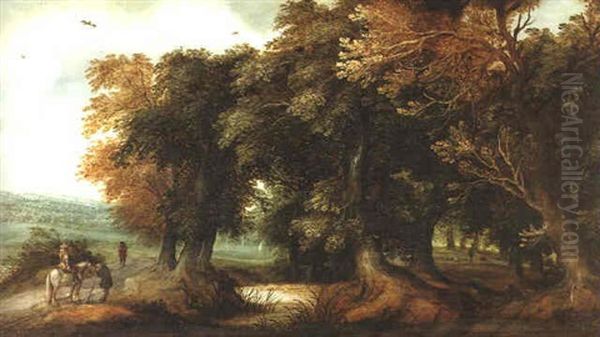
Willem van den Bundel (1577-1655) stands as a notable, if sometimes overlooked, figure in the rich tapestry of Dutch Golden Age painting. A contemporary of giants like Rembrandt and Vermeer, Van den Bundel carved his niche primarily as a painter of landscapes, often imbued with a serene, pastoral quality that resonated with the tastes of his time. His career spanned several key artistic centers in the Netherlands, including Amsterdam, Delft, and Leiden, and his work reflects both the prevailing artistic currents and his individual sensibilities.
Early Life and Artistic Beginnings in Amsterdam
Born in 1577, Willem van den Bundel's early life and artistic training are not extensively documented, a common reality for many artists of his era who did not achieve the towering fame of a select few. However, it is known that he was initially active in Amsterdam. This bustling metropolis was rapidly becoming the economic and cultural heart of the newly independent Dutch Republic. The city's burgeoning wealth, fueled by international trade, created a vibrant art market. Patrons from the prosperous merchant class were eager to adorn their homes with paintings, leading to a demand for various genres, including portraits, still lifes, genre scenes, and, significantly, landscapes.
In this dynamic environment, Van den Bundel would have been exposed to a multitude of artistic influences. The late 16th and early 17th centuries saw a transition from the more stylized, often allegorical landscapes of the Flemish tradition, exemplified by artists like Gillis van Coninxloo who had moved to Amsterdam, towards a more naturalistic depiction of the Dutch countryside. Artists were beginning to explore the unique beauty of their own flat, water-rich lands, with its distinctive light and atmosphere. It is within this evolving artistic milieu that Van den Bundel likely honed his skills. His connections with Amsterdam art dealers and collectors further suggest his integration into the city's art scene. He was known to associate with figures such as the painter and art dealer Barent van Someren and the influential pre-Rembrandtist painter Pieter Lastman, who himself would later become Rembrandt's teacher.
Relocation and Esteem in Delft and Leiden
At some point, Willem van den Bundel relocated from Amsterdam, spending significant periods in Delft and later Leiden. Delft, a city renowned for its pottery and its own thriving artistic community (which would later include Johannes Vermeer), provided a different, perhaps more intimate, setting than Amsterdam. It was in Delft that Van den Bundel became a member of the Guild of St. Luke in 1623. The Guilds of St. Luke were crucial institutions in the Low Countries, regulating the art trade, providing training, and fostering a sense of community among artists and craftsmen.
His involvement with the guild was substantial; records indicate he served as its headman (hoofdman) between 1634 and 1639. This leadership role underscores the respect and professional standing he had achieved among his peers in Delft. His reputation was not confined to Delft; he was also highly regarded in Leiden, another prominent university city with a rich cultural life. Even in his later years in Leiden, his work continued to be esteemed. This consistent recognition across different cities speaks to the quality and appeal of his art.
Artistic Style: The Pastoral Ideal and Natural Observation
Willem van den Bundel is primarily celebrated for his landscape paintings, which often exhibit a strong pastoral influence. The pastoral tradition, with its roots in classical literature and art, idealized rural life and landscapes, often depicting shepherds, idyllic scenery, and a harmonious relationship between humans and nature. This style was particularly popular in the Netherlands during the 17th century, offering an escape from the bustling city life and a romanticized vision of the countryside.
Van den Bundel's landscapes are characterized by their careful attention to the effects of light and color, creating serene and atmospheric scenes. He demonstrated a keen understanding of natural forms, rendering trees, water, and skies with a sensitivity that brought his compositions to life. While the pastoral mode often involved a degree of idealization, his work also shows an engagement with the specific qualities of the Dutch landscape. His ability to capture the subtle nuances of the local environment, combined with the prevailing taste for idyllic scenes, contributed to his success. Beyond pure landscapes, his oeuvre also included works with figures, and some sources suggest he tackled religious and mythological subjects, as well as themes drawn from Renaissance and bucolic literature, indicating a versatile artistic range.
Notable Works and Attributions
Pinpointing a definitive list of Willem van den Bundel's works presents some challenges, as is common for many artists of his period whose output might not have been as systematically cataloged as that of more famous contemporaries. However, art historical research and inventory records provide insights into his creations. It is believed that at least nine of his works are known, and they have appeared in various historical inventories.
One such documented piece is titled "Een groot lantschaft van Willem van den Bundel" (A large landscape by Willem van den Bundel). This painting was listed in the 1650 inventory of the estate of Willem Jansz Sloting, who passed away that year. The mention of a "large landscape" suggests he was capable of working on a significant scale, a format often favored for prominent display.
Another work often associated with him, or at least his immediate artistic environment, is "Circle of Willem van den Bundel." This painting, an oil on panel measuring 40.3 x 58.2 cm, depicts elegant figures conversing by a river, with a bridge visible in the distance. The term "Circle of" typically indicates a work by an artist closely associated with, or heavily influenced by, the named master, or a piece in their distinct style whose precise authorship is uncertain. The date range sometimes given for this work, 1575-1655, corresponds to Van den Bundel's lifespan, further linking it to his period of activity. Such compositions, featuring leisurely figures in a picturesque landscape, align well with the pastoral themes he favored.
The relative scarcity of definitively attributed surviving works makes each documented piece or strong attribution all the more important for understanding his artistic contribution. His paintings were clearly valued during his lifetime and in the decades following, as evidenced by their inclusion in collections and inventories.
Professional Standing and the Caravaggio Authentications
A fascinating aspect of Willem van den Bundel's career is his involvement in the authentication of works purported to be by the Italian Baroque master Michelangelo Merisi da Caravaggio. This participation speaks volumes about Van den Bundel's connoisseurship and his respected position within the Dutch art world. Caravaggio's dramatic realism and use of chiaroscuro had a profound impact across Europe, and his works were highly sought after, leading to copies and disputed attributions.
In November 1619, Van den Bundel, alongside prominent artists like Barent van Someren, Pieter Lastman, Adriaen van Nieulandt, and Louis du Pretes, was involved in certifying the authenticity of a "Crucifixion of St. Andrew" as a genuine Caravaggio. This painting was acquired by the Amsterdam art dealer Pieter de Wit and subsequently sold to Franz Segher in Antwerp.
Again, on November 19, 1621, Van den Bundel, along with fellow painters Hans Freres Mollensiege and Lambert Willemszing, was called upon to testify regarding the authenticity of another painting attributed to Caravaggio. This involvement in expert opinion suggests that Van den Bundel possessed a discerning eye and a reputation for artistic judgment that extended beyond his own creative output. It also highlights the active art market in Amsterdam and the Netherlands, where issues of attribution and value were of considerable importance. These events place him in the company of significant artistic figures of his day, engaged in critical discussions at the heart of the art trade. His connections also extended to other Amsterdam artists like Pieter van der Voort.
The Context of the Dutch Golden Age
Willem van den Bundel's career unfolded during the Dutch Golden Age, a period of unprecedented prosperity, cultural efflorescence, and artistic innovation in the Netherlands. The Eighty Years' War, which led to the de facto independence of the Dutch Republic, fostered a strong sense of national identity. This, combined with maritime trade and economic strength, created a unique environment for the arts.
Unlike in Catholic countries where the church was a primary patron, or in monarchies where the court dominated artistic commissions, the Dutch art market was largely driven by a wealthy bourgeoisie. This new class of patrons favored subjects that reflected their lives, values, and surroundings: portraits, scenes of daily life (genre paintings), still lifes, seascapes, and, crucially, landscapes. Dutch artists responded by specializing in these genres, achieving remarkable levels of realism and technical skill.
Landscape painting, in particular, flourished. Artists like Esaias van de Velde, Jan van Goyen, and Salomon van Ruysdael pioneered the "tonal" landscape style, characterized by a limited palette and a focus on atmospheric effects. Later, Jacob van Ruisdael would introduce more dramatic and monumental landscapes. While Van den Bundel's pastoral style had its own distinct qualities, it was part of this broader enthusiasm for depicting the natural world, both real and idealized. His work contributed to the diverse spectrum of landscape art that defined the Golden Age, alongside other notable landscape painters such as Aelbert Cuyp, known for his Italianate light, and the highly individualistic Hercules Segers.
Collaborations and Connections
The art world of the Dutch Golden Age was often collaborative and interconnected. While specific details of Van den Bundel's direct painting collaborations are not extensively recorded, his professional life was certainly marked by interactions with other artists. His involvement in the Guild of St. Luke in Delft inherently placed him in a network of fellow painters, sculptors, and craftsmen.
One documented association is with Aernout Elsevier, who was not only a painter but also an innkeeper. Works by both Van den Bundel and Elsevier were mentioned in the inventory of Simon van Swieten, a Leiden collector. Such mentions in contemporary inventories help art historians reconstruct the networks of artists and collectors and understand how works were disseminated and valued. The art market was a complex ecosystem of creators, dealers, experts, and buyers, and Van den Bundel was an active participant in this system. His role in authenticating paintings, as discussed earlier, further illustrates his engagement with the broader artistic community and its commercial aspects.
Legacy and Influence
While Willem van den Bundel may not be as widely known today as some of his contemporaries like Rembrandt van Rijn or Johannes Vermeer, his artistic legacy is nonetheless significant within the context of Dutch Golden Age landscape painting. His adherence to the pastoral style, combined with his skill in rendering light and atmosphere, contributed to the popularity of this genre.
His influence can be seen in the work of later artists. For instance, the Dutch painter Pieter van der Asch (1603–1678), who was also active in Delft, is noted to have been influenced by Van den Bundel in his early landscape paintings. This transmission of style and technique is a common feature of artistic development, where younger artists learn from and respond to the work of established masters.
The survival of his works, albeit limited in number, and their mention in historical inventories and auction records, attest to their value and appeal during his lifetime and beyond. His participation in significant art authentications further solidifies his status as a respected expert. Willem van den Bundel represents a vital strand in the rich fabric of 17th-century Dutch art – the dedicated landscape specialist who, through his pastoral visions and skilled execution, captured an idealized beauty that resonated with his society and left an imprint on the artistic traditions of his era. His paintings offer a window into the aesthetic preferences of the Dutch Golden Age and stand as a testament to his enduring, if quiet, contribution to art history.