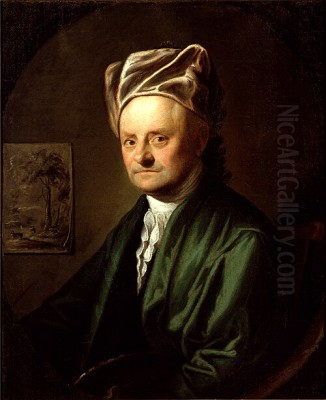
William Williams (1727-1791) stands as a fascinating, if once somewhat overlooked, figure in the annals of eighteenth-century art, a man whose life and work bridged the cultural landscapes of Georgian England and colonial America. Born in Bristol, England, Williams was not merely a painter but also an adventurer, a writer, and a teacher, embodying a spirit of versatility characteristic of his era. His journey took him from the bustling ports of his homeland across the Atlantic, where he spent three decades primarily in Philadelphia and New York, leaving an indelible mark on the nascent American art scene before returning to London for his final years. His story is one of resilience, artistic development, and multifaceted talent, contributing to both the visual and literary culture of his time.
Early Life and Maritime Adventures
William Williams was born into a world of maritime enterprise and burgeoning colonial expansion. Baptized on June 14, 1727, at St. Augustine's Church in Bristol, he was the son of William Williams and Elizabeth Williams. Bristol, at that time, was a major English port, second only to London, its quays alive with ships bound for the Americas, Africa, and the West Indies. This environment undoubtedly shaped young Williams's worldview, exposing him to tales of distant lands and the allure of the sea.
Details of his early education are somewhat scarce, but it is understood that he completed a standard secondary education for the time. However, economic circumstances, possibly family poverty as suggested by some accounts, compelled him to seek a life at sea. This was not an uncommon path for young men of limited means in port cities. His maritime career led him to the Caribbean, a region then central to European colonial interests and a crucible of cultural exchange and conflict. These voyages were fraught with peril; accounts suggest he experienced significant adventures, including the harrowing ordeal of a shipwreck. Such experiences, while challenging, would have provided a rich tapestry of human drama, exotic locales, and the raw power of nature—elements that would later subtly infuse his artistic and literary creations.
The life of a sailor in the eighteenth century was arduous and often brutal, but it also offered a unique perspective on the world. The discipline, the constant confrontation with the elements, and the exposure to diverse cultures and landscapes would have been formative. It is during this period, or perhaps shortly thereafter, that Williams began to cultivate his artistic inclinations, transitioning from the life of a mariner to that of an artist.
Arrival in America and Artistic Beginnings
Around the mid-1740s, or perhaps a little later, William Williams made the significant decision to settle in the American colonies. He arrived in Philadelphia by 1747, a city rapidly becoming the cultural and commercial heart of British North America. Philadelphia, under the influence of figures like Benjamin Franklin, was a hub of intellectual ferment and artistic aspiration. It was here that Williams truly began to establish himself as a professional artist.
In Philadelphia, Williams engaged in a variety of artistic pursuits. He advertised his services as a painter of portraits, landscapes, and decorative works. He also became involved in the burgeoning theatrical scene, contributing to the design and construction of the Southwark Theatre, one of the first permanent theatre buildings in America. This involvement speaks to his versatility and his engagement with the broader cultural life of the city. He also worked as a teacher, offering instruction in drawing and painting, a role that would prove to be of particular significance.
His time in the colonies was not confined to Philadelphia. He also spent periods in New York, another important colonial center, further expanding his network of patrons and his influence. For approximately thirty years, Williams was an active participant in the artistic life of these colonial cities, contributing to the development of a distinct, albeit still British-influenced, American visual culture. His experiences as a mariner likely lent a unique perspective to his work, perhaps a certain robustness or an eye for the dramatic that distinguished him from more formally trained European artists.
Artistic Style and Influences
William Williams's artistic style is generally characterized as being within the Rococo tradition, a style that flourished in Europe during the 18th century, known for its elegance, ornate decoration, and often light-hearted or sentimental subject matter. However, Williams's interpretation of Rococo was filtered through his own experiences and the specific demands of his colonial clientele. His work often exhibits a strong sense of drama, an appreciation for atmospheric effects, and a directness in portraiture that appealed to the pragmatic sensibilities of American patrons.
His portraits, such as the notable 1766 depiction of Deborah Hall, showcase a Rococo charm in the sitter's pose and attire, yet there is also a clarity and solidity that grounds the image. He was adept at capturing a likeness while also imbuing his subjects with a sense of dignity and presence. The inclusion of symbolic elements, as seen in the broken squirrel chain in Deborah Hall (perhaps symbolizing virtue or a controlled nature), adds layers of meaning typical of the period's portraiture conventions.
In his more imaginative works, such as landscapes or historical scenes, Williams could unleash a more theatrical and dramatic flair. His painting Amelia Struck by Lightning (1763), for instance, is a powerful composition that uses strong chiaroscuro (contrasts of light and dark) and dynamic figures to convey the terror and sublimity of the event. This piece, in particular, hints at the burgeoning Romantic sensibilities that would come to dominate art in the later part of the century and the early nineteenth century, showing an interest in the power of nature and heightened emotional states.
Williams's influences would have been diverse. As a British-born artist, he would have been aware of the prevailing trends in London, looking to the work of prominent British portraitists like Thomas Hudson or the early works of Thomas Gainsborough and Joshua Reynolds. In America, he was part of a generation of artists, many of them immigrants like himself, such as John Wollaston and Joseph Blackburn, who were collectively shaping the visual language of the colonies. He also would have encountered the work of earlier colonial painters like John Smibert and Robert Feke, who had already established traditions of portraiture in New England and the Mid-Atlantic.
Key Works: A Visual and Literary Legacy
William Williams left behind a body of work that, while not vast in quantity compared to some of his contemporaries, is significant for its quality and its insight into colonial American life and artistic tastes.
Portrait of Deborah Hall (1766): This is perhaps his most famous and frequently reproduced painting. Housed in the Brooklyn Museum, the portrait depicts the daughter of the prominent Philadelphia printer David Hall, who was Benjamin Franklin's partner. Deborah is shown in an elegant blue dress, her gaze direct and intelligent. The aforementioned broken squirrel chain, the squirrel itself (a popular pet), and the lush, somewhat idealized landscape background are all characteristic of mid-18th-century portraiture. The painting is celebrated for its refined execution, delicate color palette, and the charming, yet dignified, portrayal of its subject. It is considered a prime example of American Rococo portraiture.
William and David Hall (1766): Also from the same year, this double portrait (likely of Deborah's brothers or other male relatives of the Hall family) further demonstrates Williams's skill in capturing individual likenesses and conveying social status. Such family portraits were important commissions, reflecting the growing prosperity and self-awareness of the colonial elite. These works often served not just as personal mementos but also as statements of lineage and achievement.
Amelia Struck by Lightning (1763): This dramatic subject painting, sometimes titled A Scene from Thomson's "Seasons", illustrates Williams's capacity for narrative and emotional intensity. The scene, depicting a young woman struck by lightning while her distraught lover looks on, is rendered with a theatricality that sets it apart from his more conventional portraits. The turbulent sky, the contorted figures, and the stark lighting create a powerful and unsettling image, showcasing a different facet of Williams's artistic range and his engagement with literary themes, possibly inspired by James Thomson's popular poem "The Seasons."
Self-Portrait (c. 1750-1760): While the attribution of some self-portraits can be debated, images believed to be of Williams himself offer a glimpse into how the artist saw himself or wished to be seen. These often depict a man of thoughtful and perhaps adventurous character, consistent with his known biography.
The Journal of Llewellin Penrose, a Seaman: Beyond his visual art, Williams is also credited with a significant literary work. The Journal of Llewellin Penrose, a Seaman (often referred to as Mr. Penrose) is a novel or fictionalized memoir that recounts the adventures of a Welsh sailor cast away on the coast of Central America who lives among indigenous people. The manuscript, though likely written during Williams's lifetime, was not published until 1815, long after his death, and then in a revised form. It is considered an important early example of American or Anglo-American adventure narrative, predating many more famous works in the genre. The novel draws on Williams's own maritime experiences and reflects an interest in exotic settings and cross-cultural encounters, themes that were gaining popularity in the literature of the period. Its vivid descriptions and Robinson Crusoe-like plot contribute to its status as a pioneering work.
These key works, both visual and literary, underscore Williams's diverse talents and his contribution to the cultural fabric of the 18th-century Atlantic world.
Mentorship and Connections: Nurturing Talent
One of William Williams's most lasting contributions to American art history was his role as a mentor, particularly to the young Benjamin West. West, who would later become a towering figure in British art as the historical painter to King George III and the second president of the Royal Academy, received some of his earliest artistic encouragement and instruction from Williams in Philadelphia.
According to accounts, Williams encountered the young West, who was already showing a prodigious natural talent for drawing, and recognized his potential. Williams is said to have lent West books on art theory and technique, such as Richardson's Essay on the Theory of Painting, and provided him with practical advice and materials. This early guidance was crucial in setting West on his path to becoming a professional artist. West himself later acknowledged Williams's kindness and formative influence. This act of mentorship is significant because it connects Williams directly to the lineage of American artists who would go on to achieve international fame, effectively making him a foundational figure in the development of American painting.
Beyond Benjamin West, Williams operated within a network of other artists active in the colonies. He was a contemporary of John Singleton Copley, arguably the most talented American-born painter of the colonial era, though Copley was based primarily in Boston. While direct competition or collaboration between Williams and Copley is not extensively documented, they were part of the same small, interconnected art world. Other painters active during Williams's time in America included the aforementioned John Wollaston, an English drapery painter whose elegant, somewhat formulaic portraits were popular; Joseph Blackburn, another British artist known for his sophisticated Rococo style; and Charles Willson Peale, a younger artist who would become a major figure in post-Revolutionary American art, known for his portraits of founding fathers and his establishment of one of America's first museums.
In England, the art scene was dominated by figures like William Hogarth, whose narrative and satirical works had a profound impact; Thomas Hudson, a leading portraitist and master to Joshua Reynolds; Allan Ramsay, a Scottish portrait painter favored by royalty; and, increasingly, Sir Joshua Reynolds himself, who, along with Thomas Gainsborough, would define British painting in the latter half of the 18th century. While Williams was in America, these artists were shaping the tastes and standards of the London art world, a world to which Benjamin West, and later other American artists like Gilbert Stuart and John Trumbull, would gravitate. Williams's connection to West thus provides a link, however indirect, to this vibrant metropolitan center. His own artistic practice, while adapted to colonial tastes, would have been informed by the broader trends emanating from London.
Literary Pursuits: The Pen of a Seafaring Artist
William Williams's authorship of The Journal of Llewellin Penrose, a Seaman solidifies his position as a man of diverse creative talents. This work, a lengthy narrative of maritime adventure, shipwreck, and survival among indigenous communities in an unnamed part of Central America, is a remarkable piece of early modern fiction. Its protagonist, Llewellin Penrose, is a Welshman, which may reflect Williams's own heritage or simply a common trope of the "exotic" or "peripheral" Briton embarking on global adventures.
The novel is characterized by its detailed descriptions of the natural world, the customs of the native peoples Penrose encounters, and the psychological struggles of a man isolated from his own culture. It shares thematic similarities with Daniel Defoe's Robinson Crusoe (1719), which had established a popular genre of castaway narratives. However, Penrose offers its own unique perspective, perhaps colored by Williams's personal experiences at sea and his encounters in the Caribbean. The manuscript is said to have been composed over many years, reflecting a sustained literary effort.
The journey of the manuscript itself is a story. It remained unpublished during Williams's lifetime. After his death, it eventually found its way into the hands of Benjamin West, his former pupil. West, recognizing its merit, may have facilitated its eventual publication in 1815 by John Murray in London, albeit in an edited version prepared by Thomas Eagles. The novel's delayed appearance meant it entered a literary landscape already populated by more developed forms of the novel, yet it retains historical importance as an early example of the genre with strong American connections, given Williams's long residence there.
Literary scholars have noted its ethnographic interest, its exploration of themes of solitude and adaptation, and its contribution to the "noble savage" trope, though it also presents a more nuanced view of indigenous life than some contemporary accounts. The very existence of Penrose highlights the often-blurred lines between different forms of creative expression in the 18th century, where an artist might also be a writer, a scientist, or an inventor. For Williams, the narrative impulse found an outlet not only in his dramatic paintings but also in the written word, enriching our understanding of his imaginative world.
Return to England and Later Years
In 1776, a year marked by the American Declaration of Independence and the formal outbreak of the Revolutionary War, William Williams made the decision to return to England. The reasons for his departure from America at such a pivotal moment are not entirely clear. It could have been due to loyalist sympathies, a desire to escape the turmoil of war, or perhaps personal reasons related to age or family. Whatever the cause, he left behind the colonies where he had spent a significant portion of his adult life and artistic career.
Upon his return, he settled in London, the bustling metropolis that was the undisputed center of the British art world. He continued to practice as an artist, though perhaps with less prominence than he had enjoyed in the less crowded artistic field of colonial America. He exhibited works at the Royal Academy, which had been co-founded by his former pupil Benjamin West. This suggests he maintained connections within the London art community and sought to continue his professional career.
His final years were spent in London, and he passed away in 1791. He was buried in Bristol, his city of birth, bringing his life's journey full circle. A poignant detail from his posthumous history is that his tombstone in Bristol was reportedly damaged during the bombing raids of World War II, a reminder of the fragility of historical legacies. Despite this, surviving fragments and records ensure his memory endures.
Legacy and Historical Reassessment
For a considerable time after his death, William Williams remained a somewhat enigmatic figure in art history. The limited number of securely attributed works, the dispersal of his paintings, and the overshadowing fame of contemporaries like Copley and West contributed to a period of relative obscurity. His literary work, Penrose, also took time to gain recognition, published as it was under an editor's hand and long after its composition.
However, in more recent decades, art historians and literary scholars have undertaken a reassessment of Williams's contributions. Detailed research, including technical analysis of his paintings, has shed more light on his techniques, materials, and artistic development. Exhibitions featuring colonial art have increasingly included his work, allowing for a broader appreciation of his skill and his place within the context of early American art.
His role as Benjamin West's first significant teacher is now widely acknowledged as a crucial contribution to the development of American art. By nurturing West's talent, Williams played a part in launching a career that would see an American artist rise to the highest echelons of the British art establishment, paving the way for future generations of American artists to seek training and recognition in Europe.
Furthermore, Williams is recognized for his versatility. The fact that he was not only a painter of portraits and landscapes but also a scene painter, a writer, and an adventurer adds depth to his persona. He exemplifies the resourceful and multifaceted individual common in the 18th century, particularly in the dynamic environment of the American colonies. His works, like the portrait of Deborah Hall, are now seen as key examples of the Rococo style in America, demonstrating how European artistic trends were adapted and transformed in a New World context.
His novel, The Journal of Llewellin Penrose, is studied as an important early American narrative, offering insights into maritime life, cross-cultural encounters, and the imaginative landscape of the 18th-century Atlantic world. It contributes to a broader understanding of the literary culture that existed alongside the visual arts in colonial America and Georgian Britain.
Conclusion: A Multifaceted Figure in Atlantic Culture
William Williams of Bristol (1727-1791) emerges from the shadows of history as a compelling and multifaceted figure. His life, spanning the maritime world, the burgeoning cities of colonial America, and the artistic circles of London, was one of constant movement and adaptation. As a painter, he brought a Rococo sensibility to the American colonies, creating portraits that captured the likeness and aspirations of his sitters, and dramatic compositions that revealed his imaginative flair. His mentorship of Benjamin West alone secures him a significant place in the narrative of American art.
Beyond the canvas, his literary creation, The Journal of Llewellin Penrose, demonstrates a rich inner life and a talent for storytelling that complements his visual artistry. He was a man of his time, an adventurer whose experiences on the high seas undoubtedly informed his creative output, lending it a certain robustness and worldly perspective.
While he may not have achieved the lasting fame of some of his contemporaries during his lifetime or in the immediate centuries that followed, the ongoing work of scholars has rightfully restored William Williams to a position of importance. He is a vital link in understanding the transmission of artistic styles across the Atlantic, the development of a distinct colonial American culture, and the interconnectedness of the Anglo-American world in the 18th century. His legacy is that of a skilled artist, an influential teacher, and a pioneering writer, a testament to a life lived with creative vigor on both sides of the ocean.