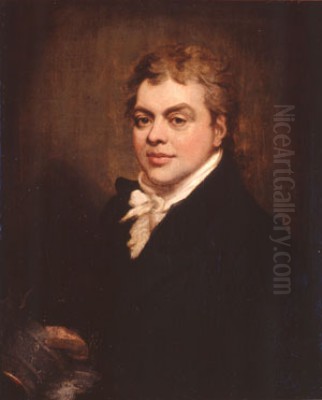
Mather Brown (1761-1831) stands as a fascinating, if somewhat enigmatic, figure in the transatlantic art world of the late eighteenth and early nineteenth centuries. An American by birth, he sought and found a career in London, the bustling artistic and cultural hub of the British Empire. His journey reflects the ambitions of many colonial artists who looked to the mother country for training, patronage, and recognition. Brown specialized in portraiture and historical painting, navigating the competitive London art scene with periods of notable success and frustrating setbacks. His legacy, though overshadowed for a time, offers valuable insights into the artistic exchanges and cultural dynamics of his era.
Early Life and Artistic Awakening in Boston
Born on October 11, 1761, in Boston, Massachusetts, Mather Brown hailed from a family of considerable colonial distinction. His mother, Elizabeth Byles Brown, was a descendant of the prominent New England Puritan clergymen Increase Mather and Cotton Mather, figures of immense religious and intellectual influence in early American history. His father was the whale-oil merchant Gawen Brown. Following his mother's early death, Mather and his sister Catherine were raised by their maternal aunts, who, interestingly, remained staunch Loyalists, supportive of King George III even as revolutionary sentiments grew in the colonies.
This Loyalist upbringing may have subtly influenced Brown's later decision to establish his career in England. His initial artistic inclinations leaned towards miniature painting, a popular and portable form of portraiture in the colonies. Around 1773, the young Brown received some early instruction from the budding American artist Gilbert Stuart, who would himself go on to achieve great fame as a portraitist, particularly for his iconic images of George Washington. This early encounter with a painter of Stuart's caliber, however brief, likely provided Brown with foundational skills and a glimpse into the life of a professional artist.
The Journey to London and the Influence of Benjamin West
The American Revolution (1775-1783) created a complex environment for individuals with Loyalist sympathies or those simply seeking broader artistic opportunities. In 1781, at the age of twenty, Mather Brown made the pivotal decision to leave America for London. This was a common path for ambitious American artists, including his future mentor, Benjamin West, and John Singleton Copley, who had already established themselves successfully in the British capital. Brown's arrival in London marked the true beginning of his professional artistic journey.
Armed with letters of introduction, possibly including one from Benjamin Franklin (who, despite his revolutionary role, often assisted young Americans abroad), Brown soon came under the tutelage of Benjamin West. West, an American expatriate from Pennsylvania, had achieved remarkable success in London, becoming Historical Painter to King George III and a co-founder and later President of the Royal Academy of Arts. West's studio was a veritable hub for aspiring artists, particularly those from America, including John Trumbull, Gilbert Stuart (who had also relocated to London), and Charles Willson Peale (though Peale's London study predated Brown's arrival). West's guidance was invaluable, providing Brown with technical training, access to influential circles, and an immersion in the prevailing neoclassical and emerging Romantic artistic trends. In 1782, Brown formally enrolled in the Royal Academy Schools, further honing his skills and preparing to launch his career.
Ascendancy in Portraiture
While Brown harbored ambitions for history painting, the most prestigious genre of the time, portraiture offered a more reliable path to financial stability and recognition in London. He quickly began to make a name for himself. His American connections proved useful; in 1785, he painted a portrait of John Adams, then the American minister to Great Britain, and in 1786, he painted Adams's wife, Abigail. A particularly significant commission came from Thomas Jefferson, Adams's successor as American minister in Paris, who sat for Brown in London in 1786. This portrait of Jefferson is one of the earliest known likenesses of the future president.
Brown's skill in capturing a likeness and conveying a sense of dignity and character attracted a distinguished clientele. He was appointed as Painter to His Royal Highness the Duke of York and Albany (Prince Frederick Augustus, second son of King George III). He painted full-length portraits of the Duke of York and the Prince of Wales (later King George IV), further cementing his status. His portraits from this period exhibit a competent, if not always groundbreaking, style, aligning with the fashionable portraiture of the day, influenced by masters like Sir Joshua Reynolds and Thomas Gainsborough, though perhaps lacking their distinctive flair. He competed for commissions with a host of talented portraitists, including George Romney, John Hoppner, and the rapidly rising Sir Thomas Lawrence.
Ventures into History Painting
Like many artists of his generation, Mather Brown aspired to success in history painting, which was considered the noblest form of art, demanding intellectual depth, compositional skill, and the ability to depict grand narratives from mythology, scripture, or history. Benjamin West was a leading proponent and practitioner of this genre, and Brown undoubtedly absorbed this ambition.
In 1784, Brown exhibited two religious paintings, reportedly an "Annunciation to the Shepherds" and a "Baptism of St. John," and collaborated with the engraver Daniel Orme to produce and sell prints of these and other works, a common practice for artists to disseminate their images and generate income. He also turned to scenes from British history and literature, particularly Shakespeare. During the 1780s, there was a surge in interest in illustrating Shakespeare, exemplified by John Boydell's famous Shakespeare Gallery project, for which artists like Henry Fuseli, James Northcote, and John Opie produced dramatic canvases. Brown contributed to this trend, creating paintings for John Bell's edition of Shakespeare's plays, including scenes from Richard III. These historical and literary works allowed Brown to showcase his compositional abilities and his capacity for dramatic expression, often reflecting the grand manner style popularized by West.
The Royal Academy and Professional Hurdles
The Royal Academy of Arts, founded in 1768 with Sir Joshua Reynolds as its first president, was the dominant artistic institution in Britain. Membership in the Academy, as an Associate (ARA) or a full Royal Academician (RA), conferred prestige and provided significant exhibition opportunities. Brown regularly exhibited at the Royal Academy from 1782 until his death, showing a total of over eighty works.
Despite his royal patronage and a steady stream of portrait commissions, Mather Brown faced a significant professional disappointment: his repeated failure to be elected to the Royal Academy. He applied for associate membership at least three times, in 1791, 1792, and again later, but was unsuccessful on each occasion. The reasons for these rejections are not entirely clear but could have stemmed from a variety of factors, including the intense competition from other talented artists, shifting artistic tastes, or perhaps even personal politics within the Academy. Artists like Angelica Kauffman and Mary Moser were among the few female founding members, while others like Richard Cosway, known for miniatures, and the aforementioned John Hoppner and Thomas Lawrence, were his successful contemporaries in portraiture. This lack of formal academic recognition was undoubtedly a blow to Brown's aspirations and may have contributed to the later decline in his career.
Artistic Style and Characteristics
Mather Brown's artistic style evolved over his career but generally remained within the broad currents of late eighteenth-century British art, which blended Neoclassicism with emerging Romantic tendencies. His early training in miniature painting may have contributed to a certain precision in his larger portraits.
In his portraiture, Brown demonstrated a solid ability to capture a sitter's likeness and convey their social standing through pose, costume, and setting. His brushwork was generally smooth and controlled, typical of the academic standards of the time. His compositions were often conventional but effective, aiming for a sense of decorum and psychological presence. Compared to the bravura of Reynolds or the feathery elegance of Gainsborough, Brown's portraits could sometimes appear more straightforward, yet they possess a sincerity and directness.
His history paintings, influenced by West, aimed for narrative clarity and dramatic impact. He employed dynamic compositions and expressive figures to convey the emotional weight of his chosen scenes, whether from the Bible, British history, or Shakespearean drama. These works often featured rich colors and a strong use of chiaroscuro to heighten the theatricality. While he may not have reached the imaginative heights of a visionary like William Blake or the dramatic intensity of Henry Fuseli, Brown's historical pieces were competent contributions to a popular genre. The claim found in some aggregated sources about him using blue for shadows and red for highlights is highly atypical for his period and likely a misattribution or misunderstanding; standard academic practice involved building up shadows with darker tones of the local color or neutral browns and grays.
Later Career, Financial Struggles, and Final Years
By the early nineteenth century, Mather Brown's career began to face challenges. The artistic landscape was changing, with new talents like Sir Thomas Lawrence dominating the portrait market. Brown's style, perhaps perceived as somewhat dated, struggled to compete. It has also been suggested that his eyesight began to decline, which would have been a severe impediment for a painter.
Commissions became scarcer, and Brown experienced increasing financial difficulties. In 1808, he left London, perhaps seeking new opportunities or a lower cost of living, and moved to Manchester. He later spent time in Liverpool and other provincial towns, continuing to paint but without regaining his earlier prominence. He reportedly taught drawing and continued to seek portrait work.
He returned to London around 1824, but his final years were marked by poverty and obscurity. He continued to exhibit sporadically at the Royal Academy, but his former successes were largely forgotten by the broader public. Mather Brown died in London on May 25, 1831, in relative poverty, a poignant end for an artist who had once painted royalty and leading statesmen. He was buried in the churchyard of St. John's Wood Chapel.
Legacy and Rediscovery
For many decades after his death, Mather Brown remained a relatively obscure figure in art history, overshadowed by more celebrated contemporaries. However, in the twentieth century, art historians, particularly those studying American art and the transatlantic connections of the period, began to re-evaluate his contributions. His portraits of key American figures like John Adams and Thomas Jefferson are of undeniable historical importance, providing valuable visual records of these founding fathers.
His career exemplifies the experiences of many artists who navigated the complex art worlds of America and Britain during a period of profound political and cultural transformation. He was part of a significant wave of American artists, including West, Copley, Stuart, and Trumbull, who sought training and patronage in London, contributing to the richness of British art while also laying the foundations for a distinct American artistic tradition.
While Mather Brown may not have achieved the lasting fame of some of his peers, his body of work provides a window into the artistic tastes and patronage systems of Georgian England. His portraits capture the likenesses of individuals who shaped history, and his historical paintings reflect the cultural preoccupations of his time. His life story, with its early successes and later struggles, underscores the often-precarious nature of an artistic career, even for those with considerable talent and initial advantages. Today, his paintings can be found in major collections in both the United States and the United Kingdom, ensuring that his contributions to the art of his era are recognized and studied. His connection to the Mather dynasty also adds a layer of historical interest, linking him to the intellectual and religious foundations of early America, even as he pursued his artistic destiny in the heart of the British Empire.