Willy Tiedjen, a notable figure in early 20th-century German art, carved a distinct path as a painter of landscapes, marine scenes, and animal subjects. Born in an era of significant artistic transition, Tiedjen's work reflects both the enduring traditions of Realism and Naturalism and the subtle influences of contemporary movements. His dedication to his craft, evident in his meticulous technique and evocative portrayals, offers a valuable window into the artistic currents of his time.
Early Life and Artistic Awakening in Hamburg
Willy Carl Tiedjen was born on February 22, 1881, in the bustling port city of Hamburg, Germany. This maritime environment, with its constant interplay of ships, water, and atmospheric conditions, likely provided early, formative impressions for the future marine painter. Hamburg, a city proud of its mercantile and cultural heritage, offered a stimulating backdrop for a young, aspiring artist.
His formal artistic education commenced at the local Kunstgewerbeschule, Hamburg's renowned School of Artistic Crafts. These institutions, common throughout Germany, aimed to provide a solid grounding in drawing, design, and various craft techniques, often with an emphasis on practical application. Here, Tiedjen would have honed his foundational skills, learning the principles of composition, perspective, and color theory, which would serve him throughout his career. The curriculum would have exposed him to a range of artistic disciplines, fostering a versatile approach to visual expression.
Broadening Horizons: Berlin and Munich
Seeking to further refine his talents, Tiedjen moved to the imperial capital, Berlin, to study at the prestigious Berlin Art Academy from 1901 to 1903. The Berlin Academy was a bastion of academic tradition, but also a place where new ideas were beginning to challenge established norms. Exposure to the vibrant Berlin art scene, with its established masters and emerging avant-garde, would have broadened his artistic perspectives considerably.
Following his studies in Berlin, Tiedjen returned to Hamburg, where he continued his education at the Hamburg Art School from 1903 to 1906. This period likely allowed him to consolidate his learning and perhaps begin to define his individual artistic voice, drawing upon the diverse influences he had encountered.
A pivotal moment in Tiedjen's development came with his move to Munich, a city then rivaling Paris as a European art capital. He enrolled in the academy led by Heinrich von Zügel (1850-1941), one of Germany's foremost animal painters. Zügel was celebrated for his Impressionistic, plein-air depictions of livestock and rural scenes, characterized by dynamic brushwork and a keen observation of light and atmosphere. Studying under Zügel would have profoundly impacted Tiedjen, particularly in his approach to animal painting and landscape, encouraging a more direct and nuanced engagement with nature. By 1912, Tiedjen had formally established his residence in Munich, immersing himself in its rich artistic milieu.
Artistic Style: Realism, Naturalism, and a Personal Touch
Willy Tiedjen's artistic style is primarily rooted in the traditions of Realism and Naturalism, which had a strong hold in German art throughout the late 19th and early 20th centuries. He predominantly worked in oil, a medium that allowed for rich textures, subtle gradations of color, and detailed rendering. His oeuvre encompasses a variety of subjects, including evocative landscapes, bustling marine scenes, sensitive animal portraits, and engaging figure studies.
A hallmark of Tiedjen's work is his meticulous attention to detail and a commitment to verisimilitude. He sought to capture the tangible reality of his subjects, whether it was the rugged texture of a mountain range, the play of light on water, or the individual character of an animal. This dedication to realistic representation was coupled with a sophisticated understanding of light and shadow, which he used to create depth, volume, and mood in his compositions. His color palette, while often grounded in natural tones, could also exhibit a nuanced vibrancy, reflecting the specific atmospheric conditions of the scenes he depicted.
While influenced by the academic training of his time, Tiedjen's work also shows an awareness of more contemporary trends, likely absorbed during his studies, particularly under the Impressionist-leaning Heinrich von Zügel. This can be seen in the atmospheric quality of some of his landscapes and the lively portrayal of his animal subjects. However, he largely remained committed to a more representational mode of expression, rather than fully embracing the abstraction or expressive distortions of more radical modernist movements.
Representative Works: A Glimpse into Tiedjen's World
Several key works illustrate the breadth and depth of Willy Tiedjen's artistic output, showcasing his skill across different genres.
Löwe in der Savanne (Lion in the Savannah), painted in 1911, is a striking example of his animal painting. This oil on canvas, measuring 46 x 66 cm, demonstrates his ability to capture the power and majesty of wildlife. The depiction of the lion, set against the backdrop of the African savannah, reveals a careful study of animal anatomy and a sensitivity to the creature's natural habitat. The work likely reflects the influence of his mentor, Heinrich von Zügel, renowned for his animal subjects, though Tiedjen here ventures into more exotic fauna.
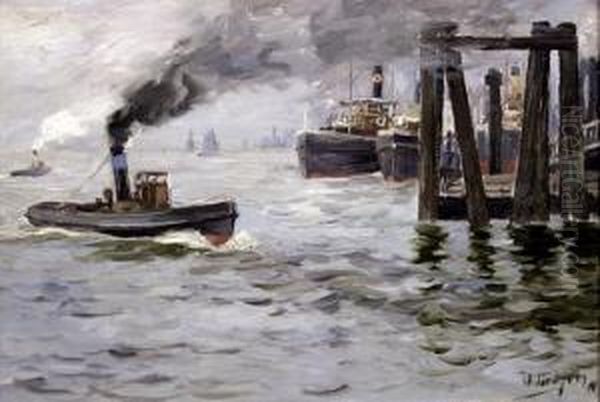
Hamburger Hafen (Hamburg Harbor), completed in 1930, is a testament to his skills as a marine painter and a nod to his origins. This 48 x 69 cm oil painting captures the dynamic atmosphere of the bustling port. Tiedjen masterfully renders the interplay of ships, water, and sky, conveying the industrial energy and maritime character of his native city. Such works place him within a long tradition of marine painting, a genre particularly popular in port cities like Hamburg.
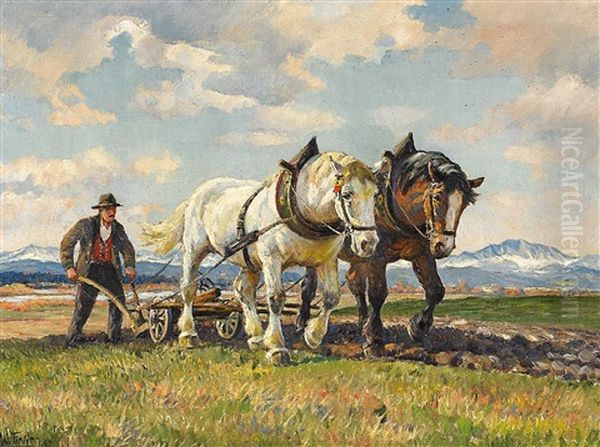
Pflügender Bauer im Voralpenland (Ploughing Farmer in the Alpine Foothills) showcases his engagement with rural themes and landscape. This oil painting (63 x 89 cm) depicts a farmer at work, a common motif in Realist art that emphasizes the dignity of labor and the connection to the land. The setting in the Alpine foothills allows Tiedjen to explore the dramatic scenery of southern Germany, a region he would frequently depict.
Sitzende Frau mit Haube (Sitting Woman with Bonnet), created around 1920, is an oil painting measuring 59.4 x 49.5 cm. This work demonstrates his ability in figure painting and portraiture. The painting portrays a woman, possibly a local character, seated outdoors. Her attire and contemplative pose suggest a quiet moment captured with sensitivity. The attention to her features and clothing reflects Tiedjen's commitment to detailed observation.
Other notable works include Kühe am Kreuzbeck (Cows at Kreuzbeck) from 1920, further highlighting his interest in rural and animal subjects, likely influenced by Zügel. Ansicht von Mittenwald im Schnee (View of Mittenwald in Snow), dated 1924, and Blick auf Ehrwald in Tirol (View of Ehrwald in Tyrol) from 1931, are fine examples of his Alpine landscapes, capturing the serene beauty and specific atmospheric conditions of these mountainous regions. These works often feature a careful rendering of light, particularly the cool, clear light of snowy or high-altitude environments.
Thematic Focus: Nature, Life, and Labor
Willy Tiedjen's thematic concerns revolved around the depiction of the natural world and the human and animal life within it. His landscapes, whether the rugged Alps or the pastoral countryside, are rendered with a deep appreciation for their inherent beauty and character. He was adept at capturing the specific mood of a place, influenced by weather, season, and time of day. His marine paintings, particularly of Hamburg Harbor, celebrate the vitality of maritime life and industry.
His animal paintings, a significant part of his oeuvre, show a genuine empathy for his subjects. Influenced by Zügel, he often depicted animals in their natural settings, engaged in typical behaviors. These are not merely anatomical studies but attempts to convey the spirit and individuality of the creatures.
Figure paintings and scenes of rural labor, like Pflügender Bauer im Voralpenland, connect Tiedjen to the broader Realist tradition that sought to ennoble everyday life and work. These works often carry a sense of quiet dignity and a respect for the enduring rhythms of human existence in harmony with nature.
Navigating the German Art Scene of the Early Twentieth Century
Willy Tiedjen's career unfolded during a period of immense artistic ferment in Germany. The late 19th century had been dominated by various forms of academic Realism, often centered in Munich, which was home to the influential "Munich School." Artists like Wilhelm Leibl (1844-1900) and Wilhelm Trübner (1851-1917), a contemporary of Zügel, championed a robust, often dark-toned Realism, focusing on portraiture, genre scenes, and landscape. Tiedjen's grounding in realistic depiction aligns with this heritage.
However, by the turn of the century, new movements were challenging the old guard. German Impressionism, spearheaded by artists such as Max Liebermann (1847-1935), Lovis Corinth (1858-1925), and Max Slevogt (1868-1932), gained prominence. These artists, while often maintaining a strong representational basis, adopted a brighter palette, looser brushwork, and a greater emphasis on capturing fleeting moments of light and atmosphere. Tiedjen's teacher, Heinrich von Zügel, was a key figure in adapting Impressionist principles to animal and landscape painting in Germany, and this influence is discernible in Tiedjen's more atmospheric works.
The period also saw the rise of various Secession movements (e.g., Munich Secession founded in 1892, Berlin Secession in 1898), where artists broke away from established academic institutions to exhibit their work independently. These movements often embraced a wider range of styles, including Symbolism, Art Nouveau (Jugendstil in Germany), and early forms of Expressionism. While Tiedjen's style remained largely within the bounds of Realism and a tempered Impressionism, he would have been acutely aware of these developments. Artists like Franz von Stuck (1863-1928), a co-founder of the Munich Secession, represented a more Symbolist and mythological direction.
Tiedjen's contemporaries, whose works sometimes appeared alongside his in auction catalogs, provide further context. Hans Thoma (1839-1924) was known for his idyllic, almost Romantic landscapes and genre scenes. The presence of works by artists like Julie Textor, Alexander Thiele, Friedrich Thurau, Otokar Bok, and Ludwig Klein in similar sales venues indicates a shared marketplace and period of activity, reflecting the diverse yet interconnected art world in which Tiedjen operated. These artists, while perhaps not all household names today, contributed to the rich tapestry of German art during this era.
The Freikorps Period and Later Life
An intriguing, though sparsely documented, aspect of Tiedjen's biography is his involvement with the "Freikorps" (Free Corps) in 1918-1919. The Freikorps were paramilitary volunteer units formed in Germany after World War I, primarily composed of demobilized soldiers and officers. They were involved in suppressing revolutionary uprisings and in border conflicts during the turbulent early years of the Weimar Republic. The provided information notes Tiedjen's participation but does not detail his specific activities or the extent of his involvement. This period of German history was fraught with political instability and violence, and participation in such groups was not uncommon for men of various backgrounds.
Later in his life, from 1942 to 1949, Willy Tiedjen resided in Garmisch-Partenkirchen, a picturesque town in the Bavarian Alps. This location, renowned for its stunning mountain scenery, undoubtedly provided ample inspiration for his landscape painting. His works from this period likely reflect a continued engagement with the Alpine environment he had depicted earlier in his career.
Throughout his career, Tiedjen was a member of several artists' associations. Such memberships were common for professional artists, providing opportunities for exhibition, networking, and mutual support. This indicates his active participation in the professional art community of his time.
Legacy and Conclusion
Willy Tiedjen passed away on February 16, 1950, in Munich, the city that had been central to his artistic development and career. He left behind a body of work characterized by technical skill, careful observation, and a deep appreciation for the natural world and its inhabitants.
While perhaps not a revolutionary innovator in the mold of the leading Expressionists or avant-garde figures of his time, Willy Tiedjen was a dedicated and accomplished painter who contributed significantly to the traditions of German Realism, landscape, and animal painting. His work reflects the solid academic training he received, enriched by the Impressionistic influences encountered through mentors like Heinrich von Zügel. His paintings offer viewers a window into the German landscapes and life of the early to mid-twentieth century, rendered with an honest and discerning eye.
His art continues to be appreciated, as evidenced by the appearance of his works in auction catalogs and collections. For art historians and enthusiasts, Willy Tiedjen remains a noteworthy artist whose career spanned a dynamic period in German art, representing a steadfast commitment to representational painting in an era of radical change. His legacy lies in the quiet beauty and enduring quality of his depictions of the world around him.