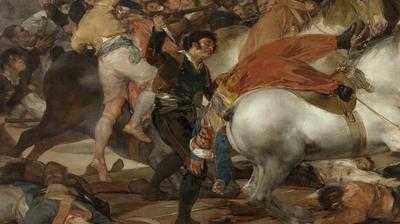
In 1814, Francisco Goya completed The Third of May 1808, a haunting masterpiece that captures a pivotal moment of human history. This canvas does not celebrate a glorious victory, but rather bears witness to a dark, chilling night in Madrid. Step into the scene. On the right, a line of faceless soldiers stands in rigid, mechanical formation, their bayonets pointed forward like cold steel teeth. Opposite them, a man in a brilliant white shirt kneels among the fallen. His arms are flung wide in a gesture of both defiance and vulnerability, his glowing clothes acting as a beacon of purity against the surrounding gloom. Around him, others cover their eyes or bow their heads, their faces etched with raw, visceral terror.
Goya uses light not as a gentle glow, but as a dramatic weapon. A square lantern on the ground casts a harsh, unforgiving glare upward, slicing through the murky shadows of the background. The color palette is heavy with earthy browns, deep blacks, and the shocking, wet crimson of fresh blood staining the soil. The brushwork is thick and urgent, abandoning smooth perfection to convey the frantic pulse of the moment. This work marks a revolutionary shift in art. Instead of idealized heroism, Goya presents the messy, agonizing reality of conflict, focusing on the individual’s suffering. It is a profound meditation on the cost of violence and the resilience of the human spirit. Through this lens, the silent darkness of the past remains forever illuminated.