In 1888, during his legendary stay in Arles, Vincent van Gogh captured the fading light of Provence in a masterpiece titled Sunset at Montmajour. For over a century, this canvas remained hidden in a private collection, long forgotten until its rediscovery restored a missing chapter to the artist’s legacy. As we look at the scene, the eye is drawn to the rugged hillside of Montmajour, covered in the hardy, golden-green scrub of the French countryside. In the distance, the ruins of an ancient abbey stand silhouetted against the sky, while a cluster of dark, twisted oak trees anchors the foreground. There is a sense of quiet movement here—the dry grass seems to sway in the evening breeze, and the distant horizon stretches out into a hazy, violet infinity.
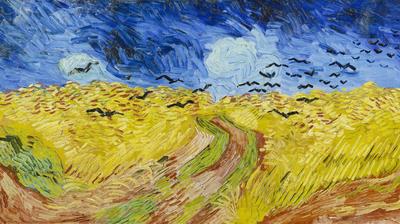
Van Gogh’s brushwork is thick and rhythmic, creating a tactile surface that feels alive. He uses a vibrant palette of ochre, forest green, and deep blues, all illuminated by the soft glow of a setting sun. The light isn't direct; instead, it's a warm radiance that fills the sky with shades of lemon and pale amber. These swirling strokes create a heavy, physical texture, making the landscape feel as solid as earth yet as fleeting as a shadow. This painting is a profound expression of Van Gogh’s fascination with nature’s raw energy and its quiet transitions. It captures that brief, magical moment when the heat of the day finally yields to the cool stillness of dusk. It is a window into a world where color and light breathe as one.