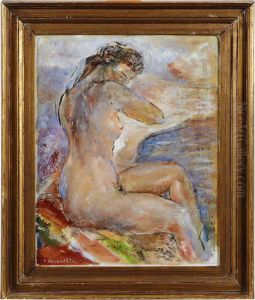
Carl Frisendahl was a notable Swedish sculptor whose work left a significant mark on the art world in the early to mid-20th century. Born on December 8, 1880, in Västergötland, Sweden, Frisendahl was deeply influenced by his Swedish heritage, which would later permeate his artistic creations. He pursued his artistic education at the Royal Swedish Academy of Fine Arts in Stockholm, where he honed his skills and developed his unique style. His education and experiences during these formative years laid the groundwork for his future success as a sculptor.
Frisendahl's work is characterized by its emphasis on neoclassical styles, yet it often incorporated elements of Art Nouveau and National Romanticism, reflecting the broader artistic movements of his time. His sculptures often featured mythological and historical themes, imbued with a sense of romanticism and a deep appreciation for the natural beauty and cultural heritage of Sweden. Throughout his career, Frisendahl participated in numerous exhibitions and received several commissions for public monuments, which helped to establish his reputation both in Sweden and internationally.
One of Carl Frisendahl's most notable contributions to public art was his involvement in the decoration of the Swedish National Museum in Stockholm, where his works are displayed prominently. His mastery of form and his ability to imbue his sculptures with a sense of life and emotion won him acclaim and contributed to his legacy as one of Sweden's foremost sculptors of the early 20th century.
Despite his success, Frisendahl remained dedicated to his craft, continually exploring new techniques and themes. He was also a dedicated educator, passing on his knowledge and passion for sculpture to the next generation of Swedish artists. Carl Frisendahl passed away on August 3, 1955, leaving behind a body of work that continues to be celebrated for its beauty, craftsmanship, and cultural significance. His contributions to the field of sculpture and to Swedish art have ensured his place in the annals of art history, making him a cherished figure long after his death.