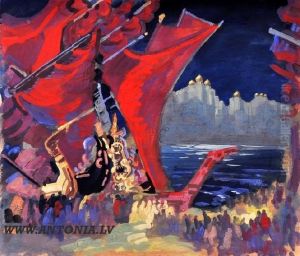
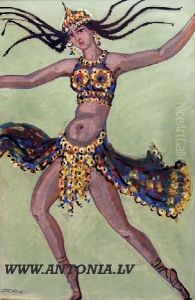
Fjodors Fedorovskis, born in 1888 in Riga, which was then part of the Russian Empire and now is the capital of Latvia, was a highly influential figure in the world of theater and stage design during the first half of the 20th century. Fedorovskis' career was marked by his innovative approach to stage design, integrating art, architecture, and technology in ways that had not been seen before. His work was not confined to one genre or style, but rather, it spanned a variety of theatrical productions, including opera, ballet, and drama, showcasing his versatility and creative vision.
After completing his education in art and architecture, Fedorovskis moved to Saint Petersburg, which was a vibrant cultural and artistic hub at the time. It was there that he became involved in the theatrical world, initially working in smaller theaters before his talent was recognized by the larger, more prestigious institutions. His breakthrough came when he started working with the Mariinsky Theatre, one of Russia's leading theaters, where he designed sets and costumes for numerous productions. His designs were noted for their elaborate detail, innovative use of space, and ability to enhance the storytelling of the productions they were part of.
Fedorovskis' career flourished during a tumultuous period in Russian history, which saw the transition from the Russian Empire to the Soviet Union. Despite the political upheavals and the challenges they presented, he managed to navigate the changing cultural landscape. In the 1920s and 1930s, he became closely associated with the Bolshoi Theatre in Moscow, where he continued to push the boundaries of stage design. His work during this period is particularly noted for its epic scale and the incorporation of new technologies, including innovative lighting techniques, which added a new dimension to his designs and the theatrical experience as a whole.
Throughout his career, Fedorovskis collaborated with many of the leading figures in Russian theater and ballet, including directors, choreographers, and composers. His ability to translate their visions onto the stage contributed to the success of many productions, which remain landmarks in the history of performing arts. Despite his significant contributions, Fedorovskis remained relatively unknown outside the Soviet Union for many years, largely due to the Iron Curtain that limited cultural exchange between the Soviet Union and the West.
Fjodors Fedorovskis passed away in 1955, leaving behind a legacy that has had a lasting impact on the world of stage design. His work is still studied and admired by theater professionals and historians, and his influence can be seen in the designs of contemporary theater productions. Despite the passage of time, his visionary approach to stage design remains relevant, inspiring new generations of designers to explore the intersection of art, technology, and architecture in the creation of theatrical space.