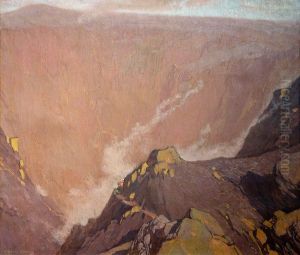
Georges Paul Leroux was a French painter and illustrator born on October 5, 1877, in Paris, France. He was known for his classical painting style and his work that often depicted mythological and allegorical subjects. Leroux studied at the École des Beaux-Arts in Paris, where he was a pupil of Gabriel Ferrier and François Flameng, both established academic painters of their time.
During his career, Leroux received numerous awards and recognitions, including the Prix de Rome in 1906, which was one of the most prestigious scholarships for arts students in France at the time. The prize allowed him to study at the Villa Medici in Rome, where he was deeply influenced by the Renaissance masters.
Leroux's work was exhibited in many prominent venues, including the Salon de Paris, where he gained a reputation for his fine detail, rich color palette, and his ability to convey emotion and narrative in his paintings. Among his notable works are 'The Wave' (La Vague) and 'The Birth of Venus' (La Naissance de Vénus), both of which exemplify his skill in portraying the human figure and his fascination with classical themes.
Beyond painting, Leroux also worked as an illustrator, contributing to various publications of the time. His illustrations were often in line with his painting style, characterized by elegance and a sense of drama.
Georges Paul Leroux's legacy as an artist is marked by his commitment to the academic tradition and his mastery of technique. His works continue to be appreciated for their beauty and classical sensibility. Leroux passed away on April 11, 1957, leaving behind a body of work that continues to be celebrated for its contribution to French art history.