Hans Soltmann was a German artist, primarily known for his work in painting and graphic design, born in 1905 and passing away in 1973. His career spanned a tumultuous period in German history, encompassing the Weimar Republic, Nazi Germany, and the post-war period, all of which influenced his artistic output. Soltmann is often celebrated for his ability to adapt and evolve his style in response to the changing political and social landscape of Germany throughout the 20th century.
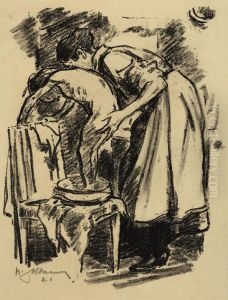
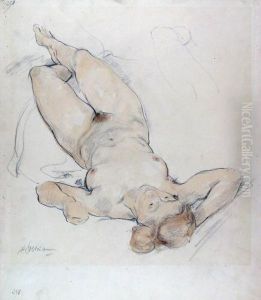
Soltmann's early work was heavily influenced by the Expressionist movement, which was prominent in Germany at the time of his education and early artistic endeavors. He studied at various prestigious institutions, where he was exposed to the forefront of avant-garde art. His initial works were characterized by bold colors, dynamic compositions, and a focus on capturing the emotional and psychological states of his subjects. This period of his oeuvre is seen as a direct response to the aftermath of World War I and the societal upheavals of the Weimar Republic.
As the political climate in Germany shifted with the rise of the Nazi regime, Soltmann, like many artists of his time, faced significant challenges. The Nazis' strict control over artistic expression and their condemnation of modernist movements as 'degenerate' forced Soltmann to adapt his style and themes to survive. Despite these constraints, he continued to produce work, albeit in a more subdued manner, focusing on landscapes, still lifes, and portraits that did not overtly challenge the regime's ideology.
After World War II, Soltmann's work underwent another transformation, reflecting the reconstruction of German identity and the broader existential questions facing humanity in the aftermath of the Holocaust and the atomic bomb. His later works displayed a return to more expressive techniques, often blending elements of his early expressionism with a newfound interest in abstraction. This period is marked by a contemplative quality, with Soltmann exploring themes of rebirth, memory, and the resilience of the human spirit.
Throughout his career, Hans Soltmann remained dedicated to exploring the depths of human emotion and the complexities of the modern world through his art. His ability to navigate the shifting cultural landscapes of 20th-century Germany, adapting his style while maintaining a unique voice, has cemented his legacy as a significant figure in German art history. Soltmann's work continues to be studied and appreciated for its historical significance and its artistic merit, offering a window into the soul of a nation undergoing profound transformations.