Helen West Heller was an American artist known for her work in woodcuts, painting, and poetry. Born on December 4, 1872, in Rushville, Illinois, she grew up in a time when opportunities for women in the arts were limited. Despite these limitations, Heller pursued her artistic passions with vigor and determination.
Heller initially trained as a painter and was largely self-taught in her early years. She began her career as a stage actress, which allowed her to travel and be exposed to various art forms and movements. However, she eventually turned her focus to the visual arts. By the 1920s, Heller had settled in New York City, which was rapidly becoming a thriving center for the arts and the avant-garde in America.
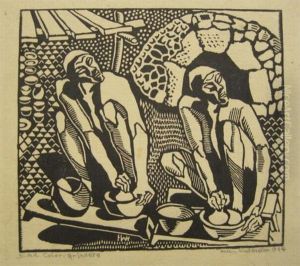
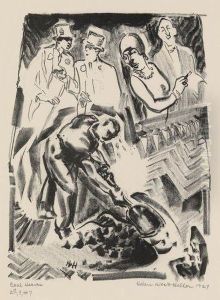
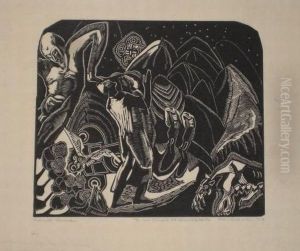
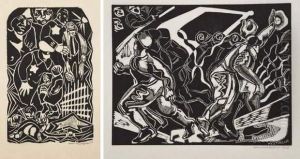
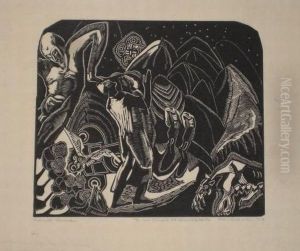
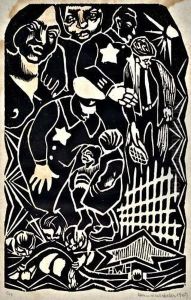
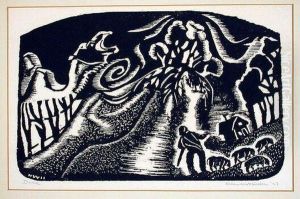
In New York, Heller's artistic career began to flourish. She was particularly drawn to the medium of woodcut prints, which suited her bold, expressive style. Her work often featured social commentary, with a focus on themes such as poverty, war, and the human condition. She was also influenced by her personal interest in spiritual and philosophical subjects. Heller's woodcuts were innovative in their technique, and she was known for her ability to capture movement and emotion in the stark contrasts between light and dark.
Despite her talent, Heller struggled to gain recognition in a male-dominated art world. Nevertheless, she continued to work and exhibit her art throughout the 1920s and 1930s. She was a member of various art organizations, including the Provincetown Printers, with whom she shared a dedication to the woodcut medium. Heller was also active in the WPA Federal Art Project, a New Deal program to fund the visual arts in the United States, which gave her some financial stability during the Great Depression.
Throughout her career, Heller also wrote poetry, and some of her verses were published. Her written work shares the same expressive quality as her visual art, often exploring similar themes with a lyrical and introspective voice.
Helen West Heller's contributions to American art were significant, particularly in the realm of printmaking. Her work is an important part of the early 20th century American art scene, reflecting both the societal concerns of the era and the personal explorations of an artist determined to express her vision despite the challenges she faced. Heller passed away on August 31, 1955, in New York City. Although not as widely known as some of her contemporaries, her art continues to be appreciated by collectors and scholars for its intensity and its unique blend of social realism and mystical abstraction.