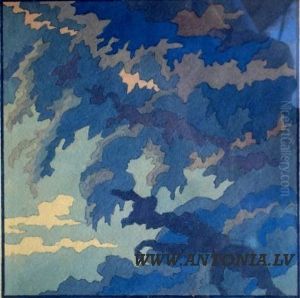
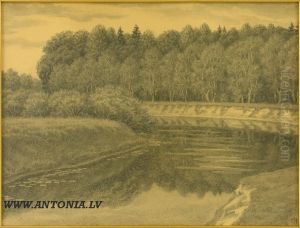
Julijs Madernieks was a prominent Latvian artist and designer, widely regarded as one of the founders of professional decorative art in Latvia. Born on February 24, 1870, in the town of Cēsis, which was then part of the Russian Empire, Madernieks developed a profound interest in art at an early age. His creative journey began in earnest when he pursued studies at the St. Petersburg Central School of Technical Drawing, also known as the Baron Stieglitz's Central Drawing School, a prestigious institution that catered to the training of artists in Russia.
After completing his education in St. Petersburg, Madernieks further honed his skills by traveling and studying in Western Europe. This period was crucial for his artistic development, exposing him to new ideas and movements that were sweeping through the European art world at the turn of the 20th century. Upon returning to Latvia, he worked as a teacher while simultaneously engaging in various artistic projects.
Madernieks was instrumental in the development of the Latvian National Romanticism style, which sought to fuse national identity with artistic expression. His work often incorporated traditional Latvian folk motifs and symbols, which he reinterpreted with a modern sensibility. He was particularly interested in the design of interiors, furniture, textiles, and other decorative elements. One of his most significant contributions was his role in designing the interior of the Latvian Ethnographic Museum, which opened in 1916.
Throughout the 1920s and 1930s, Madernieks continued to be an influential figure in Latvian art and design. He was not only a practicing artist but also an educator, teaching at various institutions, including the Latvian Art Academy. His work during this period included graphic design, book illustrations, and set designs for theater productions, showcasing his versatility across different mediums.
Julijs Madernieks' legacy is one of innovation and dedication to the integration of national identity into the fabric of modern art and design. He passed away on October 22, 1955, in Riga, Latvia. Today, his work is celebrated for its pioneering role in the formation of Latvian national art and remains an inspiration for Latvian artists and designers.