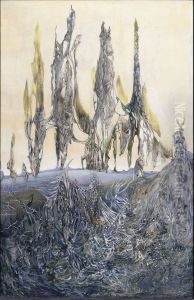
Wolfgang Paalen was an Austrian-Mexican painter, sculptor, and art philosopher who played a significant role in the development of Surrealism and was an influential figure among the mid-20th-century art movements. Born on July 22, 1905, in Vienna, Austria, to a wealthy and intellectual family, Paalen had the opportunity to be exposed to the arts from a young age. His early interest in painting and the intellectual culture within his family home set the stage for his future as an artist and thinker.
Paalen traveled extensively as a young man, which broadened his perspectives on art and culture. He settled in Paris in the 1920s, where he became associated with the Surrealist group led by André Breton. His work during this period was marked by a fascination with the unconscious and the use of automatic drawing techniques, which sought to release the creative potential of the subconscious mind.
In 1935, Paalen moved to Mexico, where he became deeply influenced by the country's indigenous art and culture, as well as its varied landscapes. His time in Mexico led to a significant evolution in his artistic style and philosophical outlook. He also became involved with the Dynaton Movement, which emphasized the spiritual and mystical dimensions of artistic expression.
Paalen's work was characterized by a combination of surrealistic imagery, pre-Columbian symbolism, and totemic elements, which he integrated into both his paintings and sculptures. He was not only an artist but also a prolific writer and theorist, publishing the influential art magazine 'DYN' in which he explored his ideas regarding the role of art and the artist in society.
Wolfgang Paalen's philosophical contributions and artistic innovations were an important bridge between European Surrealism and American Abstract Expressionism. His ideas influenced prominent artists such as Jackson Pollock, with whom he shared a fascination for the unconscious aspects of creative expression.
Paalen continued to create art and write until his death on September 24, 1959, in Mexico. His legacy endures through his contributions to Surrealism, his influence on later art movements, and the ongoing interest in his work by art historians and collectors. Despite facing personal struggles, including mental health issues, Paalen's intellectual curiosity and creative drive left a lasting mark on the art world.