Albert Charpin (1842-1924) stands as a significant, if sometimes overlooked, figure in the rich tapestry of 19th-century French art. Primarily celebrated for his evocative landscape paintings, often populated with sheep, Charpin's work embodies the enduring appeal of pastoral themes and the meticulous observation of nature that characterized the Barbizon School and its succeeding artistic currents. His long career spanned a period of immense artistic change, from the height of Realism to the dawn of Modernism, yet he remained steadfast in his dedication to capturing the tranquil beauty of the French countryside.
Early Life and Artistic Formation
Born in Grasse, in the Alpes-Maritimes department of southeastern France, in 1842, Albert Charpin's early life was set against the backdrop of a region renowned for its stunning natural beauty and vibrant light – elements that would later permeate his artistic oeuvre. While specific details about his earliest artistic training are not extensively documented, it is evident that he developed a profound connection to the rural environment from a young age. This connection would become the cornerstone of his artistic identity.
The mid-19th century in France was a fertile ground for artistic development. The academic traditions, though still powerful, were being challenged by a growing desire among artists to depict the world with greater realism and immediacy. It was in this environment that Charpin would have sought out instruction and honed his skills. His artistic journey led him to become a pupil of Charles-François Daubigny, one of the leading figures of the Barbizon School. This mentorship was pivotal in shaping Charpin's artistic direction.
The Influence of the Barbizon School
The Barbizon School, which flourished roughly between 1830 and 1870, was a movement of French landscape painters who congregated in and around the village of Barbizon, near the Forest of Fontainebleau. These artists, including luminaries such as Jean-Baptiste-Camille Corot, Théodore Rousseau, Jean-François Millet, and Charpin's mentor Charles-François Daubigny, rejected the idealized and historical landscapes favored by the Academy. Instead, they advocated for a direct and truthful representation of nature, often working en plein air (outdoors) to capture the fleeting effects of light and atmosphere.
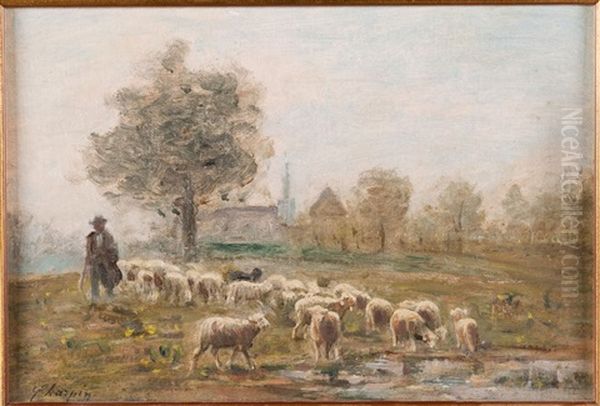
Daubigny, known for his gentle, atmospheric river scenes and pastoral landscapes, would have instilled in Charpin a deep appreciation for the nuances of the natural world. His influence is visible in Charpin's sensitive handling of light, his harmonious color palettes, and his ability to evoke a sense of peace and tranquility in his scenes. Like Daubigny, Charpin often focused on the unspectacular, everyday beauty of the countryside, finding poetry in quiet meadows, tranquil riverbanks, and the gentle rhythm of rural life. Other Barbizon painters like Constant Troyon, who specialized in animal painting, particularly cattle and sheep, also paved the way for artists like Charpin to focus on pastoral scenes with livestock as central subjects.
Charpin's Distinctive Style and Subject Matter
While firmly rooted in the Barbizon tradition, Albert Charpin developed a distinctive style characterized by his particular fondness for depicting sheep. His canvases are often filled with flocks of sheep grazing peacefully in sun-dappled pastures, being led by a shepherd or shepherdess, or resting by a stream. These scenes are rendered with a remarkable tenderness and an acute observation of animal behavior and anatomy. The fleece of the sheep, the play of light on their forms, and their integration into the landscape are all handled with consummate skill.
Charpin's landscapes are typically imbued with a soft, diffused light, often capturing the golden hues of early morning or late afternoon. This preference for specific times of day allowed him to explore subtle tonal variations and create a serene, almost idyllic atmosphere. His brushwork, while detailed enough to convey realism, often possesses a gentle touch that enhances the overall tranquility of his compositions. He was a master of creating depth and space, leading the viewer's eye through carefully constructed scenes that balance open fields with copses of trees or distant hills.
His palette favored naturalistic greens, earthy browns, and soft blues, punctuated by the creamy whites and greys of his beloved sheep. Unlike the Impressionists who were his contemporaries and who were radically experimenting with color and light to capture fleeting moments, Charpin's approach remained more aligned with the Barbizon ethos of capturing the enduring, timeless qualities of nature.
Representative Works and Recurring Themes
While a comprehensive list of all his works is extensive, certain themes and compositions recur, showcasing his mastery. Titles such as "Retour du Troupeau" (Return of the Flock), "Moutons au Pâturage" (Sheep in Pasture), "Bergère et ses Moutons" (Shepherdess and her Sheep), and "Troupeau de Moutons au Bord de la Rivière" (Flock of Sheep by the Riverbank) are indicative of his primary focus.
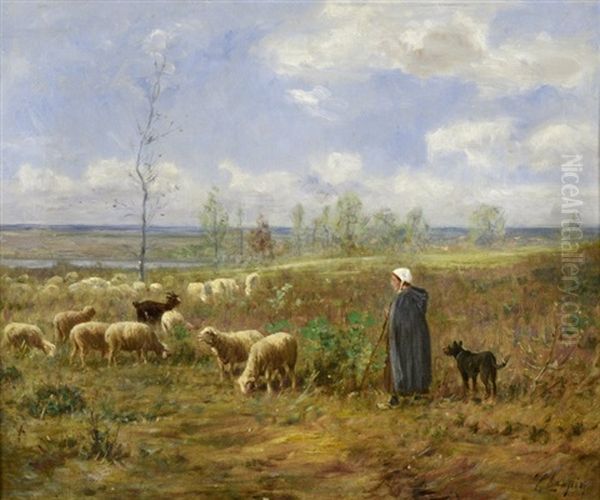
One of his notable works, often cited, is "Le Rentré au Parc" (Returning to the Pen), which exemplifies his skill in depicting a large flock moving through a landscape, enveloped in the soft light of dusk. Another example might be "Moutons s'abreuvant" (Sheep Drinking), showcasing his ability to capture naturalistic animal behavior within a meticulously rendered setting. These paintings are not merely animal portraits; they are carefully composed landscapes where the animals are an integral part of the natural harmony. The shepherd or shepherdess, when present, is often depicted as a quiet, unobtrusive figure, at one with the flock and the environment, echoing Millet's dignified portrayals of peasant life but with a gentler, less socially charged focus.
The recurring motif of sheep in Charpin's work can be interpreted in several ways. On one level, it reflects the agricultural reality of the French countryside. On another, sheep have long held symbolic connotations of peace, innocence, and pastoral simplicity – ideals that resonated with a society undergoing rapid industrialization and urbanization. Charpin's paintings offered an escape, a vision of a timeless, harmonious existence.
Exhibitions, Recognition, and Contemporaries
Albert Charpin was a regular exhibitor at the prestigious Paris Salon, the official art exhibition of the Académie des Beaux-Arts, from 1875 onwards. Participation in the Salon was crucial for an artist's career in 19th-century France, providing visibility and opportunities for patronage. Charpin achieved considerable success and recognition through these exhibitions, receiving an honorable mention in 1887 and a third-class medal in 1889. He was awarded a bronze medal at the Exposition Universelle (World's Fair) in Paris in 1900, a testament to his established reputation. In 1892, he was made a Chevalier of the Legion of Honour, a significant mark of distinction.
His career unfolded alongside a dazzling array of artistic talents. Beyond his Barbizon predecessors like Corot, Rousseau, and Millet, and his mentor Daubigny, he was a contemporary of the Impressionists, including Claude Monet, Camille Pissarro, Edgar Degas, and Pierre-Auguste Renoir, whose revolutionary approach to light and color was transforming the art world. While Charpin did not adopt the Impressionistic style, he would have been well aware of their innovations.
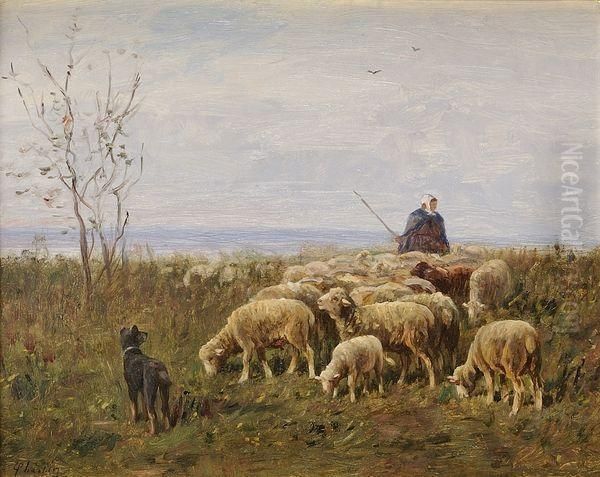
Other notable landscape and animal painters of the era include Rosa Bonheur, celebrated for her powerful and realistic depictions of animals, and Jules Breton, known for his poetic scenes of rural peasant life. Painters like Léon Germain Pelouse continued the landscape tradition with a Barbizon sensibility, while figures such as Jules Bastien-Lepage championed a form of Naturalism that shared Realism's commitment to truth but often with a more photographic detail. Charpin's work, therefore, existed within a vibrant and diverse artistic milieu, holding its own with its consistent quality and appealing subject matter. Even artists like Gustave Courbet, a leading figure of Realism, often depicted rural scenes, though with a more rugged and sometimes politically charged edge than Charpin's gentle pastorals.
The Enduring Appeal of Charpin's Art
Albert Charpin continued to paint into the early 20th century, passing away in 1924. His dedication to his chosen themes and style remained largely consistent throughout his long career. While artistic tastes evolved and new movements like Fauvism and Cubism emerged, Charpin's work retained its appeal for collectors and art lovers who appreciated its technical skill, its serene beauty, and its nostalgic evocation of rural life.
His paintings offer a window into a world that was rapidly changing. The late 19th and early 20th centuries saw increased industrialization, which transformed the French landscape and society. Charpin's idyllic scenes, therefore, can be seen not just as realistic depictions but also as a form of pastoral elegy, a celebration of a way of life that was perceived to be under threat. This nostalgic quality contributes to their enduring charm.
Today, Albert Charpin's paintings can be found in numerous public and private collections, particularly in France and the United States. Museums such as the Musée des Beaux-Arts de Chambéry, the Musée de Grenoble, and others hold examples of his work. His paintings continue to be sought after at auctions, appreciated for their decorative qualities, their technical finesse, and the peaceful ambiance they convey.
Charpin's Place in Art History
Albert Charpin may not have been a revolutionary innovator in the vein of Monet or Cézanne, but his contribution to French art is significant. He was a master of a particular genre – the pastoral landscape with sheep – and he pursued it with unwavering dedication and skill. He represents the continuation and refinement of the Barbizon tradition, adapting its principles to his own gentle and poetic vision.
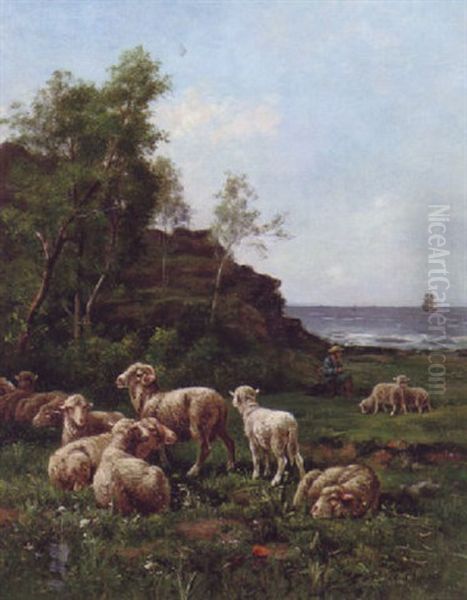
His work serves as an important link between the mid-century Realism of the Barbizon painters and the later currents of landscape painting that continued to find inspiration in the French countryside. He was part of a generation of artists, including figures like Henri Biva or Paul Désiré Trouillebert (a follower of Corot), who maintained a commitment to representational art even as Modernism began to take hold. His focus on the harmonious relationship between animals and their environment also places him within the lineage of great animal painters, a tradition that includes artists from Paulus Potter in the Dutch Golden Age to Constant Troyon and Rosa Bonheur in his own century.
In an era that saw dramatic shifts in artistic paradigms, Albert Charpin's art offered a sense of continuity and enduring beauty. His paintings are more than just charming depictions of sheep; they are carefully crafted expressions of a deep love for nature and a profound understanding of its subtle moods and harmonies. They invite contemplation and offer a respite from the complexities of modern life, a quality that ensures their relevance and appeal to contemporary audiences. His legacy is that of a dedicated and talented artist who masterfully captured the soul of the pastoral French landscape.