Alfred Provis stands as a notable, if sometimes overlooked, figure within the rich tapestry of nineteenth-century British art. Active during a period of profound social and artistic change, Provis dedicated his career to the depiction of rustic interiors and scenes of humble domesticity. His work, characterized by its warmth, attention to detail, and gentle sentiment, found favour with a Victorian public increasingly drawn to nostalgic and idealized portrayals of rural life. While not an innovator on the scale of some of his contemporaries, Provis was a skilled craftsman whose paintings offer a valuable window into the popular tastes and social preoccupations of his era.
The Artist's Life and Times
Alfred Provis was born in Chippenham, Wiltshire, England, in 1818. He passed away in 1890, his life spanning a significant portion of Queen Victoria's reign. This era, from 1837 to 1901, was marked by industrialization, urban growth, and the rise of a prosperous middle class, which became a significant patron of the arts. While detailed biographical information about Provis's early training and personal life remains somewhat scarce compared to more prominent figures, his artistic output clearly places him within the tradition of Victorian genre painting. He established himself as a professional artist, regularly exhibiting his works and catering to a market that appreciated his chosen subject matter.
The artistic landscape of nineteenth-century Britain was vibrant and diverse. The Royal Academy of Arts in London was the premier institution, and its annual exhibitions were major social and cultural events. Artists like Provis sought recognition and sales through these exhibitions, as well as through other venues such as the British Institution and the Society of British Artists, Suffolk Street. Success in these forums could lead to commissions, critical acclaim, and a comfortable livelihood. Provis was indeed a frequent exhibitor, showcasing his carefully rendered scenes to a receptive audience.
The Victorian Fascination with Genre Painting
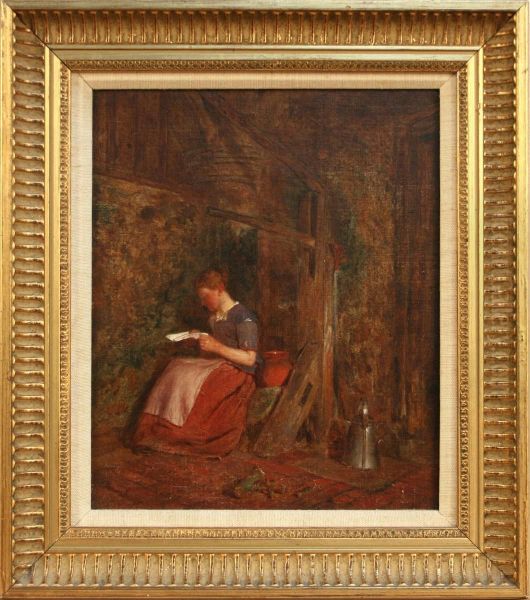
Genre painting, the depiction of scenes from everyday life, enjoyed immense popularity in Victorian Britain. This was partly a reaction against the perceived elitism of historical and mythological subjects, and partly a reflection of the middle class's interest in seeing their own values and experiences, or idealized versions thereof, reflected in art. Rural themes, in particular, held a special appeal, offering an escape from the perceived grime and anonymity of the rapidly expanding cities. Cottage interiors, farmyard scenes, and depictions of simple family life evoked a sense of nostalgia, piety, and national identity.
Artists specializing in genre subjects often focused on narrative, imbuing their scenes with anecdotal details that viewers could readily interpret and enjoy. Themes of childhood innocence, domestic harmony, rural labour, and quiet contemplation were common. Provis excelled in this domain, creating intimate portrayals of cottage life that resonated with the prevailing sentiments of the time. His work can be seen as part of a broader movement that included artists who, in various ways, explored the lives of ordinary people.
Alfred Provis's Distinctive Artistic Style
Alfred Provis developed a recognizable style characterized by several key elements. His primary medium was oil on canvas, and he typically worked on a modest scale, suitable for domestic display. His subject matter was consistently focused on the interiors of rural cottages, often featuring women, children, and occasionally domestic animals. These scenes are typically bathed in a warm, gentle light, often emanating from a window or a hearth, creating an atmosphere of coziness and tranquility.
Provis paid meticulous attention to the details of these humble settings: the texture of stone floors and whitewashed walls, the gleam of copper pots, the rough-hewn wooden furniture, and the simple clothing of his figures. This careful rendering of objects and textures contributed to the realism and relatability of his scenes. His compositions are generally straightforward and balanced, drawing the viewer's eye to the central figures and their activities. While not overtly dramatic, his paintings often convey a quiet narrative or a moment of gentle interaction.
His use of colour was typically subdued, favouring earthy tones, soft browns, greys, and muted greens, punctuated by occasional brighter accents in clothing or household items. This palette enhanced the rustic and unpretentious quality of his subjects. The figures in Provis's paintings are often engaged in simple domestic tasks – sewing, minding children, preparing food – or are shown in moments of quiet repose. There is a pervasive sense of order and contentment, even in the humblest of surroundings.
Representative Work: "Children in an Old Mill"
Among Alfred Provis's body of work, "Children in an Old Mill" serves as a fine example of his characteristic themes and stylistic approach. While the exact date of its creation might not be widely documented, its subject matter and execution align perfectly with his known oeuvre. The painting, reportedly an oil on canvas measuring approximately 28.5 x 41.5 cm, would depict a scene likely set within the rustic interior of a disused or partially functioning mill, a common feature in the rural landscape of nineteenth-century Britain.
One can envision such a painting featuring children, perhaps playing or observing the workings of the mill, their figures illuminated by a soft light filtering through a dusty window or doorway. Provis would have likely rendered the textures of the old stone or wooden structure with his customary care, contrasting them with the softer forms of the children's figures and clothing. The scene would evoke a sense of childhood innocence and curiosity, set against a backdrop that speaks of history and rural industry. The "old mill" itself provides a picturesque and slightly romantic setting, a common trope in Victorian art that appealed to the era's nostalgia for a pre-industrial past.
The composition would likely be carefully arranged to lead the viewer's eye through the scene, perhaps using a diagonal recession or a focal point created by a light source. The emotional tone would be gentle and sentimental, rather than dramatic or overtly didactic. Such a work would encapsulate Provis's skill in capturing the charm of everyday rural life and the innocence of youth, themes that were highly popular with his contemporary audience.
Contemporaries and the Artistic Milieu
Alfred Provis worked during a period rich with talented genre painters, each contributing to the diverse artistic landscape of Victorian Britain. Understanding his work in relation to his contemporaries helps to situate his specific contributions.
Thomas Webster (1800-1886) was renowned for his charming and often humorous depictions of village life, particularly schoolroom scenes and children at play. Like Provis, Webster focused on rural subjects and found great popularity, though his work often had a more overtly anecdotal or comical element.
Frederick Daniel Hardy (1827-1911) and his brother George Hardy (1822-1909) were key figures in the Cranbrook Colony, a group of artists who specialized in meticulously detailed and often sentimental scenes of domestic interiors and cottage life. Their work shares a close affinity with Provis's in terms of subject matter and attention to detail, though the Cranbrook artists often achieved an even finer degree of finish.
George Bernard O'Neill (1828-1917), another member associated with the Cranbrook Colony, also excelled in depicting intimate domestic scenes, often with a focus on family relationships and childhood. His paintings, like Provis's, convey a sense of warmth and emotional connection.
William Powell Frith (1819-1909) was one of the most successful painters of the era, known for his large-scale, panoramic depictions of modern life, such as "The Derby Day" and "The Railway Station." While Frith's subjects were often more urban and socially complex than Provis's, both artists catered to the Victorian taste for narrative and detailed observation of everyday existence.
The Scottish painter Thomas Faed (1826-1900) gained fame for his poignant and often sentimental portrayals of Scottish rural life, frequently depicting scenes of hardship, emigration, and domestic piety. His work, while sometimes more overtly emotional than Provis's, shared a common interest in the lives of the rural poor.
Myles Birket Foster (1825-1899), primarily a watercolourist but also an oil painter, was celebrated for his idyllic and highly detailed landscapes and rustic scenes, often featuring charming cottages and picturesque groups of children. His vision of rural England was highly romanticized and immensely popular, aligning with the nostalgic appeal found in Provis's work.
The Pre-Raphaelite Brotherhood, founded in 1848, also had an impact on the art world, though their aims were initially quite different from those of traditional genre painters. However, artists like John Everett Millais (1829-1896), in his later career, produced popular genre subjects, such as "Bubbles," which resonated with Victorian sentimentality. Even earlier Pre-Raphaelite works, with their emphasis on truth to nature and moral seriousness, sometimes touched on themes of contemporary life. Other figures associated with or influenced by Pre-Raphaelitism, like Ford Madox Brown (1821-1893) with his painting "Work," also engaged with social realities, albeit often with a more critical or didactic intent than seen in Provis's gentler scenes.
Later Victorian artists like Luke Fildes (1843-1927) and Hubert von Herkomer (1849-1914) brought a greater degree of social realism to genre painting, often depicting the harsher realities of poverty and urban life. Their work contrasts with the more idealized and comforting vision typically presented by Provis, highlighting the diverse ways in which Victorian artists approached the depiction of everyday life. Other notable painters of the era who touched upon genre or domestic themes include Augustus Leopold Egg (1816-1863), known for his moralizing narrative series, and Richard Redgrave (1804-1888), who also explored social themes in his art.
Provis, therefore, operated within a well-established and popular field. His particular niche was the quiet, unassuming charm of the cottage interior, a theme he explored with consistency and skill throughout his career. He did not perhaps strive for the grand social commentary of a Frith or the intense realism of a Fildes, but rather offered a more intimate and comforting vision of rural domesticity.
The Enduring Appeal of Provis's Art
The popularity of Alfred Provis's paintings during his lifetime can be attributed to several factors. Firstly, his chosen subject matter tapped into a deep-seated Victorian nostalgia for an idealized rural past, a world perceived as simpler, more virtuous, and closer to nature than the rapidly industrializing urban centres. His scenes offered a reassuring image of domestic stability and contentment.
Secondly, his technical skill was evident. The careful rendering of details, the competent handling of light and shadow, and the pleasing compositions all contributed to the aesthetic appeal of his works. Victorian art buyers, particularly those from the burgeoning middle class, appreciated well-crafted paintings that demonstrated skill and attention to detail.
Thirdly, the gentle sentimentality of his scenes resonated with the emotional tenor of the age. While avoiding excessive melodrama, Provis's paintings often evoked feelings of tenderness, innocence, and quiet joy. These were emotions that the Victorian public readily embraced, particularly in art intended for the home.
Today, Alfred Provis's paintings continue to be appreciated by collectors and art enthusiasts interested in Victorian genre painting. His works appear in auctions and are held in private collections, and occasionally in public galleries, particularly in the UK. They serve as charming examples of a specific type of Victorian art and provide valuable insights into the tastes and values of the period. While he may not be as widely known as some of his more famous contemporaries, his contribution to the depiction of nineteenth-century domestic life is undeniable.
Legacy and Collections
Alfred Provis did not leave behind a large body of theoretical writings or attract extensive contemporary critical analysis in the way that some more avant-garde or controversial artists did. His legacy lies primarily in his paintings themselves. These works consistently reflect his dedication to a particular vision of rural domesticity. His paintings are often found in British art collections, both public and private, that specialize in nineteenth-century genre scenes. Regional museums in the UK, particularly those with collections of Victorian art, may hold examples of his work.
The art market continues to show interest in Provis's paintings. His works regularly appear at auction houses specializing in British and European art. The prices they command reflect their appeal to collectors who appreciate Victorian genre painting for its charm, historical interest, and decorative qualities. The "collection price" of 80,000 yuan mentioned for "Children in an Old Mill" (if this refers to a modern valuation or sale price) indicates a significant level of appreciation for his work in certain markets, though such figures can vary widely depending on the specific piece, its condition, provenance, and the prevailing market conditions.
His contribution is that of a diligent and skilled practitioner within a popular artistic tradition. He may not have revolutionized art, but he capably fulfilled the desires of his patrons and produced a body of work that continues to offer pleasure and insight. He represents a significant strand of Victorian art that focused on the intimate, the everyday, and the sentimental.
Conclusion: A Quiet Observer of Victorian Life
Alfred Provis was an artist of his time, skillfully capturing the quiet charm and idealized domesticity of rural Victorian England. His paintings of cottage interiors, filled with gentle light, meticulous detail, and scenes of simple family life, resonated deeply with his contemporaries and continue to hold appeal for their nostalgic and sentimental qualities. While he operated within a well-established tradition of genre painting, alongside notable figures like Thomas Webster, Frederick Daniel Hardy, and Myles Birket Foster, Provis carved out his own niche with his consistent focus and recognizable style.
His works, such as the indicative "Children in an Old Mill," offer a window into a world that the Victorians cherished – a world of rustic simplicity, domestic harmony, and childhood innocence. As an art historian, one recognizes in Provis a competent and dedicated painter who understood his audience and proficiently supplied them with art that was both aesthetically pleasing and emotionally comforting. His paintings remain a testament to the enduring appeal of everyday scenes rendered with warmth and sincerity, securing his place as a valued, if modest, chronicler of nineteenth-century British life.