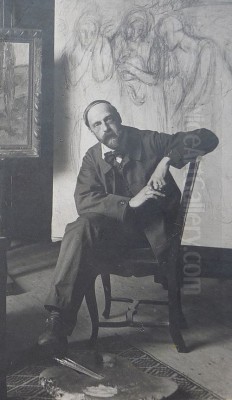
Alfredo Müller, a name perhaps not as universally recognized as some of his contemporaries, stands as a significant figure in the vibrant art world of late 19th and early 20th century Paris. A Swiss artist by nationality, born in German Silesia, Müller carved a distinct niche for himself, particularly through his masterful contributions to the revival of color printmaking techniques. His work, imbued with the spirit of the Belle Époque, captures the elegance, dynamism, and fleeting moments of a transformative era in European culture, positioning him as an important, if sometimes overlooked, master of the graphic arts.
Early Life and Artistic Inclinations
Born in 1869 in Liebau, Silesia (then part of Germany, now Lubawka, Poland), Alfredo Müller's early life set the stage for an international artistic career. While detailed records of his earliest artistic training are not as extensively documented as those of some peers, it is evident that he developed a profound interest in the visual arts from a young age. His Swiss nationality provided him with a certain neutrality and perhaps a broader European perspective, which would serve him well as he navigated the cosmopolitan art circles of his time.
The late 19th century was a period of immense artistic ferment across Europe. Traditional academic art was being challenged by successive waves of innovation, from Impressionism to Post-Impressionism and the burgeoning Symbolist movement. It was in this dynamic environment that Müller would eventually find his calling, drawn inexorably to Paris, the undisputed capital of the art world. His formative years would have exposed him to these shifting artistic currents, shaping his aesthetic sensibilities and technical aspirations.
Parisian Allure and the Belle Époque
The decision to move to Paris was a pivotal one for Müller, as it was for countless artists seeking inspiration, instruction, and recognition. He arrived in a city teeming with creative energy, a hub where painters, sculptors, writers, and musicians congregated, exchanged ideas, and pushed the boundaries of their respective crafts. The Belle Époque, roughly spanning from the 1870s to the outbreak of World War I in 1914, was characterized by optimism, peace at home, new technologies, and a flourishing of the arts. Cafes, cabarets, theaters, and grand boulevards became the backdrop for a new urban culture, and artists were keen to capture its essence.
Müller immersed himself in this milieu. He would have encountered the works of established masters like Pierre-Auguste Renoir, whose depictions of joyful social gatherings and luminous figures defined an aspect of the era, and the more avant-garde creations of artists like Henri de Toulouse-Lautrec, whose posters and paintings vividly chronicled the city's nightlife and entertainment scene. The influence of Japanese prints (Japonisme), with their bold compositions, flat color planes, and decorative qualities, was also pervasive, impacting artists such as Mary Cassatt, Pierre Bonnard, and Édouard Vuillard.
Championing the Art of Color Printmaking
While Müller also engaged in painting, it was in the realm of printmaking, particularly color aquatint and etching, that he made his most enduring mark. The late 19th century witnessed a significant revival of interest in original prints as an autonomous art form, rather than mere reproductions. Artists sought to explore the unique expressive possibilities of various printmaking techniques. Müller was at the forefront of the renaissance of color aquatint, a complex intaglio process capable of producing rich tonal variations and subtle gradations of color, akin to watercolor washes.
He became closely associated with a circle of artists dedicated to advancing color printmaking. Among his key collaborators and contemporaries in this field was Eugène Delâtre, a master printer and artist himself, whose workshop became a crucial center for experimentation. Delâtre's expertise was instrumental in helping many artists, Müller included, realize their visions in color. Other notable figures in this movement included Théophile Steinlen, renowned for his socially conscious illustrations and iconic posters like "Le Chat Noir," and Manuel Robbe, who also excelled in creating evocative color aquatints of Parisian life and feminine subjects.
Müller's technical proficiency in color aquatint was exceptional. He skillfully manipulated the granular resin ground and the acid biting process to achieve a remarkable range of textures and hues. His prints often display a sophisticated understanding of color harmony and a delicate, atmospheric quality. This dedication to the craft distinguished him and contributed significantly to the elevation of color printmaking during the Belle Époque. Artists like Jacques Villon (Gaston Duchamp), who was also exploring intaglio techniques with a modernist sensibility, and Félix Vallotton, with his stark and innovative woodcuts, further illustrate the diversity and dynamism within the printmaking scene of the period.
Themes, Subjects, and Signature Style
Alfredo Müller's subject matter was deeply rooted in the Parisian life he observed and experienced. His prints often feature elegant women, a quintessential Belle Époque motif, depicted in fashionable attire, at leisure, or in moments of quiet contemplation. These figures are not merely decorative but often convey a sense of mood and personality, captured with a sensitivity that speaks to Müller's observational skills. Works such as "Femme au Chapeau" (Woman with a Hat) or "Le Lever" (The Awakening/Rising) exemplify this focus, showcasing his ability to combine graceful figuration with rich, atmospheric color.
Beyond portraits and figures, Müller also turned his attention to the broader spectacle of Parisian life. Scenes from cafes, theaters, and the bustling city streets found their way into his oeuvre. He was adept at capturing the ambiance of these locales, the interplay of light and shadow, and the subtle narratives unfolding within them. His style, while individual, shows an affinity with the elegance of Art Nouveau in its flowing lines and decorative sensibility, yet it also retains a connection to the observational realism inherited from Impressionism and Post-Impressionism.
His color palette was often refined and nuanced, capable of evoking specific times of day or emotional states. Unlike the bolder, more contrasting colors used by some of his contemporaries in poster art, Müller's aquatints frequently feature a more subtle and harmonious blending of tones, contributing to their sophisticated and often poetic appeal. His work appeared in respected contemporary art journals such as Cocorico and Le Courrier Français, which helped to disseminate his images to a wider audience and solidify his reputation.
Representative Works and Artistic Dialogue
Identifying a definitive list of "representative works" for an artist whose output was prolific can be challenging, but certain prints stand out for their technical mastery and thematic resonance. "La Danse" (The Dance) is one such example, capturing the movement and energy of performance, a popular theme during the era. His depictions of solitary female figures, often in intimate interior settings, such as "Jeune Femme à sa Toilette" (Young Woman at Her Dressing Table), are characteristic of his sensitive portrayal of femininity and his skill in rendering textures and light through the aquatint medium.
The artistic dialogue Müller engaged in was not limited to printmakers. The broader artistic currents of Paris inevitably shaped his vision. The Symbolist movement, with its emphasis on suggestion, mood, and the inner world, likely resonated with his more introspective pieces. While perhaps not directly a Symbolist painter like Odilon Redon or Gustave Moreau, the evocative atmosphere in Müller's prints shares some common ground with Symbolist aesthetics.
Furthermore, the influence of artists who excelled in capturing modern life, such as Edgar Degas with his dancers and cafe scenes, or even the earlier graphic work of Honoré Daumier in chronicling Parisian society, provided a rich artistic heritage upon which Müller and his contemporaries could build. The legacy of James McNeill Whistler, whose etchings and lithographs emphasized tonal harmonies and atmospheric effects, also played a role in shaping the aesthetic landscape for printmakers of Müller's generation.
Exhibitions, Recognition, and Legacy
Alfredo Müller's work was exhibited in various Salons and galleries in Paris, which were crucial venues for artists to gain visibility and patronage. The inclusion of his prints in publications like Cocorico placed him alongside many leading artists and illustrators of the day. His dedication to the art of color aquatint earned him respect among his peers and connoisseurs. Notably, his works were acquired by important public collections, including the Musée du Luxembourg in Paris (whose collections of art from this period are now largely housed in the Musée d'Orsay), a testament to the contemporary recognition of his artistic merit.
The revival of color printmaking, to which Müller contributed so significantly, had a lasting impact. It demonstrated the expressive potential of these techniques and encouraged subsequent generations of artists to explore printmaking as a primary medium for artistic expression. While the dazzling innovations of Fauvism and Cubism would soon dominate the Parisian avant-garde, the refined artistry of printmakers like Müller, Paul César Helleu (known for his elegant drypoints of society women), and Auguste Lepère (a master of wood engraving) represents a crucial and beautiful facet of Belle Époque art.
Alfredo Müller continued to work into the 20th century, witnessing dramatic shifts in the art world. He passed away in Paris in 1939, on the cusp of another world war that would irrevocably change the European cultural landscape. His legacy resides in his exquisite prints, which offer a window into a bygone era, celebrated for its elegance and artistic vitality. He remains an important figure for collectors of Belle Époque prints and for art historians studying the rich history of printmaking.
The Enduring Appeal of Müller's Art
The art of Alfredo Müller continues to hold appeal for several reasons. Firstly, his technical mastery of the color aquatint process is undeniable. His prints are a testament to the beauty and subtlety that can be achieved through this demanding medium. Secondly, his subject matter, rooted in the everyday elegance and intimate moments of Parisian life during the Belle Époque, evokes a sense of nostalgia and charm. He captured a world that, while perhaps idealized, continues to fascinate.
His work provides a valuable counterpoint to the more radical artistic movements of his time. While artists like Pablo Picasso and Georges Braque were deconstructing form and challenging the very nature of representation, Müller and his circle were refining and elevating traditional printmaking techniques to new heights of aesthetic achievement. This diversity is characteristic of the richness of the period.
In the broader narrative of art history, Alfredo Müller's contribution lies in his dedication to the craft of printmaking and his role in the revival of color intaglio techniques. He, along with artists like Delâtre, Robbe, and Steinlen, ensured that printmaking remained a vital and expressive medium for artists. His prints are not merely historical documents but works of art that continue to engage the viewer with their beauty, skill, and evocative power, securing his place as a distinguished Swiss artist who made his mark on the international stage of Paris. His oeuvre stands as a refined echo of a luminous period in art history.