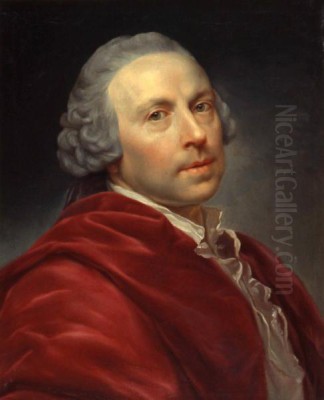
Anton von Maron stands as a significant, if sometimes overlooked, figure in the landscape of late 18th-century European art. An Austrian painter who found his artistic home and greatest success in Rome, Maron became one of the preeminent portraitists of his era, skillfully navigating the transition from the late Baroque and Rococo sensibilities to the burgeoning ideals of Neoclassicism. His career was inextricably linked with that of his teacher and brother-in-law, Anton Raphael Mengs, a leading proponent of Neoclassical theory and practice. Maron's meticulous technique, his ability to capture both a sitter's likeness and their social standing, and his engagement with the intellectual currents of his time, particularly through figures like Johann Joachim Winckelmann, solidify his place in art history.
Early Life and Artistic Genesis in Vienna
Born on January 8, 1733, in Vienna, the heart of the Habsburg Empire, Anton von Maron (christened Anton Maron, the "von" was a later ennoblement) emerged into a city rich in artistic tradition, though one still heavily influenced by the grandeur of the Baroque. His early artistic training in Vienna would have exposed him to the prevailing styles, likely under local masters whose names are not prominently recorded in connection with his formative years. However, Vienna, as a major European capital, was not isolated. It was a crucible of cultural exchange, and young artists were increasingly aware of developments elsewhere, particularly in Italy, the perennial lodestone for artistic pilgrimage and study.
The precise details of Maron's earliest education at the Academy of Fine Arts Vienna (Akademie der bildenden Künste Wien) are somewhat sparse, but it is clear that he demonstrated considerable talent from a young age. The Academy, while perhaps not as revolutionary as some institutions, provided a solid grounding in drawing, anatomy, and the principles of composition. It was during these formative years that Maron would have honed the foundational skills that would later define his precise and elegant style. However, like many ambitious artists of his generation, Maron recognized that to truly make his mark and to immerse himself in the wellspring of classical art, a journey to Italy was essential.
The Lure of Rome and the Mentorship of Mengs
In 1755, at the age of 22, Anton Maron made the pivotal decision to move to Rome. This was not merely a change of scenery but a profound immersion into the epicenter of the classical world and a vibrant contemporary art scene. Rome in the mid-18th century was a melting pot of artists, scholars, patrons, and Grand Tourists, all drawn by its ancient ruins, Renaissance masterpieces, and the intellectual ferment surrounding the rediscovery and reinterpretation of classical antiquity.
Crucially, upon his arrival or shortly thereafter, Maron entered the studio of Anton Raphael Mengs (1728-1779). Mengs, a German-Bohemian painter, was already a towering figure in Rome, celebrated for his erudition and his role as a key theorist and practitioner of the emerging Neoclassical style. Mengs advocated for a return to the purity of Greek art, as interpreted through Renaissance masters like Raphael, and a rejection of what he perceived as the frivolity of Rococo. His influence on Maron was transformative and profound.
Under Mengs's tutelage, Maron absorbed the principles of Neoclassicism: clarity of form, a smooth and polished finish, idealized yet recognizable figures, and a strong emphasis on drawing. Mengs was not just a technical instructor; he was an intellectual guide, and his circle included prominent figures like the art historian Johann Joachim Winckelmann, whose writings were foundational to the Neoclassical movement. Maron's association with Mengs provided him with unparalleled access to this influential network. In 1765, this relationship was further cemented when Maron married Mengs's sister, Therese Concordia Mengs (1725-1806), herself a talented painter, particularly of miniatures and pastels. This union brought Maron even more firmly into the Mengsian orbit, both personally and professionally.
Forging a Path in Portraiture
While Maron, like many academically trained artists, initially harbored ambitions for history painting – considered the noblest genre – he soon found his true calling and greatest success in portraiture. Rome was a bustling market for portraits, fueled by the stream of wealthy Grand Tourists from Britain and other parts of Europe, as well as by local and visiting aristocracy and high-ranking clergy. Maron's style, which blended Neoclassical dignity with a keen observation of individual character, proved highly appealing.
His portraits are characterized by their refined elegance, meticulous attention to detail in costume and setting, and a subtle psychological insight. He possessed a remarkable ability to convey the status and aspirations of his sitters while maintaining a sense of naturalism. His brushwork is typically smooth and controlled, creating surfaces that are almost enamel-like in their perfection. The lighting in his works is often carefully managed to model forms clearly and to create a sense of calm, ordered space, hallmarks of the Neoclassical aesthetic.
Maron quickly established himself as a rival to Pompeo Batoni (1708-1787), who had long been the leading portraitist in Rome, especially favored by British Grand Tourists. While Batoni's style often retained a slightly more Rococo grace and a penchant for elaborate allegorical settings, Maron's work leaned more decisively towards the sterner, more archaeologically informed Neoclassicism championed by Mengs and Winckelmann. This distinction, however, was not always rigid, and both artists catered to a discerning clientele that appreciated sophisticated and flattering representations.
Key Works and Notable Commissions
Anton von Maron's oeuvre is rich with portraits of some of the most distinguished figures of his time. Among his most celebrated works is the Portrait of Johann Joachim Winckelmann (1768). This iconic painting depicts the famed art historian and archaeologist seated in his study, surrounded by books and classical artifacts, quill in hand, gazing thoughtfully towards the viewer. Maron masterfully captures Winckelmann's intellectual intensity and his profound connection to the classical past. The composition is balanced and dignified, the lighting emphasizing Winckelmann's face and hands, drawing attention to his scholarly pursuits. This portrait is not merely a likeness but a tribute to a key intellectual figure of the Enlightenment and a testament to Maron's ability to convey character and context.
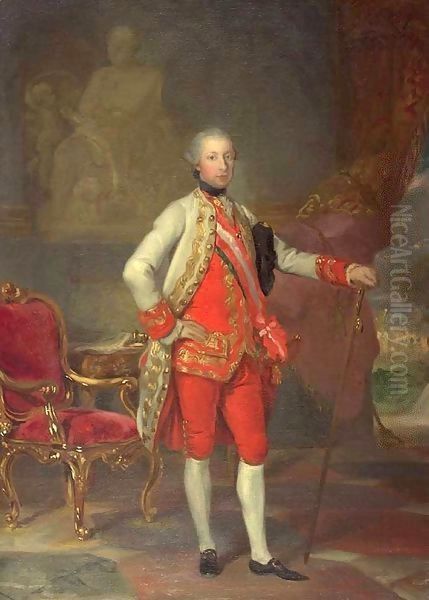
Maron also received prestigious commissions from European royalty and aristocracy. He painted members of the Habsburg imperial family, including portraits of Emperor Joseph II and later Emperor Franz II (Francis I of Austria). These imperial portraits required a careful balance of individual representation and the depiction of sovereign authority, a task at which Maron excelled. His portrait of Archduke Ferdinand Karl Anton of Austria-Este and his wife Maria Beatrice Ricciarda d'Este (circa 1775-1776) is another fine example of his grand manner portraiture, showcasing the sitters in opulent attire, surrounded by symbols of their status, yet rendered with a certain approachable dignity.
Another notable work, demonstrating his skill in group portraiture and his connection to the British Grand Tour phenomenon, is the Portrait of Franciszek and Kazimierz Rzewuski with Krystian Wilhelm Schütz (1772). This painting depicts the young Polish noblemen with their tutor, set against a backdrop that likely alludes to their classical studies in Rome. Such works were highly sought after as souvenirs of the educational and cultural journey undertaken by young European elites.
While portraiture was his mainstay, Maron did produce some history paintings, often with classical themes, such as The Return of Orestes (1796). These works, though fewer in number, demonstrate his commitment to Neoclassical principles in narrative composition, drawing on mythological or historical subjects to convey moral or heroic ideals. His history paintings, like his portraits, are characterized by clear drawing, balanced compositions, and a restrained emotional tenor.
The Roman Art World: Contemporaries and Connections
Anton von Maron operated within a vibrant and competitive artistic environment in Rome. His primary mentor and later brother-in-law, Anton Raphael Mengs, was undoubtedly the most significant influence. However, Maron's career also intersected with numerous other important artists.
Pompeo Batoni was his chief competitor in the lucrative field of Grand Tour portraiture. Their careers ran parallel for many years, and patrons often had to choose between the two leading masters. The Swiss-born Angelica Kauffmann (1741-1807) was another prominent Neoclassical artist active in Rome during part of Maron's career. Kauffmann, celebrated for her history paintings and portraits, was a founding member of the Royal Academy in London and enjoyed an international reputation. She, Maron, and Mengs were part of a circle that shared Neoclassical sympathies.
The Scottish painter Gavin Hamilton (1723-1798), also based in Rome, was another key figure in the Neoclassical movement, known for his large-scale history paintings based on Homeric themes. Hamilton, like Mengs and Winckelmann, was an important proponent of classical ideals. The Italian painter Domenico Corvi (1721-1803) was another contemporary working in a Neoclassical vein, often undertaking large altarpieces and historical subjects.
Maron would also have been aware of the work of French artists in Rome, such as Joseph-Marie Vien (1716-1809), who was a pioneer of Neoclassicism in France and served as director of the French Academy in Rome. Vien's students, including the great Jacques-Louis David (1748-1825), would later become the standard-bearers of Neoclassicism in France, and their presence in Rome for study would have contributed to the city's artistic dynamism.
The architect and etcher Giovanni Battista Piranesi (1720-1778), famous for his dramatic views of Roman ruins (the Vedute di Roma) and his imaginative "Prisons" series (Carceri d'invenzione), also shaped the contemporary perception of Rome and influenced the Neoclassical imagination, even if his style was more Romantic in its intensity. Maron's circle also included sculptors like Christopher Hewetson (c. 1737-1798), an Irish Neoclassical sculptor active in Rome, known for his portrait busts.
Maron's students included figures like Giovanni Domenico Cherubini and Giovanni Battista Piamontesi, who would have carried forward aspects of his style and teaching. He also had connections with artists from other parts of Europe who passed through Rome, such as the Spanish painter Francisco Bayeu y Subías (1734-1795), who was a brother-in-law of Francisco Goya and worked with Mengs in Madrid. The German painter Johann Zoffany (1733-1810), though primarily active in England, also spent time in Italy and his group portraits, or "conversation pieces," offer an interesting comparison to Maron's more formal works. Even the Venetian masters like Giovanni Battista Tiepolo (1696-1770), though representing an older, more Rococo tradition, had sons like Giandomenico Tiepolo (1727-1804) whose later work showed an awareness of the shifting tastes towards Neoclassicism.
Academic Role and Later Years
Anton von Maron's standing in the Roman art world was formally recognized through his involvement with the Accademia di San Luca, the prestigious academy of artists in Rome. He became a member of the Accademia and, significantly, served as its Principe (Director) in 1784. This position underscored his reputation and influence among his peers. As Director, he would have played a role in shaping the curriculum, organizing exhibitions, and upholding the standards of artistic practice in the city.
His marriage to Therese Concordia Mengs in 1765 was a significant personal and professional alliance. Therese was an accomplished artist in her own right, specializing in pastels and miniatures, and she likely played a supportive role in Maron's career, managing aspects of his studio or assisting with copies, as was common in artistic families of the time.
Maron continued to paint actively throughout his life, adapting subtly to evolving tastes but remaining fundamentally committed to the Neoclassical principles he had absorbed from Mengs. He was known for his diligent work ethic and his professional demeanor. His studio was a respected establishment, attracting pupils and patrons alike. He also engaged in the study and copying of ancient Roman frescoes, contributing to the era's burgeoning archaeological interest. This practice not only deepened his understanding of classical art but also provided valuable visual resources for the Neoclassical movement.
Artistic Style: Precision, Elegance, and Neoclassical Ideals
Maron's artistic style is a quintessential example of Roman Neoclassicism, particularly in portraiture. His approach was characterized by several key elements:
1. Linear Precision: Drawing was fundamental. His figures are clearly delineated, with firm contours and a strong sense of underlying anatomical structure. This emphasis on line over painterly effect was a core tenet of Neoclassicism, inspired by ancient sculpture and Renaissance masters like Raphael.
2. Smooth Finish: Maron typically employed a highly polished finish, with minimal visible brushstrokes. This created an effect of idealized perfection and clarity, distancing his work from the more gestural and textured surfaces of Rococo or Baroque painting.
3. Balanced Composition: His portraits are generally well-balanced and harmonious, often employing stable pyramidal or triangular compositions. Sitters are presented with dignity and composure, reflecting the Neoclassical emphasis on order and rationality.
4. Subdued Palette and Controlled Lighting: While his colors could be rich, particularly in depicting luxurious fabrics, his overall palette was often more restrained than that of his Rococo predecessors. Lighting was used to model forms clearly and create a sense of three-dimensionality, but rarely for overtly dramatic effect. Instead, it contributed to the calm and clarity of the scene.
5. Psychological Acuity: Despite the idealizing tendencies of Neoclassicism, Maron was adept at capturing the individual character and personality of his sitters. His portraits are not mere masks; they convey a sense of presence and often a subtle psychological insight.
6. Attention to Detail: Maron rendered costumes, accessories, and settings with meticulous care. These details were not merely decorative; they served to indicate the sitter's social status, profession, or cultural interests, as seen in the books and artifacts surrounding Winckelmann.
7. Classical Allusions: Often, his portraits would incorporate classical elements in the background – a column, a sculpture, a view of ancient ruins – to situate the sitter within the esteemed tradition of antiquity and to underscore their cultural sophistication.
Maron's style represented a conscious departure from the dynamic movement and emotional intensity of the Baroque and the playful sensuality of the Rococo. It embodied the Enlightenment values of reason, order, and moral seriousness, finding its ideal expression in the perceived purity and rationality of classical art.
Legacy and Lasting Influence
Anton von Maron died in Rome on March 3, 1808, at the age of 75. He had spent over five decades in the city, becoming one of its most respected artistic figures. His legacy is multifaceted. As a portraitist, he created a valuable record of the leading personalities of his time, from emperors and popes to scholars and Grand Tourists. His works are prized for their technical excellence and their elegant representation of an era.
He played a crucial role, alongside Mengs, in establishing and popularizing the Neoclassical style in Rome, which then radiated outwards to influence art across Europe. His adherence to Neoclassical principles, combined with his skill in capturing individual likeness, provided a model for subsequent portrait painters. While perhaps not as revolutionary a figure as Jacques-Louis David, Maron was a master of his craft and a significant contributor to the dominant artistic movement of his age.
His influence extended through his students and through the many artists who would have studied his works in Rome. He helped to solidify Rome's position as a center for Neoclassical art and contributed to the cultural exchange between Austria, Germany, Italy, and other European nations. Today, Anton von Maron's paintings are held in major museums and collections worldwide, including the Kunsthistorisches Museum in Vienna, the Uffizi Gallery in Florence, the National Gallery in London, and the Hermitage Museum in St. Petersburg. They continue to be admired for their refined beauty, their historical significance, and their embodiment of Neoclassical ideals. He remains a testament to the enduring power of portraiture to capture not just a face, but an era.