Antonio Cortés Cordero: A Spanish Painter of the 19th Century and His Artistic Milieu
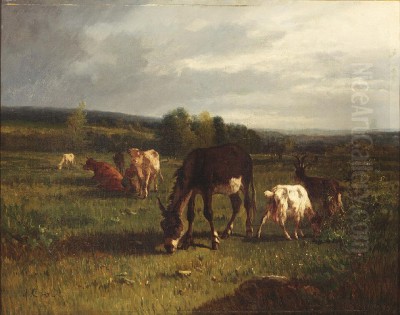
Antonio Cortés Cordero, a Spanish painter active during the vibrant and transformative 19th century, offers a glimpse into the artistic currents of his time. While perhaps not as globally renowned as some of his contemporaries, his work, his familial connections to the art world, and his presence in notable Spanish collections secure his place in the annals of Spanish art history. Understanding his contributions requires situating him within the broader European and Spanish artistic landscape, a period marked by the waning of Neoclassicism, the passion of Romanticism, the rise of Realism, and the nascent stirrings of Impressionism.
Biographical Sketch and Known Works
Born in 1827, Antonio Cortés Cordero lived until 1908, a lifespan that bridged significant shifts in artistic paradigms. Information regarding his early training and the full scope of his oeuvre remains somewhat elusive in comprehensive art historical surveys, often overshadowed by more dominant figures or, in some instances, confused with other individuals bearing similar names from different fields. However, specific works and collection records provide concrete evidence of his practice.
One of the most frequently cited pieces by Antonio Cortés Cordero is "Vaches près de l'étang" (Cows near the Pond). This oil on canvas, measuring 57 x 81 cm, is dated to 1859. The subject matter – a pastoral scene featuring livestock in a natural setting – aligns with popular themes in 19th-century landscape and animal painting. Such scenes often sought to capture the rustic charm of the countryside, sometimes with a romanticized sensibility, other times with a more objective, Realist approach. The 1859 date places this work firmly in a period when Realism was gaining significant traction across Europe, challenging the idealized forms of Academic art and the emotional intensity of Romanticism.
The style of "Vaches près de l'étang," though detailed visual analysis without direct access is speculative, would likely reflect the prevailing tastes for naturalism. It might share affinities with the works of the French Barbizon School painters, such as Jean-Baptiste-Camille Corot, Théodore Rousseau, or Charles-François Daubigny, who championed plein air (outdoor) sketching and a direct, unembellished depiction of nature. In Spain, a similar impetus towards landscape realism was also developing, influenced by both international trends and local traditions.
The Artistic Context of 19th-Century Spain
To appreciate Antonio Cortés Cordero's position, one must consider the dynamic art scene of 19th-century Spain. The century began under the long shadow of Francisco Goya (1746-1828), whose powerful and often unsettling works defied easy categorization and profoundly influenced subsequent generations. His unflinching portrayal of contemporary events, his psychological depth in portraiture, and his imaginative "Black Paintings" set a high bar for artistic innovation.
Following Goya, Spanish art navigated various European trends. Romanticism found expression in historical and literary themes, often imbued with a sense of national pride or dramatic fervor. Key figures in Spanish Romantic painting include Federico de Madrazo y Kuntz (1815-1894), who, while also a master of portraiture within an academic framework, produced works with Romantic sensibilities. His contemporary, Eugenio Lucas Velázquez (1817-1870), often evoked Goya's spirit in his dynamic and sometimes dark genre scenes.
The mid-century, when Cortés Cordero was active, saw the rise of Realism. In Spain, this often translated into detailed genre scenes, historical paintings rendered with meticulous accuracy, and an increasing interest in landscape. Carlos de Haes (1826-1898), a Belgian-born painter who became a highly influential professor at the Royal Academy of Fine Arts of San Fernando in Madrid, was a pivotal figure in promoting a more objective and naturalistic approach to landscape painting, encouraging his students to work directly from nature. His impact on a generation of Spanish landscape artists was profound.
Another towering figure of Spanish art in the latter half of the 19th century was Mariano Fortuny y Marsal (1838-1874). Though his life was short, Fortuny achieved international fame for his brilliantly colored, technically dazzling genre scenes, often with Orientalist themes or set in the Rococo period. His virtuosity and vibrant palette influenced many, even if his style was more about "preciosismo" – a meticulous, jewel-like finish – than the broader tenets of French Realism as championed by Gustave Courbet (1819-1877).
Later in the century, artists like Joaquín Sorolla (1863-1923) would emerge, capturing the brilliant light of the Spanish coast with a style often described as Spanish Impressionism or Luminism. While Sorolla belongs to a slightly later generation than Cortés Cordero's primary period of activity for "Vaches près de l'étang," his work represents the culmination of 19th-century Spanish painting's engagement with light and contemporary life. Other notable contemporaries who shaped the artistic landscape include Martín Rico y Ortega (1833-1908), known for his luminous cityscapes, particularly of Venice, and Raimundo de Madrazo y Garreta (1841-1920), son of Federico, who excelled in elegant portraiture and genre scenes.
A Familial Artistic Legacy: Edouard Cortès
One of the most significant aspects of Antonio Cortés Cordero's legacy is his connection to his son, Edouard Cortès (1882-1969). Edouard, though French by birth and primarily active in France, was of Spanish descent through his father. He became a highly popular Post-Impressionist painter, renowned for his evocative Parisian street scenes, particularly at dusk or during inclement weather, imbued with a warm, inviting light emanating from shop windows and street lamps.
The artistic environment provided by a painter father like Antonio would undoubtedly have been formative for the young Edouard. Growing up in a household where art was practiced and discussed would have offered early exposure to materials, techniques, and artistic discourse. While Edouard Cortès developed his own distinct style, focusing on the urban landscapes of Paris rather than the pastoral scenes like his father's "Vaches près de l'étang," the foundational influence of a paternal artistic figure is a common thread in the biographies of many artists.
Edouard Cortès's style, characterized by its vibrant yet harmonious color palette and its ability to capture the atmosphere of Belle Époque and early 20th-century Paris, found a wide audience. His works are distinct from the more radical avant-garde movements of his time, such as Cubism, pioneered by Pablo Picasso (another Spaniard who made his career largely in France) and Georges Braque. Instead, Edouard Cortès continued a tradition of representational painting that appealed to a broad public, much like the works of other Parisian scene painters such as Jean Béraud or Luigi Loir. The connection between Antonio Cortés Cordero and his more famous son highlights the intergenerational transmission of artistic inclination and the international nature of art in Europe.
Representation in Collections
The presence of Antonio Cortés Cordero's work in significant Spanish collections attests to his recognition within his national context. His paintings are held by the Museo Nacional del Romanticismo in Madrid. This museum is dedicated to the art and culture of Spanish Romanticism, and while Cortés Cordero's 1859 work "Vaches près de l'étang" leans more towards Realism, the period of Romanticism (roughly the first half of the 19th century) provided the immediate backdrop and, in some ways, the cultural soil from which later movements grew. The museum's collection offers a rich tapestry of the era, featuring works by many of the artists mentioned, including Federico de Madrazo and Eugenio Lucas Velázquez.
His art is also found in the Colección Bellver in Seville. This important private collection, now housed in the Casa Fabiola, showcases 19th and early 20th-century Spanish painting, with a particular focus on Sevillian art but also encompassing broader national trends. The inclusion of Cortés Cordero's work here places him alongside other artists who contributed to the diverse artistic production of the period. Such collections are invaluable for understanding the nuances of regional and national art histories that might be overlooked in grander, international narratives.
Style and Potential Influences
Given the 1859 date of "Vaches près de l'étang" and its pastoral subject, it is plausible to situate Antonio Cortés Cordero's style within the broader movement of 19th-century Realism, with potential affinities to the Barbizon School in France. These French painters, including Constant Troyon (known for his animal paintings) and Rosa Bonheur (celebrated for her realistic depictions of animals), emphasized direct observation of nature and rural life. Their influence was felt across Europe, and Spanish artists were not immune to these trends, often traveling to Paris or being exposed to French art through publications and exhibitions.
In Spain itself, the tradition of landscape and genre painting had deep roots. The works of earlier masters like Diego Velázquez (1599-1660), with his remarkably modern approach to landscape in his Villa Medici views, or the genre scenes of Bartolomé Esteban Murillo (1617-1682), provided a rich heritage. While direct stylistic links might be tenuous across centuries, the enduring Spanish appreciation for realism and scenes of everyday life formed part of the cultural context.
Cortés Cordero's work would have been created during a time when academic training was still paramount, emphasizing strong drawing skills and a degree of finish. However, the Realist impulse encouraged artists to look beyond idealized subjects and classical compositions towards the world around them. The depiction of "Cows near the Pond" suggests an engagement with this ethos, choosing a humble, everyday scene rather than a grand historical or mythological narrative. The quality of light, the rendering of animal anatomy, and the depiction of the landscape would all be key indicators of his specific stylistic approach within the Realist spectrum.
Challenges in Reconstructing a Full Profile
It is important to acknowledge the challenges in constructing a complete artistic biography for painters like Antonio Cortés Cordero who may not have achieved the same level of fame or whose works are not as extensively documented as some of their peers. Art history often prioritizes major innovators or figures who became emblematic of particular movements. However, the fabric of art history is woven from the contributions of many artists, each reflecting and shaping the cultural environment of their time.
The confusion in some sources with other individuals named Antonio Cortés or Cordero (such as the Mexican politician Antonio Rocha Cordero or the tenor Antonio Cortis) underscores the need for careful scholarship in distinguishing historical figures. For Antonio Cortés Cordero, the painter, the verifiable facts – his lifespan, his Spanish nationality, his specific artwork "Vaches près de l'étang," his connection to Edouard Cortès, and his representation in the Museo Nacional del Romanticismo and Colección Bellver – provide a solid foundation.
Further research into Spanish art archives, exhibition records from the period, and provincial art historical studies might yield more information about his career, other potential works, and his interactions with the artistic community of his day. For instance, records of Salons or national exhibitions in Spain during the mid-to-late 19th century could reveal his participation and critical reception.
Legacy and Conclusion
Antonio Cortés Cordero's legacy, while perhaps modest in comparison to giants like Goya or Sorolla, is nonetheless significant. As a Spanish painter of the 19th century, he contributed to the artistic currents of his era, likely working within the Realist tradition that valued direct observation and the depiction of everyday life and landscape. His painting "Vaches près de l'étang" serves as a tangible example of this engagement.
His most prominent legacy might be through his son, Edouard Cortès, a celebrated painter of Parisian scenes. The familial link underscores the often-personal and intergenerational nature of artistic pursuits. Furthermore, the inclusion of Antonio Cortés Cordero's works in respected Spanish collections like the Museo Nacional del Romanticismo and the Colección Bellver ensures that his contribution is preserved and available for study, allowing for a more nuanced understanding of the breadth and depth of 19th-century Spanish art.
He stands as a representative of a generation of artists who, working within established genres like landscape and animal painting, reflected the evolving tastes and artistic philosophies of their time. While the full extent of his oeuvre and influence awaits further elucidation, Antonio Cortés Cordero remains a noteworthy figure in the rich panorama of Spanish art history, a painter whose work offers a window into the pastoral concerns and Realist aesthetics of the mid-19th century. His art, and the art of his contemporaries, helps to paint a fuller picture of a fascinating period of artistic transition and achievement in Spain and beyond.