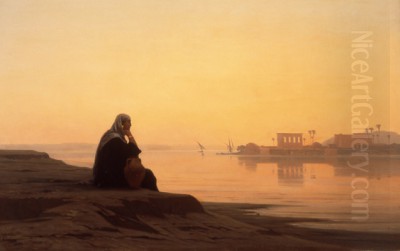
Auguste Louis Veillon (1834-1890) stands as a significant, if sometimes overlooked, figure in 19th-century Swiss art. A dedicated landscape painter, his oeuvre captures the majestic beauty of his native Alps, the luminous allure of Venetian canals, and the exotic mystique of North African vistas. Working in both oil and watercolor, Veillon developed a distinctive style characterized by a keen sensitivity to light and atmosphere, placing him firmly within the Romantic tradition while also hinting at the emerging concerns of Realism. His extensive travels provided a rich tapestry of subjects, allowing him to explore diverse environments and their unique play of light, which became a hallmark of his artistic identity.
Early Life and Artistic Formation in Switzerland
Born in 1834 in Bex, a picturesque town nestled in the Canton of Vaud near the Rhône valley and close to the border of Canton Wallis, Auguste Louis Veillon was immersed from a young age in the stunning natural beauty of Switzerland. This early exposure to dramatic mountain scenery, serene lakes, and verdant valleys undoubtedly shaped his artistic inclinations. The mid-19th century was a fertile period for landscape painting in Switzerland, with artists increasingly turning their attention to the sublime and picturesque qualities of their homeland, a trend that had been gaining momentum since the pioneering work of painters like Caspar Wolf in the late 18th century.
Veillon's formal artistic training began in Geneva under the tutelage of François Diday (1802-1877). Diday was a leading figure of the Geneva School of landscape painting, renowned for his dramatic and often idealized depictions of the Alps. Alongside his contemporary and sometimes rival, Alexandre Calame (1810-1864), who also studied with Diday, he helped to popularize Swiss mountain scenery across Europe. Under Diday, Veillon would have learned the fundamentals of landscape composition, the techniques for rendering the textures of rock and ice, and the importance of capturing the grandeur of nature. The influence of these masters, particularly their emphasis on the sublime aspects of the Alpine environment, can be seen in Veillon's early works. Other notable Swiss artists of the period, such as Barthélemy Menn (1815-1893), who became an influential teacher in Geneva, were also contributing to a vibrant artistic scene that valued direct observation of nature, albeit often filtered through a Romantic sensibility.
Veillon's education was not confined to Geneva. The traditional path for aspiring artists of his time often included a period of study and travel abroad, particularly to the artistic capitals of Europe. This exposure to different artistic traditions and environments was considered crucial for broadening an artist's horizons and refining their skills.
The Grand Tour Broadened: Paris, Rome, and the Netherlands
Following his studies in Geneva, Veillon embarked on travels that took him to several key artistic centers. Paris, then the undisputed capital of the art world, would have exposed him to a dynamic range of styles and movements. The Barbizon School, with artists like Jean-Baptiste-Camille Corot (1796-1875) and Théodore Rousseau (1812-1867), was championing a more naturalistic approach to landscape painting, emphasizing plein air sketching and a direct engagement with the rural environment. While Veillon remained rooted in a more Romantic tradition, the influence of French naturalism, with its focus on accurate depiction and atmospheric effects, likely resonated with his own artistic pursuits.
Rome, another essential stop on the traditional Grand Tour, offered a wealth of classical and Renaissance art, as well as a picturesque surrounding countryside that had attracted landscape painters for centuries. The experience of Italian light and landscape, different in quality and character from that of Switzerland, would have been invaluable. Artists like Claude Lorrain (1600-1682) and Nicolas Poussin (1594-1665) had established a classical landscape tradition in Rome that continued to influence painters.
Veillon also journeyed to the Netherlands. Dutch Golden Age painting, particularly the works of landscape artists such as Jacob van Ruisdael (c. 1629-1682) and Meindert Hobbema (1638-1709), was celebrated for its meticulous observation of nature, its subtle rendering of light and atmosphere, and its focus on everyday scenery. This tradition, with its emphasis on realism and the specific character of a place, may have offered Veillon an alternative perspective to the grandiosity of Alpine scenery or the historical weight of Roman landscapes. The Dutch mastery of light, especially in depicting skies and water, could have provided rich lessons for a painter so attuned to atmospheric effects.
These travels were not merely sightseeing expeditions; they were integral to Veillon's artistic development, allowing him to absorb diverse influences, experiment with different techniques, and expand his repertoire of subjects. Each location offered unique challenges and opportunities for capturing the interplay of light, color, and form.
The Venetian Interlude: Capturing the Serene Republic
A significant period in Veillon's artistic journey was the two years he spent living in Venice. The city of canals, with its unique architecture, shimmering reflections, and ever-changing light, had long been a magnet for artists. From the veduta painters of the 18th century, such as Canaletto (1697-1768) and Francesco Guardi (1712-1793), who captured its bustling life and architectural splendor, to later Romantic painters like J.M.W. Turner (1775-1851), who evoked its ethereal, dreamlike qualities, Venice offered endless inspiration.
Veillon was captivated by the city's distinctive atmosphere. His Venetian scenes often focus on the interplay of light on water and stone, the subtle gradations of color at dawn or dusk, and the tranquil, sometimes melancholic, beauty of its less-frequented canals and lagoons. He sought to capture not just the topographical accuracy of a scene but its mood and emotional resonance. Works like Evening in Venice (a title associated with his Venetian period, though specific dating can be complex) and La Punta della Dogana, Venice exemplify his approach. In La Punta della Dogana, Venice, he depicts the iconic customs house at the entrance to the Grand Canal, likely focusing on the atmospheric conditions and the way light models the historic architecture and reflects off the water. This painting, which later fetched 6,000 Swiss Francs at auction, showcases his ability to render the unique charm of the city.
His contemporary, Félix Ziem (1821-1911), was also renowned for his vibrant and often romanticized views of Venice, and while their styles differed, they shared a common fascination with the city's luminous qualities. Veillon's Venetian works are characterized by a delicate touch, a refined color palette, and a sense of poetic realism. He was less interested in the grand ceremonial aspects of Venice and more in its intimate moments, its quiet corners, and the ephemeral effects of light that define its unique character.
Journeys to the Orient: The Lure of Egypt
The 19th century witnessed a surge of European interest in the "Orient"—a term then used broadly to refer to North Africa, the Middle East, and sometimes further afield. This fascination, fueled by colonial expansion, archaeological discoveries, and romantic literature, gave rise to Orientalism in art, a genre that depicted the landscapes, people, and cultures of these regions, often through a romanticized or exoticizing lens. Auguste Louis Veillon was among the many European artists drawn to these lands, particularly Egypt.
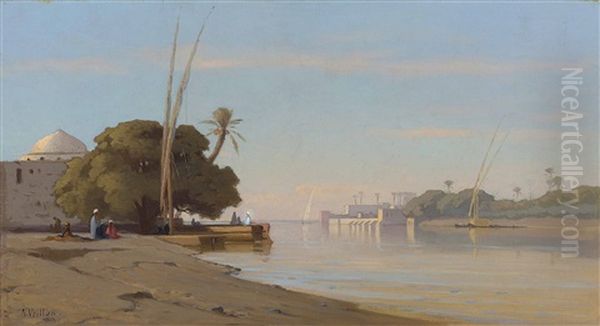
He made at least one significant trip to Egypt, reportedly in 1874 in the company of a painter friend, possibly Alexis Diday (the son of his teacher, or another artist with a similar name). The Nile, with its ancient monuments, vibrant river life, and distinctive desert light, offered a stark contrast to the Alpine scenery of his homeland or the watery vistas of Venice. Veillon's Egyptian works, such as the notably titled Mosque on the banks of the Nile and Le Nil environs d'Edfou, reflect his engagement with this new environment.
Mosque on the banks of the Nile, exhibited in Zurich in 1889 and later sold for a modest sum (400/600 Swiss Francs, perhaps indicating it was a smaller study or watercolor), would have allowed Veillon to explore the interplay of Islamic architecture with the riverine landscape. He would have been interested in the quality of the North African light – its clarity, intensity, and the way it created sharp contrasts and vibrant colors. Le Nil environs d'Edfou suggests a focus on a specific location along the Nile, known for its well-preserved ancient temple.
Veillon's Orientalist works can be seen in the context of other prominent Orientalist painters of his era. Jean-Léon Gérôme (1824-1904) was famous for his highly detailed and often dramatic scenes of Egyptian and Middle Eastern life. Eugène Fromentin (1820-1876) brought a more painterly and atmospheric approach to his depictions of Algeria. British artists like David Roberts (1796-1864), with his extensive series of lithographs of Egypt and the Holy Land, and John Frederick Lewis (1804-1876), known for his intricate watercolors of Cairo interiors, had already established a strong visual tradition of Orientalist art. Ludwig Deutsch (1855-1935) and Rudolf Ernst (1854-1932) were later Austrian painters who specialized in meticulously rendered Orientalist scenes. American artist Frederick Arthur Bridgman (1847-1928) also gained fame for his depictions of North Africa.
Compared to some of the more overtly ethnographic or narrative-driven works of his contemporaries, Veillon's Orientalist paintings likely maintained his characteristic focus on landscape and atmosphere. He was probably less concerned with detailed depictions of customs or historical events and more with capturing the essence of the place through its light, color, and overall mood. His Orientalist Scene, once in the collection of Dr. Jules Coulin of Basel, further attests to his engagement with these themes.
The Swiss Homeland Revisited: Alpine Vistas and Tranquil Lakes
Despite his extensive travels and his fascination with foreign lands, Veillon frequently returned to Swiss subjects throughout his career. The landscapes of his youth, the majestic Alps and serene lakes, remained a constant source of inspiration. His Swiss scenes, painted with the benefit of his international experience, often display a mature understanding of light and composition.
Works like Lake of Brienz (the title "Lake of Bribes" in some records is almost certainly a mistranscription of Brienz) showcase his ability to capture the tranquil beauty of the Swiss lakes, often framed by towering mountains. Lake Brienz, with its distinctive turquoise waters and dramatic surrounding peaks, was a popular subject for 19th-century landscape painters. Veillon would have sought to convey the specific atmospheric conditions of such scenes – the clarity of the mountain air, the reflections on the water's surface, and the subtle shifts in color throughout the day.
His approach to Alpine scenery, while rooted in the tradition of Diday and Calame, likely evolved over time. While early Romantic depictions often emphasized the terrifying sublime and the untamed power of nature, later artists, including Veillon, sometimes sought a more harmonious or picturesque vision, or a more nuanced exploration of light and atmosphere. His Swiss landscapes are an important part of his legacy, demonstrating his deep connection to his native land and his ability to reinterpret familiar scenes with fresh eyes. He was part of a continuing tradition of Swiss artists, including later figures like Ferdinand Hodler (1853-1918), who found profound inspiration in the Alpine environment, though Hodler's style would move towards Symbolism and a more monumental approach.
Artistic Style, Techniques, and Thematic Focus
Auguste Louis Veillon's artistic style is characterized by a delicate balance between Romantic sensibility and an emerging Realist observation. His primary concern was the accurate yet evocative depiction of light and atmosphere. Whether painting the crisp air of the Alps, the hazy humidity of Venice, or the brilliant sunshine of Egypt, Veillon demonstrated a remarkable ability to capture the specific quality of light in each environment.
He worked proficiently in both oil and watercolor. His oil paintings often possess a smooth finish and a careful attention to detail, while his watercolors showcase a lighter touch and a greater emphasis on transparency and luminosity. Watercolor was particularly well-suited for capturing fleeting atmospheric effects and for sketching outdoors, a practice that was becoming increasingly common among landscape painters in the 19th century.
His compositions are generally well-balanced, often leading the viewer's eye into the scene through carefully constructed perspectives. He paid close attention to the nuances of color, employing a palette that could range from the cool blues and grays of an Alpine morning to the warm golden hues of a Venetian sunset or the vibrant tones of an Oriental marketplace.
Thematically, Veillon's work revolved around landscape. While figures occasionally appear in his scenes, they are usually secondary to the overall depiction of the natural or architectural environment. His interest lay in the mood and character of a place, as revealed through its light, weather, and topography. This focus aligns him with the broader concerns of 19th-century landscape painting, which saw nature increasingly valued as a subject in its own right, capable of conveying a wide range of emotions and ideas. His work can be seen as part of the Swiss Romantic movement, which, while sharing characteristics with German and French Romanticism, also had its own distinct regional inflections, particularly in its celebration of the Alpine landscape.
Exhibitions, Recognition, and Legacy
Auguste Louis Veillon actively exhibited his work during his lifetime, gaining recognition for his skills as a landscape painter. The record of his participation in the Swiss Art Exhibition in Zurich in 1889, where he showed works such as Mosque on the banks of the Nile, Lac de Tibériade, matin d'Avril (Lake Tiberias, April Morning), and Le Nil environs d'Edfou, indicates his standing within the Swiss art community. Lac de Tibériade suggests his travels may have also extended to the Holy Land, another popular destination for Orientalist painters.
His paintings found their way into private collections, such as the aforementioned Orientalist Scene owned by Dr. Jules Coulin in Basel, and La Punta della Dogana, Venice, which was in a Swiss private collection before being auctioned. The auction records, though modest for some pieces, confirm that his work was appreciated and collected.
While perhaps not achieving the same level of international fame as some of his more flamboyant contemporaries, Veillon carved out a niche for himself as a painter of refined and atmospheric landscapes. His dedication to capturing the nuances of light and his ability to evoke the distinct character of diverse geographical locations mark him as a talented and sensitive artist. His work provides valuable insight into the artistic concerns of his time, straddling the late Romantic fascination with the sublime and the exotic, and the growing 19th-century interest in a more direct and observational approach to the natural world.
Auguste Louis Veillon passed away in 1890. His legacy lies in his evocative depictions of the world as he saw it, from the familiar peaks of his native Switzerland to the sun-drenched banks of the Nile and the shimmering canals of Venice. He remains a noteworthy representative of Swiss 19th-century landscape painting, an artist whose work continues to charm with its quiet beauty and its masterful handling of light. His paintings serve as a visual diary of his travels and a testament to his lifelong pursuit of capturing the ephemeral essence of place and atmosphere. His contribution enriches our understanding of a period when artists were increasingly venturing forth to explore and interpret the wider world, bringing back visions that expanded the imaginative horizons of their audiences.