Introduction
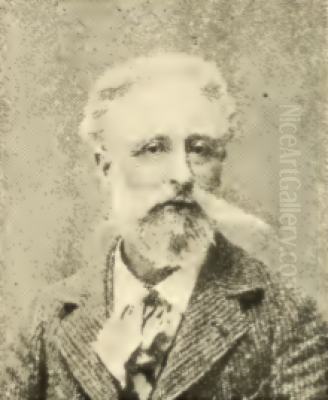
Émile Boivin (1846-1920) presents a fascinating and somewhat enigmatic figure within the landscape of late 19th and early 20th-century French art. Primarily recognized today for his evocative Orientalist paintings, particularly watercolors depicting North African desert scenes, Boivin lived a life marked by a unique duality. He was not only a dedicated artist capturing the light and atmosphere of distant lands but also an ordained Catholic priest serving communities in France. This article delves into the known aspects of Boivin's life, explores his artistic output and style, places him within the vibrant artistic context of his time, and examines his presence in the art market, painting a portrait of a man whose devotion seemingly spanned both the spiritual and the aesthetic realms.
Life and Background: A French Identity
Details regarding Émile Boivin's early life and formal training remain scarce in readily available records, a common challenge when researching artists who operated outside the main avant-garde circles of their time. However, key biographical points establish his identity firmly within France. He was born in La Chapelle-Saint-Sauveur, a commune in the Saône-et-Loire department of eastern France, in 1846. This places his formative years squarely within a period of significant social and political change in France, transitioning from the July Monarchy through the Second Republic and into the Second Empire.
His French nationality is undisputed. His life and career unfolded within French borders, marked by significant milestones tied to French institutions. One of the most defining aspects of his professional life was his commitment to the Catholic Church. Records indicate that Émile Boivin was ordained as a priest in 1897. Following his ordination, he served in various pastoral roles within France. He is known to have been the parish priest (curé) in Muides-sur-Loire and later, from 1911, in Ternay (Loir-et-Cher). His involvement in religious life is further evidenced by his participation in a Catholic conference or synod held in Blois in 1934, although this date seems problematic given his generally accepted death year of 1920 – suggesting either a discrepancy in records or perhaps confusion with another individual of the same name later on. However, the core identity as a French priest active in the late 19th and early 20th centuries is consistent.
Beyond his religious duties and artistic pursuits, Boivin also demonstrated an interest in historical scholarship. He is credited with authoring a book titled Histoire du journalisme (History of Journalism). This foray into writing suggests an intellectual curiosity extending beyond theology and art, hinting at a multifaceted personality engaged with the broader cultural and historical currents of his era. His life concluded in 1920, capping a career that uniquely blended clerical service with artistic creation.
The Dual Path: Priest and Painter
The combination of a Catholic priest and an Orientalist painter is certainly unusual and prompts intriguing questions about how Boivin reconciled or integrated these two seemingly disparate callings. The historical record, unfortunately, offers little direct insight into his personal thoughts on this matter. We lack diaries, letters, or extensive interviews that might illuminate his motivations or the interplay between his faith and his art. Did he view his artistic talent as a God-given gift to be cultivated? Did his travels to North Africa, presumably the inspiration for his Orientalist works, occur before his ordination, during specific leaves of absence, or were they perhaps mental voyages fueled by the accounts and images of others?
Orientalism as an artistic movement often involved themes of exoticism, sensuality, and sometimes ethnographic observation that could potentially sit uneasily with traditional clerical sensibilities. Boivin's known works, however, tend to focus on landscapes, caravans, and scenes of daily life in the desert – subjects less likely to court controversy than, say, depictions of harems or violent historical events favored by some other Orientalists. His paintings often emphasize the vastness and atmosphere of the desert, the play of light, and the resilience of life in harsh environments. One might speculate whether his religious perspective influenced his choice of subject matter, perhaps finding a spiritual dimension in the stark beauty and solitude of the desert, or seeing dignity in the lives of its inhabitants.
Alternatively, his art might have been a more private passion, pursued alongside his clerical duties without necessarily being deeply integrated theologically. The late 19th century saw many individuals pursuing diverse interests. It's possible Boivin simply possessed a strong artistic inclination and the means or opportunity to develop it, finding in the popular Orientalist genre a suitable vehicle for his talents. His authorship of a history of journalism further complicates a simple profile, suggesting a man of broad intellectual engagement. Without more personal documentation, the precise nature of his dual path remains a subject for conjecture, adding a layer of mystique to his biography.
Artistic Style: The Allure of the Orient
Émile Boivin's artistic reputation rests primarily on his work as an Orientalist painter. This genre, immensely popular in Europe throughout the 19th century, focused on depicting scenes from North Africa, the Middle East, and Asia – lands perceived by Europeans as exotic, mysterious, and often romanticized. Boivin worked in both watercolor and oil, but he seems particularly noted for his facility with watercolor, a medium well-suited to capturing the luminous effects of desert light and atmosphere.
His style is characterized by a fluid and confident application of color. Descriptions of his work highlight his ability to render the subtle gradations of light on sand, the deep shadows cast by figures or structures, and the vibrant hues of sky at dawn or sunset. While rooted in a representational approach, aiming for recognizable scenes, his work often transcends mere topographical accuracy. There's a sense of atmosphere and mood, achieved through skillful handling of light and color, that aligns his work with a blend of Realism and Romanticism. The brushwork is often described as detailed yet retaining a certain painterly quality, avoiding photographic rigidity.
His subject matter consistently revolves around North African themes, particularly desert landscapes. Common motifs include vast expanses of sand, oasis settings providing respite, Bedouin figures, travelers, and caravans traversing the arid terrain. Works like Beduini nel deserto (Bedouins in the Desert) and La caravane avant l'oasis (The Caravan Before the Oasis) exemplify this focus. He seems less interested in dramatic historical narratives or ethnographic studies of costume and custom, and more focused on the relationship between figures and the overwhelming scale and specific atmospheric conditions of the desert environment. The recurring theme of travelers moving through the landscape perhaps resonated with his own life journey or spiritual understanding.
Compared to some of the leading figures of Orientalism, like the highly detailed and often dramatic Jean-Léon Gérôme or the more romantically inclined Eugène Fromentin, Boivin's work might be seen as occupying a quieter, more atmospheric niche within the genre. His strength lay in capturing the visual poetry of the desert landscape itself.
Notable Works
While a complete catalogue raisonné of Émile Boivin's work may not exist, auction records and descriptions provide glimpses into his artistic output. Several specific pieces help illustrate his style and thematic concerns:
Beduini nel deserto (Bedouins in the Desert): This watercolor, measuring 24 x 34.5 cm, appeared at auction with an estimate of €700-900. The title clearly indicates his focus on desert inhabitants within their environment. Its medium, watercolor, suggests an emphasis on light and atmosphere.
A Late 19th Century Desert Scene: Described as a watercolor depicting travelers resting at a fountain during sunset, this work (29.5 x 39 cm) highlights Boivin's skill in capturing specific times of day and the interplay of light, shadow, and human activity within the landscape. The inclusion of a fountain suggests an oasis setting, a common Orientalist motif.
La caravane avant l'oasis (The Caravan Before the Oasis): This oil painting further underscores his interest in the theme of travel and respite in the desert. The use of oil might suggest a different handling of texture and color compared to his watercolors, perhaps allowing for richer impasto or deeper tones.
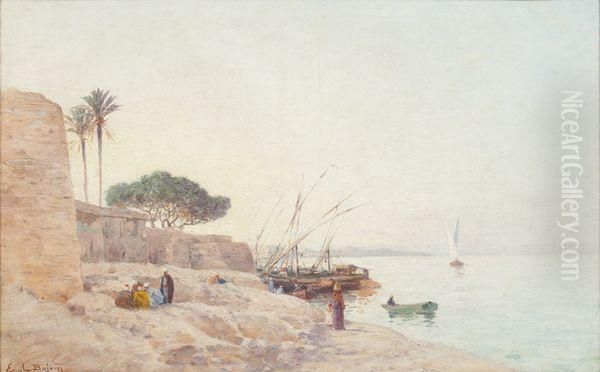
Paysage au bord du Nil (Landscape on the Banks of the Nile): An oil painting noted for its relatively large size and higher estimate (€2800-3200), this work indicates Boivin also tackled river landscapes within the broader North African context. The Nile was a classic subject for Orientalist painters, offering opportunities to depict lush vegetation contrasting with arid surroundings, ancient ruins, and local boat traffic (feluccas).
L'entrée dans le village (Entrance into the Village): Mentioned as an example of his work, this title suggests scenes of settlement and community life, broadening his scope slightly beyond pure landscape or nomadic scenes.
Le chiffre (The Number/Figure?): An oil painting (27 x 40.5 cm) with a lower estimate (€250-300). The title is ambiguous; it could refer to a specific figure, a calculation, or perhaps a scene involving trade or counting.
Portrait de Paul Rajon en train de graver (Portrait of Paul Rajon Engraving): This work, described as a print sold for €150-180, is intriguing. Paul Adolphe Rajon (1843-1888) was a noted French etcher and painter. If Boivin depicted him, it suggests an engagement with the contemporary Parisian art scene and fellow artists, a facet of his life not otherwise well-documented. It also shows Boivin worked in or had his work reproduced via printmaking.
These examples collectively showcase Boivin's dedication to Orientalist themes, his proficiency in both watercolor and oil, and his focus on landscape, atmosphere, and scenes of travel and daily life in North Africa, alongside occasional forays into portraiture or related subjects.
Context: The French Art World in Boivin's Time
Émile Boivin's artistic career (roughly spanning the 1870s to 1920) unfolded during one of the most dynamic and revolutionary periods in French, and indeed Western, art history. To fully appreciate his position, it's essential to understand the complex artistic milieu in which he worked. The dominant force for much of the 19th century had been the Académie des Beaux-Arts and its official exhibition, the Salon de Paris. Academic art, emphasizing historical subjects, meticulous finish, and idealized forms, held sway. Orientalism, while depicting exotic locales, often adhered to these academic standards of finish and composition, making it a popular and generally accepted genre within the Salon system. Artists like Jean-Léon Gérôme achieved immense fame and success through their highly polished Orientalist canvases exhibited at the Salon.
However, Boivin's time also witnessed successive waves of rebellion against this academic hegemony. The Realism of Gustave Courbet had already challenged idealized subject matter in the mid-century. Then, starting in the 1870s, Impressionism burst onto the scene. Painters like Claude Monet, Pierre-Auguste Renoir, Edgar Degas, and Camille Pissarro rejected the historical and mythological themes of the Academy, focusing instead on modern life, landscape, and the fleeting effects of light and color, often painting outdoors (en plein air) with visible brushstrokes. Their independent exhibitions, starting in 1874, marked a definitive break with the Salon system.
Following Impressionism, the 1880s and 1890s saw the rise of Post-Impressionism. This was not a unified movement but rather a collection of distinct artistic personalities who had absorbed lessons from Impressionism but pushed beyond its focus on optical sensation. Paul Cézanne sought underlying structure and permanence in form, laying groundwork for Cubism. Vincent van Gogh used intense color and expressive brushwork to convey powerful emotions. Paul Gauguin employed flattened forms and symbolic color, often inspired by his travels to Brittany and the South Pacific, seeking a more "primitive" and spiritual art. Georges Seurat developed Pointillism, a systematic application of color theory.
Simultaneously, Symbolism emerged as another significant trend, reacting against both Realism and Impressionism's focus on the observable world. Artists like Gustave Moreau, Odilon Redon, and Pierre Puvis de Chavannes (whose work Boivin reportedly purchased) explored themes of mythology, dreams, spirituality, and the inner psyche, often using evocative, non-naturalistic imagery. Puvis de Chavannes, in particular, was known for his large-scale, serene, and somewhat archaic mural-like compositions.
Within this incredibly diverse and rapidly evolving artistic landscape, Émile Boivin appears to have charted a relatively conservative course. His adherence to Orientalism placed him within a well-established, commercially viable genre that still found favor with parts of the public and the Salon, even as the avant-garde movements garnered increasing critical attention (and notoriety). He was a contemporary of giants like Monet, Renoir, Degas, Cézanne, Van Gogh, Gauguin, Redon, and also figures like the chronicler of Parisian nightlife, Henri de Toulouse-Lautrec, and the pivotal Édouard Manet, whose work bridged Realism and Impressionism. While there's no record of direct interaction between Boivin and these leading avant-garde figures, he undoubtedly worked in the same artistic climate, a period defined by the tension between academic tradition, the rise of modernism, and the enduring appeal of genres like Orientalism. His path as a priest-painter focusing on North African scenes represents one specific, unique thread in the rich tapestry of late 19th-century French art.
Legacy and Market Presence
Assessing the long-term legacy of Émile Boivin is complicated by the relative scarcity of information about his life and the full extent of his oeuvre. He does not feature prominently in standard art historical narratives that tend to focus on the major movements and innovators. However, his work persists, primarily visible today through auction house sales. The appearance of his paintings and prints on the art market indicates a continued level of interest among collectors, particularly those specializing in Orientalist art or 19th-century French painting.
The price points mentioned in auction records (€250 to over €3000) suggest a moderate but respectable market valuation. His watercolors and oils depicting classic Orientalist themes – deserts, oases, caravans – seem to be the most sought after. The quality of execution, size, condition, and specific subject matter likely influence the value of individual pieces. His work appeals to a taste for well-executed, atmospheric depictions of exotic locales, a niche that retains its appeal for many collectors.
His dual identity as a priest adds a layer of biographical interest, though it doesn't seem to significantly impact the market valuation, which is driven more by the artistic merits and genre appeal of the works themselves. The lack of documented major exhibitions during his lifetime or inclusion in major museum collections (based on available information) means his reputation is sustained more through the circulation of his works in the private market than through institutional validation.
Ultimately, Émile Boivin's legacy is that of a competent and dedicated painter working within the popular Orientalist tradition of his time. He skillfully captured the light and atmosphere of North African landscapes, creating evocative scenes that continue to find an audience. While perhaps overshadowed by the revolutionary artistic developments happening around him, his work offers a valuable glimpse into the enduring appeal of Orientalism and represents a unique personal synthesis of religious life and artistic practice in late 19th and early 20th century France. The portrait of Paul Rajon also hints at connections to the wider art world that warrant further investigation.
Conclusion
Émile Boivin remains a figure marked by intriguing dualities and frustrating gaps in the historical record. A French Catholic priest serving parishes like Muides and Ternay, he was simultaneously an artist drawn to the light and landscapes of North Africa, contributing skilled watercolors and oils to the popular Orientalist genre. Born in 1846 and dying in 1920, he lived and worked through a period of profound artistic upheaval in France, witnessing the rise of Impressionism, Post-Impressionism, and Symbolism, yet seemingly maintaining his focus on more traditional, representational depictions of the "Orient."
His works, such as Beduini nel deserto, La caravane avant l'oasis, and Paysage au bord du Nil, showcase his talent for capturing atmospheric effects, particularly the unique light of the desert, rendered with fluid color and competent draftsmanship. While not an innovator on the scale of contemporaries like Monet, Cézanne, or Gauguin, Boivin carved out a niche for himself, producing appealing works that continue to circulate on the art market. His additional identity as an author on the history of journalism further rounds out the picture of an intellectually engaged individual. Émile Boivin exemplifies the diversity of artistic practice in his era and stands as a fascinating case study of a life dedicated to both spiritual service and the creation of visual beauty.