Cajetan Roos, also known by the Italianized name Gaetano Rosa, stands as a significant figure in the landscape and animal painting tradition of the German Baroque era. Born into a dynasty of artists, Roos carved out his own niche, blending inherited skills with personal observation and the influences of his time. His life spanned a period of rich artistic exchange across Europe, and his work reflects this dynamic environment, particularly the interplay between Northern European traditions and the allure of the Italian landscape. Active primarily during the first half of the 18th century, his paintings continue to be appreciated for their atmospheric beauty and detailed depiction of the natural world.
An Artistic Dynasty: The Roos Family Context
The Roos family name resonates through several generations of German art history. Cajetan Roos (1690-1770) was born into this remarkable artistic lineage in Rome, a city that profoundly shaped the careers of many Northern European artists. His grandfather was Johann Heinrich Roos (1631-1685), a highly regarded German Baroque painter himself, particularly known for his pastoral landscapes filled with animals, who had established the family's reputation.
Cajetan's father was the celebrated Philipp Peter Roos (1655/57-1706), famously known as Rosa da Tivoli. Philipp Peter spent most of his prolific career in Italy, gaining renown for his dramatic and often large-scale depictions of animals, especially sheep and goats, set against the backdrop of the Roman Campagna. His vigorous brushwork and focus on animal life became hallmarks of the Roos family style.
Cajetan was not the only son of Philipp Peter to follow in the family profession. His brother, Jacob Roos (c. 1682 - after 1730), sometimes referred to as Rosa da Napoli, also became a painter, working in a similar vein, often focusing on animal subjects within landscape settings. The artistic tradition continued beyond Cajetan's generation, notably through his own son, Joseph Roos (1726-1805), who also became a successful landscape and animal painter, eventually serving as director of the Imperial Gallery in Vienna. This familial context provided Cajetan with both a strong foundation and a standard against which his own artistic identity would develop.
Early Life and Training in Italy and Vienna
Born in Rome in 1690, Cajetan Roos spent his formative years immersed in the artistic vibrancy of the Eternal City. Growing up under the direct influence of his father, Philipp Peter Roos (Rosa da Tivoli), Cajetan undoubtedly received his initial training within the family workshop. He would have absorbed his father's techniques for rendering animal anatomy and fur, as well as his approach to composing pastoral scenes inspired by the Italian countryside.
The environment of Rome itself was a crucial teacher. The city was a melting pot of artistic ideas, home to ancient ruins, magnificent Baroque architecture, and a thriving community of international artists. Exposure to the works of Italian masters and fellow Northern European painters working in Italy, particularly those specializing in landscape, would have broadened his artistic horizons beyond the immediate family style.
In 1706, following his father's death, the young Cajetan Roos relocated to Vienna. This move marked a significant transition, bringing him into the orbit of the Habsburg Imperial court and the burgeoning artistic scene of the Austrian capital. Vienna offered new patronage opportunities and exposure to different artistic currents, including the developing taste for elegant Rococo aesthetics alongside the established Baroque traditions. His Italian upbringing combined with his subsequent career in Vienna positioned him uniquely within the German-speaking art world.
Artistic Style and Development
Cajetan Roos built upon the foundation laid by his father and grandfather, specializing in landscape and animal painting, yet he developed a distinct artistic personality. While the family legacy, particularly the work of Rosa da Tivoli, often emphasized large, dynamically painted animals dominating the foreground, Cajetan frequently gave greater prominence to the landscape itself. His works often feature more expansive, panoramic views than those of his immediate predecessors.
His landscapes typically depict idyllic, pastoral scenes. Rolling hills, verdant valleys, meandering rivers, and distant mountains form the backdrops for his compositions. He often incorporated architectural elements such as rustic buildings, classical ruins, castles, or towers, adding points of interest and evoking a sense of timelessness or gentle melancholy, characteristic of the Arcadian landscape tradition popularised by artists like Claude Lorrain. These elements were rendered with attention to detail, contributing to the overall richness of the scene.
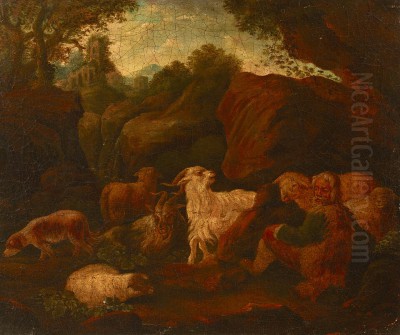
Animals remain central to his work, often featuring herds of cattle, flocks of sheep, or goats tended by shepherds or peasant figures. These figures and animals are usually situated comfortably within the landscape, often in the middle ground or foreground, but integrated harmoniously rather than overwhelming the setting. Roos depicted animals with anatomical accuracy and a sensitivity to their natural postures and groupings, a skill clearly honed through family tradition and close observation. His style is often described as free and natural, capturing the textures of fur, foliage, and terrain with fluid brushwork, while maintaining clarity and structure in the overall composition.
Key Influences and Artistic Dialogue
The most significant influence on Cajetan Roos was undoubtedly his father, Philipp Peter Roos (Rosa da Tivoli). He inherited the family's thematic focus on pastoral landscapes populated with animals and likely adopted many of his father's techniques for rendering textures and forms. However, Cajetan adapted this inheritance, often favouring calmer compositions and a greater emphasis on the breadth and atmosphere of the landscape setting compared to his father's more dramatic, animal-centric works.
Living and working in Rome during his youth, and later engaging with the international artistic scene, Roos absorbed the influence of the Dutch Italianate painters. Artists like Nicolaes Berchem (1620-1683) and Karel Dujardin (1626-1678), who had worked in Italy decades earlier, were masters of depicting sun-drenched Italian landscapes populated with peasants and livestock. Their idealized yet naturalistic scenes, characterized by warm light and careful composition, resonated strongly with the tradition Cajetan Roos was working within. Echoes of their approach to light and atmosphere can often be discerned in his paintings.
The broader tradition of classical landscape painting, particularly the work of French masters active in Rome like Claude Lorrain (1600-1682) and Nicolas Poussin (1594-1665), though perhaps less direct, likely informed his sense of idealized composition and the integration of classical or pastoral elements. Earlier Dutch Italianates such as Jan Both (c.1610/18-1652) and Adam Pynacker (1622-1673) also contributed to the genre he embraced. Within the Viennese context, he would have been aware of contemporaries or slightly earlier landscape specialists like Franz de Paula Ferg (1689-1740), although Roos maintained his distinct style rooted in the Roos family tradition and Italianate influences. His brother Jacob Roos also worked in a similar style, suggesting mutual influence or shared studio practices.
Representative Works
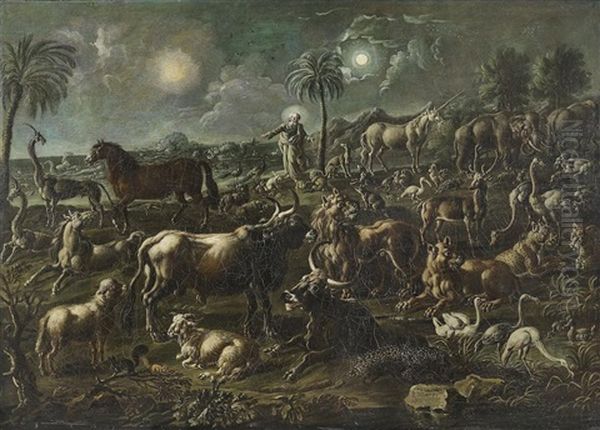
Several key works exemplify Cajetan Roos's artistic style and thematic concerns. One notable example is his painting often titled Noah's Ark or Noah's Ark After the Flood. This subject allowed Roos to combine his skill in animal painting with a grand landscape setting. Typically, such works depict a wide variety of animals peacefully coexisting in a lush, renewed landscape after the biblical flood, often with Noah and his family present. These compositions showcase his ability to handle complex groupings of figures and animals within an expansive natural environment, conveying themes of harmony and divine providence. One version, measuring approximately 144 x 146 cm, highlights his capacity for large-scale, detailed work.
Paintings titled A Pastoral Scene with a Herder and His Cattle or similar variations are quintessential examples of his output. These works focus on the idyllic relationship between humanity, animals, and nature. A typical composition might feature a shepherd resting or tending his flock near a river or ruins, set within a rolling landscape bathed in soft light. A specific example mentioned measures 154 x 127 cm, indicating his comfort with substantial canvas sizes for these pastoral themes.
Other works, such as Cattle by a Hilly Lake (mentioned as 60x80 cm), demonstrate his focus on smaller, more intimate scenes, still centered on the careful depiction of animals within their natural habitat. Across these examples, common threads emerge: the harmonious integration of figures and animals into detailed landscapes, the skillful rendering of animal forms, and the creation of a tranquil, often idealized, atmosphere. Hunting scenes are also mentioned as part of his oeuvre, showcasing a more dynamic aspect of his animal painting.
Career in Vienna and Later Life
After moving to Vienna in 1706, Cajetan Roos established his career in the Habsburg capital, where he remained for the rest of his life, dying there in 1770. Vienna provided a stable environment for artistic production, with patronage available from the aristocracy and the burgeoning middle class, in addition to potential court connections. While specific details of his commissions or patrons are not extensively documented in easily accessible sources, the consistent production of works suggests a successful professional life.
His presence in Vienna placed him within a significant Central European artistic hub. He continued the Roos family tradition, specializing in the type of pastoral and animal landscapes that had proven popular. His style, blending Italianate warmth with Northern European detail, likely found favour among collectors who appreciated both traditions.
He passed on the family's artistic mantle to his son, Joseph Roos (1726-1805). Joseph also became a respected painter in Vienna, known for landscapes and animal scenes, eventually achieving the prestigious position of Keeper (and later Director) of the Imperial Picture Gallery at the Belvedere Palace. This continuation of the family profession into the next generation underscores the strength and reputation of the Roos artistic legacy, which Cajetan played a crucial role in maintaining and transmitting. Cajetan's long life allowed him to witness significant shifts in artistic taste, from the High Baroque towards the lighter Rococo and the beginnings of Neoclassicism, though his own work remained largely rooted in the established Baroque landscape tradition.
Legacy and Influence
Cajetan Roos holds a firm place in the history of German and Austrian Baroque art as a skilled practitioner of landscape and animal painting. His primary legacy lies in his successful continuation and subtle adaptation of the distinctive Roos family style, ensuring its prominence into the mid-18th century. He effectively bridged the gap between the more robust, animal-focused work of his father, Rosa da Tivoli, and the evolving tastes of the 18th century, which often favoured more expansive and detailed landscape settings.
His ability to blend Northern European traditions of detailed naturalism with the idealized beauty and warm light associated with Italianate landscape painting contributed to the richness of the genre in Central Europe. While perhaps not a radical innovator, his work consistently displays a high level of technical skill, particularly in the rendering of animals and the creation of atmospheric, harmonious landscape compositions.
The enduring appeal of his work is evidenced by its presence in museum collections and its continued circulation on the art market. His paintings appear in auctions in major art centers, indicating sustained interest from collectors. He influenced his son Joseph Roos, ensuring the family tradition continued, and his work stands as representative of the popular taste for pastoral and animal subjects within landscape settings during the Baroque and early Rococo periods. He remains a testament to the enduring power of artistic dynasties and the fruitful cross-pollination of artistic ideas across European borders.
Conclusion
Cajetan Roos was a talented and dedicated artist who skillfully navigated the artistic currents of the 18th century. Born into the celebrated Roos dynasty of painters, he honoured his heritage by specializing in the family métier of landscape and animal painting. Yet, he was not merely an imitator; he refined the tradition, placing greater emphasis on the expansive beauty and atmospheric qualities of the landscape, while continuing to populate his canvases with meticulously observed animals and pastoral figures. His work, shaped by his Italian birth and upbringing and his long career in Vienna, reflects a harmonious blend of influences, resulting in idyllic scenes that capture the enduring appeal of the natural world. As a key link in the Roos family chain and a fine painter in his own right, Cajetan Roos made a lasting contribution to the German Baroque tradition.