In the annals of art history, certain families etch their names across generations, creating a lineage of talent that shapes and reflects the artistic currents of their times. The Roos family, of German origin, stands as a prominent example, particularly renowned for their mastery in depicting pastoral landscapes and animal subjects. Within this distinguished dynasty, Jacob Roos, known affectionately and significantly as "Rosa di Napoli," carved his own niche. Active primarily in Naples during the late Baroque and early Rococo periods, Jacob continued the family tradition while imbuing his work with the vibrant atmosphere and distinct character of his adopted Italian home. His life and art offer a fascinating glimpse into the cross-cultural artistic exchanges and the enduring appeal of idyllic, nature-centric themes.
The Patriarchal Brush: Johann Heinrich Roos
To understand Jacob Roos, one must first acknowledge the formidable artistic foundations laid by his grandfather, Johann Heinrich Roos (1631–1685). Born in Otterberg, Germany, Johann Heinrich became one of the most significant German animal and landscape painters of the Baroque era. His training took him to Amsterdam, where he likely absorbed the influences of Dutch Italianate painters like Karel Dujardin and Nicolaes Berchem, who specialized in sun-drenched Italian landscapes populated with peasants and livestock.
Johann Heinrich's own works are characterized by their sensitive portrayal of animals, particularly sheep, goats, and cattle, often set within atmospheric landscapes that sometimes featured classical ruins—a nod to the Italianate ideal. He developed a remarkable ability to capture the textures of animal fur and the play of light on their forms. His compositions were typically harmonious, evoking a sense of pastoral tranquility. He worked for various patrons, including the Elector of Mainz, and his success established a strong artistic and commercial model for his descendants. His influence was not limited to his direct family; his style resonated with other German artists interested in pastoral themes.
Philipp Peter Roos: The Roman Star "Rosa da Tivoli"
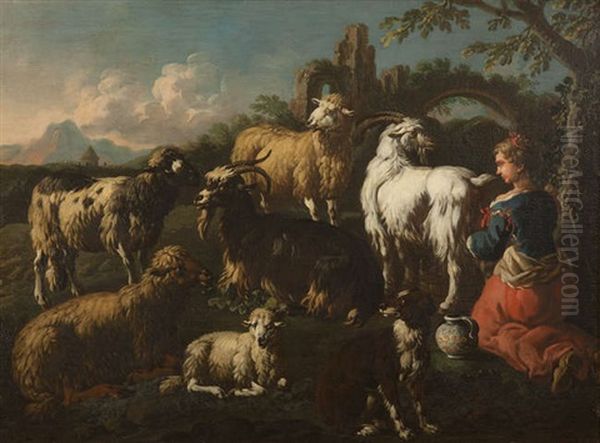
The most internationally renowned member of the Roos dynasty, and Jacob's father, was Philipp Peter Roos (1655/57–1706). Recognizing the allure and artistic opportunities Italy offered, Philipp Peter ventured south, eventually settling in Rome. Here, he achieved immense fame and adopted the moniker "Rosa da Tivoli," a name that signaled his primary area of operation and the rustic, picturesque quality of his subjects, often inspired by the countryside around Tivoli, near Rome.
Rosa da Tivoli’s canvases were larger, his brushwork more vigorous and impetuous than his father's. He specialized in dynamic compositions of animals – herds of sheep, goats, cattle, and horses – often in dramatic, expansive landscapes. His speed of execution was legendary, allowing him to produce a vast oeuvre that was highly sought after by collectors across Europe. He lived a somewhat bohemian and extravagant lifestyle, but his artistic output remained consistently popular. His style, while rooted in the Dutch Italianate tradition, possessed a distinctly Roman grandeur and a robust, almost tangible quality. He became a dominant figure in the Roman art scene for animal painting, influencing contemporaries and followers. Artists like the Italian Andrea Locatelli, though more focused on classical landscapes, operated in a similar market for pastoral scenes.
Jacob Roos: Forging an Identity in Naples
Born around 1682, Jacob Roos grew up under the towering artistic shadow of his father, Philipp Peter "Rosa da Tivoli," and the established legacy of his grandfather, Johann Heinrich. While his father was the "Rose of Tivoli," Jacob became associated with another great Italian city, earning the name "Rosa di Napoli" (the Rose of Naples). This distinction is crucial, as it points to his primary sphere of activity and the specific local inflections that would come to characterize his work. He passed away around 1730 or perhaps slightly later, with some sources suggesting activity into the 1730s.
It is highly probable that Jacob received his initial artistic training from his father, absorbing the family's specialized knowledge of animal anatomy and landscape composition. He also had a brother, Cajetan Roos (c. 1690–1770), also known as Gaetano de Rosa, who likewise became a painter in the family tradition, further complicating attributions at times but also highlighting the familial dedication to this artistic niche. Cajetan, too, worked in Italy, and their styles, while individual, shared the common Roos heritage.
Jacob’s decision to base himself in Naples was significant. Naples at the turn of the 18th century was a bustling metropolis with a vibrant artistic scene, distinct from that of Rome. While Rome was the center for classical antiquity and High Baroque grandeur, Naples had its own robust school of painting, known for its dramatic naturalism, championed earlier by artists like Jusepe de Ribera, and its rich decorative traditions, later exemplified by masters such as Luca Giordano and Francesco Solimena. While Jacob Roos did not directly engage with the large-scale religious or mythological compositions of these Neapolitan giants, the city's unique atmosphere and artistic environment undoubtedly shaped his perspective.
The Artistic Signature of "Rosa di Napoli"
Jacob Roos specialized, much like his forebears, in animal and landscape painting. His works typically feature pastoral scenes: shepherds and shepherdesses tending their flocks, often amidst a landscape that, while idealized, carried a strong sense of local Italian character. His canvases are populated with sheep, goats, and cattle, rendered with an understanding of their forms and behaviors that was a hallmark of the Roos family.
His style, however, was not a mere imitation of his father's. While Philipp Peter's work often had a grand, sometimes tumultuous energy, Jacob's paintings could exhibit a more tranquil, intimate quality. There's a discernible sensitivity in his portrayal of rural life. His brushwork, often described as rapid and characterized by deft, quick strokes of white or lighter paint to highlight forms and suggest texture, lent a freshness and immediacy to his scenes. This technique was particularly effective in capturing the fleece of sheep or the play of sunlight on leaves and terrain.
His landscapes often incorporate architectural elements, such as classical ruins or rustic farm buildings, which serve not just as picturesque backdrops but also to anchor the compositions and add a layer of historical or pastoral romance. The influence of the Neapolitan environment can be subtly felt in the quality of light and the specific types of foliage or terrain depicted. He shared with other landscape painters of the era, such as the slightly earlier Dutch master Abraham Begeyn or the French artist Jean-Baptiste Oudry (though Oudry was more focused on royal hunts and still lifes), an interest in the careful observation of nature, even within idealized settings.
Representative Works and Thematic Concerns
Several works attributed to Jacob Roos help to illustrate his artistic contributions. "Sheep and Livestock" or "Sheep Herding" are titles indicative of his primary subject matter. These paintings showcase his skill in composing groups of animals in naturalistic poses, integrated into a believable landscape setting. The focus is often on the peaceful coexistence of humans and animals within a benevolent natural world.
A notable piece, often cited, is "A Shepherdess With Her Flock Beside a Ruined Arch." This painting, reportedly dated to 1735 (which, if accurate, would extend his working life or suggest a posthumous dating convention), encapsulates many of his characteristic elements. The presence of a ruined arch provides a classical, picturesque motif, common in Italianate landscapes since Claude Lorrain and Nicolas Poussin, and continued by artists like Giovanni Paolo Panini. The shepherdess and her flock are the focal point, rendered with that typical Roos attention to animal detail and pastoral charm. The composition likely balances the figures with the landscape, creating a harmonious whole. This work was notably in the collection of Sir Benjamin Lee Guinness in Dublin.
Another painting, "Landscape with Herds of Sheep," once exhibited at the Galleria Salga in Rome before passing into a private collection, further underscores his dedication to these themes. Such works demonstrate a continuity of the German landscape tradition infused with Italianate sensibilities, marked by what has been described as a strong local character and a particular attention to the nuances of rural existence. His hunting scenes, though perhaps less common than his purely pastoral subjects, would have allowed for more dynamic compositions, a trait he might have inherited from his father's more vigorous style.
The painting "A Shepherd and Shepherdess with Cattle in a Southern Landscape," once part of the esteemed Schaumburg-Lippe ducal family collection, also points to the desirability of his works among aristocratic patrons. The "Southern Landscape" descriptor emphasizes the Italian setting that was so crucial to his identity as "Rosa di Napoli."
In his depictions, there is often an objectivity combined with sensitivity. He doesn't overly sentimentalize the rural scenes but presents them with a directness that allows the natural charm of the subject to emerge. This approach aligns him with a broader European interest in pastoral themes during the 17th and 18th centuries, seen in the works of Dutch artists like Paulus Potter (though earlier) and Flemish painters such as David Teniers the Younger, who, while known for peasant scenes, also depicted animals with great skill.
The Neapolitan Context and Artistic Contemporaries
Operating in Naples, Jacob Roos would have been aware of the dominant artistic figures of the city. Francesco Solimena (1657–1747) was a towering presence, his late Baroque style influencing a generation of Neapolitan painters. While Solimena's grand religious and allegorical works were far removed from Roos's pastoral scenes, the general artistic vitality of Naples, with its numerous churches and palaces requiring decoration, fostered a rich environment for artists of all specializations.
The legacy of Salvator Rosa (1615–1673), a Neapolitan by birth who also worked in Rome and Florence, was particularly potent in the realm of landscape painting. Salvator Rosa was famed for his wild, romantic landscapes, often featuring banditti, dramatic rock formations, and stormy skies. While Jacob Roos's temperament seems to have leaned towards more tranquil and idyllic scenes, Salvator Rosa's impact on landscape painting as an independent and expressive genre was undeniable and would have formed part of the artistic consciousness in Naples.
Jacob Roos's specialization in animal painting placed him in a lineage that included not only his own family but also artists who catered to a specific market demand for such pictures. In France, contemporaries like Alexandre-François Desportes (1661–1743) and Jean-Baptiste Oudry (1686–1755) were achieving great success as animal and hunt painters for the royal court. While their style and patronage differed, the general appreciation for skilled animal depiction was a Europe-wide phenomenon. Jacob's work, therefore, tapped into a well-established and appreciated genre.
His closest artistic connections, naturally, were within his own family. His brother, Cajetan Roos ("Gaetano de Rosa"), painted in a similar vein, and their works can sometimes be difficult to distinguish, a common issue with artistic families where skills and subjects are shared. Their father, Philipp Peter, remained the benchmark, but both sons developed their own subtle variations on the family theme.
Challenges of Attribution and Lasting Legacy
The Roos family's prolific output and the similarity of their subject matter—pastoral landscapes with animals—can present challenges for art historians in terms of precise attribution. Signatures can be ambiguous or absent, and workshop practices might have involved collaboration. Jacob Roos, "Rosa di Napoli," is perhaps less documented and his oeuvre less definitively cataloged than that of his more famous father, "Rosa da Tivoli," or his grandfather, Johann Heinrich.
Despite this, Jacob Roos holds a distinct place. His moniker, "Rosa di Napoli," firmly ties him to a specific Italian artistic center, suggesting that his work was recognized and appreciated there. He represents the continuation and adaptation of a Northern European artistic tradition on Italian soil, a phenomenon that enriched both cultures. His paintings contributed to the enduring popularity of pastoral imagery, offering patrons idyllic visions of harmony between humanity and nature.
His works are found in various private and public collections, indicating their appeal over time. The presence of his paintings in collections like that of Sir Benjamin Lee Guinness or the Schaumburg-Lippe family attests to their quality and desirability. While perhaps not an innovator on the scale of some of his contemporaries, Jacob Roos was a skilled and sensitive practitioner of his chosen genre. He successfully carried the Roos family's artistic torch into the 18th century, leaving behind a body of work that continues to charm with its depictions of the serene Neapolitan and Italian countryside.
Conclusion: The Gentle Brush of Rosa di Napoli
Jacob Roos, "Rosa di Napoli," remains an intriguing figure within the broader narrative of European Baroque and Rococo art. As a scion of the distinguished Roos painterly dynasty, he inherited a rich artistic legacy centered on the depiction of animals and landscapes. He skillfully adapted this heritage to the vibrant artistic environment of Naples, infusing his works with a distinct local character and a gentle, observant eye.
His paintings, characterized by their tranquil pastoral scenes, adept animal portrayal, and fresh brushwork, offer a counterpoint to the grander, more dramatic productions of some of his Neapolitan contemporaries. Instead, they invite the viewer into a world of rustic charm and natural beauty. While he may be overshadowed in art historical accounts by his more famous father, Philipp Peter "Rosa da Tivoli," Jacob Roos's contribution as "Rosa di Napoli" is significant. He not only perpetuated his family's artistic tradition but also enriched the diverse tapestry of Italian art in the 18th century, leaving behind a legacy of sensitively rendered landscapes that continue to evoke the timeless allure of the Italian countryside. His art serves as a quiet reminder of the enduring human connection to nature and the simple, profound beauty found within it.