Charles Brooke Branwhite (1851-1929) stands as a notable figure in the annals of British art, a painter whose canvases captured the nuanced beauty of the English landscape, particularly its wintry aspects. His life and career spanned a period of significant artistic evolution, yet he remained dedicated to a vision rooted in careful observation and a deep appreciation for the natural world. As an artist of British nationality, his professional background was firmly established as a painter, with a body of work that continues to attract interest and admiration.
Early Life and Artistic Foundations
Born in 1851, Charles Brooke Branwhite emerged into a Britain where artistic traditions were rich and varied. While the provided information initially suggests his specific birthplace was not clearly mentioned, further details clarify that his father, Charles Branwhite Snr. (1817-1880), a significant artist in his own right, was born in Bristol. This connection to Bristol, a city with a burgeoning artistic scene, likely played a role in the younger Branwhite's early exposure to art. The Branwhite family itself had artistic inclinations; Charles Branwhite the elder was a respected miniaturist, sculptor, and landscape painter, ensuring that Charles Brooke grew up in an environment steeped in creative pursuits.
The artistic lineage of the Branwhite family was indeed strong. Charles Branwhite (1817-1880) initially pursued sculpture, exhibiting at the Royal Academy from 1837. He later transitioned to painting, particularly known for his landscapes and genre scenes, often in watercolour. The elder Branwhite became an associate of the Society of Painters in Water Colours in 1849. This rich artistic environment undoubtedly shaped Charles Brooke Branwhite's early inclinations towards a similar path, fostering a sensitivity to form, colour, and composition from a young age.
Some accounts suggest that Charles Brooke Branwhite himself initially explored sculpture before dedicating himself to painting. This early grounding in three-dimensional form could have contributed to the solidity and structural integrity evident in his later landscape compositions. The transition from sculpture to painting was not uncommon for artists of the period, allowing for a different mode of expression and engagement with subject matter.
The Influence of the Bristol School and William Müller
The artistic milieu of Bristol was particularly significant. The city was home to the Bristol School of artists, a loose collective active in the early to mid-19th century, known for their romantic and atmospheric depictions of local scenery and their plein air sketching. Key figures associated with this movement included Francis Danby, Samuel Jackson (father of Samuel Philips Jackson, a contemporary of Branwhite), and James Baker Pyne. While Charles Brooke Branwhite's active period was somewhat later, the legacy of the Bristol School, with its emphasis on direct observation of nature and the poetic interpretation of landscape, would have permeated the artistic atmosphere of his formative years.
A pivotal influence on Charles Brooke Branwhite was William James Müller (1812-1845). Though Müller passed away before Branwhite fully embarked on his career, Müller's impact, particularly on Bristol artists, was profound and lasting. Müller, himself a Bristol native, was celebrated for his vigorous brushwork, rich colouring, and his exotic Eastern subjects, as well as his evocative British landscapes, especially those of the Devon river valleys. Branwhite became a pupil of Müller, and this tutelage was instrumental in shaping his artistic style.
Müller's approach to watercolour, often incorporating bodycolour (gouache) for opacity and textural richness, is reflected in Branwhite's own watercolour practice. The emphasis on capturing the transient effects of light and atmosphere, a hallmark of Müller's work, also became a central concern for Branwhite. The influence can be seen in Branwhite's dynamic compositions and his ability to convey the tactile qualities of the natural world, from the roughness of stone to the crispness of snow.
Defining an Artistic Vision: Style and Technique
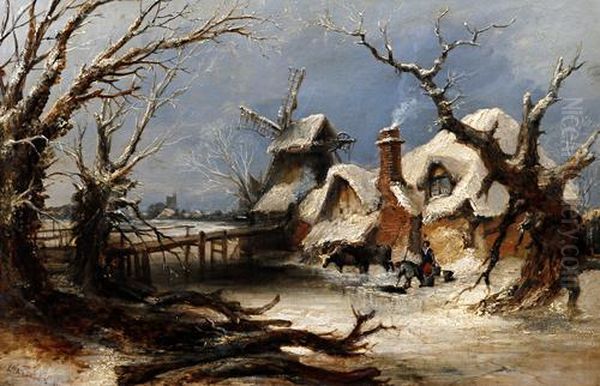
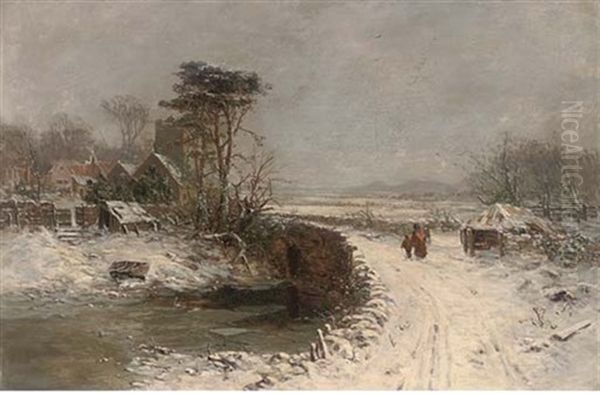
Charles Brooke Branwhite's artistic style is characterized by a robust realism, particularly evident in his depictions of winter. He possessed a keen ability to convey the chill and the stark beauty of the season, capturing the way light interacts with snow-covered terrain and frozen water. His winter landscapes are not merely picturesque; they often evoke the harsh realities of rural life during the colder months, sometimes featuring figures of laborers braving the elements.
His handling of light and shadow was a distinguishing feature of his work. Branwhite was adept at rendering the subtle gradations of light on a snowy field, from brilliant highlights where the sun strikes, to the cool, deep shadows that define form and create depth. This sensitivity to chiaroscuro lent a dramatic and often poignant quality to his scenes. While fundamentally a realist, there are romantic undertones in his paintings, a sense of atmosphere and mood that elevates them beyond simple topographical records.
Branwhite was proficient in both oil and watercolour. His oil paintings often exhibit a confident application of paint, building up textures that convey the materiality of his subjects. His watercolours, as noted, frequently employed bodycolour, allowing for a density and vibrancy akin to oil painting, a technique he likely refined under Müller's influence. Works like Rocky River are cited as exemplifying this, with its heavy use of bodycolour reminiscent of Müller's Devon scenes.
He was particularly noted for his ability to depict the "gloaming," the twilight hours, where the fading light creates long shadows and a melancholic atmosphere. This focus on specific times of day allowed him to explore a range of chromatic and tonal effects, showcasing his skill in capturing the ephemeral qualities of the British landscape.
A Canvas of Britain: Key Themes and Subjects
Branwhite's oeuvre demonstrates a deep engagement with the British landscape, with a particular fondness for certain regions and recurring themes. His subjects ranged from coastal views to inland rural scenes, often marked by the changing seasons.
The area around St Ives in Cornwall held a particular attraction for him. He was among the pioneering artists who utilized the newly established railway lines in the 1860s and 1870s to travel to St Ives, drawn by its unique light and picturesque scenery. His paintings of this region contributed to its growing reputation as an artists' colony, a reputation later solidified by figures like Walter Langley and Stanhope Forbes. Branwhite exhibited St Ives scenes alongside other Bristol artists, indicating a shared interest in this coastal haven.
Jersey, one of the Channel Islands, also featured in his work. His oil painting IN PORTELET BAY, JERSEY, dated 1884, is a testament to his exploration of coastal subjects beyond the mainland. This work, with its specific location and date, provides a concrete example of his artistic travels and his interest in maritime landscapes.
Somerset, a county neighboring his Bristol base, was another favored location. Works such as SOMERSET: WINTER SCENES highlight his recurring fascination with winter and his ability to capture the essence of this region under a blanket of snow. Similarly, Winter: A Shropshire Landscape indicates his travels further afield in pursuit of compelling winter subjects.
Rural life and its accoutrements were common motifs. An Old Suffolk Windmill—Winter demonstrates his interest in vernacular architecture and its place within the landscape, again choosing the winter season to imbue the scene with a particular mood. His depictions often included figures, not as primary subjects, but as integral parts of the landscape, engaged in everyday activities, grounding his scenes in a lived reality.
Masterstrokes: Representative Works
Several works stand out as representative of Charles Brooke Branwhite's artistic concerns and stylistic strengths.
IN PORTELET BAY, JERSEY (1884), an oil on canvas, showcases his skill in rendering coastal scenery. While specific visual details of this painting are not extensively described in the provided material, its title and medium suggest a work capturing the unique interplay of sea, sky, and land in the Channel Islands. The dimensions given for one version (29.5 x 49.5 cm, later another version 54.5 x 94.5 cm) indicate works of a scale suitable for detailed landscape portrayal.
Rocky River, a watercolour, is highlighted for its stylistic connection to William Müller. The use of bodycolour would have lent this piece a substantial, almost opaque quality, allowing Branwhite to build up textures and depict the ruggedness of a riverine landscape with force and vivacity. Such works demonstrate his mastery of the watercolour medium beyond transparent washes.
Winter: A Shropshire Landscape is another key example of his specialization. This watercolour would have likely focused on the transformative effect of snow on the terrain, his skill in depicting the subtle colours of winter light, and perhaps the stark silhouettes of trees against a cold sky. The choice of Shropshire suggests a deliberate seeking out of diverse English landscapes for his winter theme.
A Winter's Morning, a work combining pencil, watercolour, and bodycolour, further illustrates his mixed-media approach and his focus on specific times of day. The combination of media would allow for both delicate linear work and robust colour application, ideal for capturing the crisp light and defined shadows of a morning in winter.
Other notable titles include SOMERSET: WINTER SCENES, likely a composition or series focusing on the varied aspects of winter in that county, and An Old Suffolk Windmill—Winter, which would have combined architectural interest with his characteristic winter atmosphere. His paintings often depicted laborers in the snow, highlighting a social realist aspect to his work, showing the human element within the often harsh beauty of nature.
Engagement with the Art World: Exhibitions and Affiliations
Charles Brooke Branwhite was an active participant in the British art world, exhibiting his work in prominent venues and associating with fellow artists. He regularly submitted paintings to the Royal Academy in London, the premier exhibition space in the country, a mark of professional ambition and recognition. His work was also shown at the Bristol Society of Artists, reflecting his strong ties to his local artistic community.
A significant affiliation was his membership in the Royal West of England Academy (RWA) in Bristol, which he joined in 1913. The RWA, with its long history, was (and remains) a key institution for artists in the west of England, and his membership underscores his established position within that regional art scene.
His interactions with contemporaries are particularly noted in the context of St Ives. During the 1860s and 1870s, he exhibited scenes of St Ives alongside other Bristol-based artists, including Charles Parsons Knight, Samuel Philips Jackson (son of the Bristol School artist Samuel Jackson), and George Wolfe. This collaborative exhibition activity suggests a shared artistic exploration of new locales and a supportive network among these painters. These artists, like Branwhite, were drawn to the dramatic coastal scenery and the quality of light that St Ives offered.
The broader context of Victorian landscape painting included renowned figures such as John Constable and J.M.W. Turner, whose influence, though from an earlier generation, had reshaped the genre. Contemporaries who also excelled in landscape and found popular success included artists like Benjamin Williams Leader, known for his idyllic and often autumnal British scenes, and Alfred de Bréanski Sr., who painted dramatic views of the Scottish Highlands and Welsh mountains. In the realm of watercolour, Myles Birket Foster was immensely popular for his charming depictions of rural England. Branwhite's focus on the less conventionally picturesque, often starker, aspects of the landscape, particularly winter, carved out a distinct niche for him.
The Lure of St Ives: An Early Pioneer
Charles Brooke Branwhite's connection to St Ives is particularly noteworthy. His visits in the 1860s and 1870s place him among the vanguard of artists who "discovered" the town's potential as an artistic subject and retreat. The extension of the railway network into Cornwall made previously remote areas like St Ives more accessible, and Branwhite was quick to seize this opportunity.
His St Ives paintings would have captured the rugged coastline, the bustling fishing harbour, and the unique clarity of light for which the area became famous. By exhibiting these works, he helped to introduce the charms of St Ives to a wider audience, predating the establishment of the more formal St Ives School of painting led by artists like Stanhope Forbes and Walter Langley in the later 1880s and 1890s. While Branwhite may not be as famously associated with St Ives as these later figures, his early presence and depiction of the locale contributed to the artistic momentum that would transform the town into an internationally renowned art colony.
His engagement with St Ives demonstrates an adventurous spirit and a keen eye for landscapes that offered strong visual and atmospheric qualities. It aligns with a broader Victorian trend of artists seeking out diverse and "unspoiled" regions of Britain for their subject matter, moving beyond the traditionally celebrated beauty spots.
Legacy and Enduring Appeal
Charles Brooke Branwhite passed away in 1929, leaving behind a significant body of work that continues to be appreciated. His paintings regularly appear at auction, indicating a sustained interest among collectors. For instance, his oil painting IN PORTELET BAY, JERSEY (the 29.5 x 49.5 cm version) was noted with an estimate of £150-£200, while another work, SOMERSET: WINTER SCENES (36 x 62 cm), combining watercolour and oil, carried an estimate of £1,000-£1,500, reflecting the varying market values depending on size, medium, and subject matter. One recorded sale of Portlet Bay, Jersey in 2022 reached £220.
His legacy lies in his dedicated and skillful portrayal of the British landscape, especially his evocative winter scenes. He captured a specific facet of Britain's natural beauty, one that was perhaps less conventionally celebrated than summer pastorals but possessed its own stark power and poetic resonance. His ability to convey the sensory experience of winter – the cold, the quality of light, the textures of snow and ice – remains compelling.
The Branwhite family name itself, with its historical spelling variations such as Branthwaite and Branthwayte, hints at a deeper lineage, though the direct impact on his artistic career is less clear. His primary contribution was through his brush and his distinctive vision. He was part of a generation of British artists who, while perhaps not achieving the revolutionary fame of some of their predecessors or modernist successors, diligently and artfully recorded the world around them, creating a valuable visual heritage.
His work can be seen as part of the broader tradition of British landscape painting that valued fidelity to nature, combined with a personal, often romantic, interpretation. He was influenced by significant figures like William Müller and participated in the artistic life of his time through exhibitions and associations, contributing to the vibrant tapestry of Victorian and early 20th-century British art.
Conclusion
Charles Brooke Branwhite (1851-1929) was a dedicated and talented British painter who carved a distinct path in the landscape genre. From his early artistic immersion in Bristol, through the influential tutelage of William Müller, he developed a style characterized by robust realism, a masterful handling of light and shadow, and a profound sensitivity to the moods of nature, particularly the stark beauty of winter.
His explorations of St Ives, Jersey, and the varied counties of England resulted in a body of work that captures the essence of the British landscape in its many forms. Through his oils and watercolours, often enhanced with bodycolour, he conveyed not just the visual appearance of a scene, but its atmosphere and emotional resonance. Exhibiting regularly at institutions like the Royal Academy and the Royal West of England Academy, and associating with fellow artists, he was an active participant in the art world of his day.
While he may not be a household name on the scale of Turner or Constable, Charles Brooke Branwhite's contributions are significant. He remains appreciated for his skillful technique, his consistent vision, and his ability to find beauty and poetry in the often-overlooked aspects of the landscape, especially the challenging yet rewarding subject of winter. His paintings offer a window into the British environment of his time, rendered with an honest eye and a painter's deep affection for his native land.