Charles Edward Hallé: A Victorian Painter and Gallerist
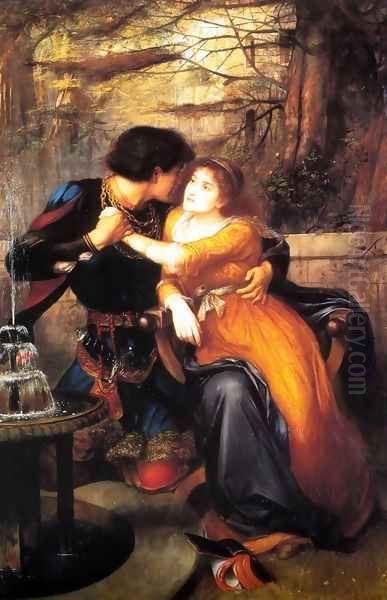
Charles Edward Hallé, a notable figure in the late Victorian art world, carved a distinct niche for himself not only as a painter of evocative, often literary and mythological scenes, but also as an influential gallery director. Born into an exceptionally artistic family, his career reflects the shifting tides of British art in the latter half of the 19th century, navigating the currents of late Pre-Raphaelitism, Aestheticism, and Symbolism. His contributions extended beyond his own canvases, as he played a pivotal role in establishing alternative exhibition spaces that championed artists diverging from the Royal Academy's mainstream.
Early Life and Artistic Formation
Charles Edward Hallé was born in Paris on December 13, 1846, though he would later become a British national. His father was the illustrious German-born pianist and conductor Sir Charles Hallé (Karl Halle), who became a central figure in British musical life after settling in Manchester. His mother was Desirée Saultau. Growing up in such a culturally rich environment undoubtedly exposed young Hallé to the arts from an early age, fostering an appreciation that would steer him towards a career in painting.
His formal artistic education began at the prestigious Royal Academy Schools in London. During this formative period, he benefited from the tutelage of several established artists. Among them was Richard "Dicky" Doyle, famed for his whimsical illustrations, particularly of fairies, and his work for Punch magazine. Doyle's imaginative flair and narrative skill may have subtly influenced Hallé's later penchant for storytelling in his own art. Another significant instructor was Baron Carlo Marochetti, an Italian-born sculptor of considerable renown in Victorian England, known for his grand public monuments, including the equestrian statue of Richard Coeur de Lion outside the Palace of Westminster. While Marochetti was primarily a sculptor, his classical sensibilities and academic training would have provided Hallé with a strong foundation in draughtsmanship and composition.
Parisian Sojourn and Italian Influences
Seeking to broaden his artistic horizons, the young Hallé travelled to France. In Paris, he had the invaluable opportunity to work with Victor Mottez, a distinguished painter who had himself been a pupil of the great Neoclassical master Jean-Auguste-Dominique Ingres. Mottez was also known for his revival of fresco painting techniques. This association exposed Hallé to the rigorous discipline of the French academic tradition and the enduring appeal of classical forms. It was during this period in France, and through subsequent travels, that Hallé developed a profound admiration for Italian art, particularly the masters of the Renaissance and the lingering echoes of Neo-classicism. This Italian influence would become a recurring feature in his work, evident in his choice of subjects, his treatment of the human form, and his compositional strategies.
Upon his return to London in 1866, Hallé began to establish his presence in the British art scene. He made his debut at the Royal Academy, exhibiting four paintings, a significant early milestone for any aspiring artist. His desire to refine his technique, particularly in the use of colour and light, led him to Venice. The Venetian School, with its emphasis on rich colour, atmospheric effects, and sensuous forms, as exemplified by masters like Titian, Veronese, and Tintoretto, left an indelible mark on his artistic development. This period of study in Venice equipped him with a more nuanced understanding of painterly techniques, which he would later apply to his own distinct vision.
The Grosvenor Gallery: A New Platform for Art
The 1870s marked a period of growing dissatisfaction among many artists with the perceived conservatism and exclusivity of the Royal Academy. This sentiment culminated in the establishment of alternative exhibition venues. In 1877, Charles Edward Hallé played a crucial role in one of the most significant of these ventures: the founding of the Grosvenor Gallery. He collaborated closely with the art critic Joseph Comyns Carr and Sir Coutts Lindsay, a painter himself and the primary financial backer, to bring this ambitious project to fruition.
The Grosvenor Gallery, located in Bond Street, quickly became the leading alternative exhibition space in London. It was designed to showcase artists associated with the Aesthetic Movement and the second wave of Pre-Raphaelitism, many of whom felt marginalized by the Royal Academy. The gallery's ethos was one of artistic freedom and a commitment to "art for art's sake." Hallé served as one of its directors, alongside Carr, and was instrumental in shaping its exhibition policy and curating its shows.
The Grosvenor Gallery became synonymous with artists like Edward Burne-Jones, whose dreamlike, medievalizing paintings were central to its identity. Other prominent artists who exhibited there included George Frederic Watts, known for his allegorical and symbolist works; James McNeill Whistler, whose aesthetic theories and distinctive style often courted controversy (most famously leading to the Whistler vs. Ruskin trial, which had links to a Grosvenor exhibition); Walter Crane, a key figure in the Arts and Crafts Movement; and Lawrence Alma-Tadema, with his meticulously rendered scenes of classical antiquity. Figures like Dante Gabriel Rossetti, though he rarely exhibited publicly in his later years, was a spiritual godfather to many artists shown at the Grosvenor. The gallery also provided a platform for artists like John Roddam Spencer Stanhope and Evelyn De Morgan, whose works shared a similar poetic and often melancholic sensibility. Hallé himself regularly exhibited his paintings at the Grosvenor, aligning his work with the gallery's progressive artistic vision.
The New Gallery: Continuing the Vision
After a decade of success, internal disagreements, particularly concerning commercial pressures and artistic direction, led to a schism within the Grosvenor Gallery's leadership. In 1888, Charles Edward Hallé, along with Joseph Comyns Carr, parted ways with Sir Coutts Lindsay. Undeterred, they immediately set about establishing a new venue that would continue the spirit of the Grosvenor. This resulted in the founding of the New Gallery, located in Regent Street.
Edward Burne-Jones, who had been a stalwart of the Grosvenor, threw his considerable support behind Hallé and Carr, becoming a key figure associated with the New Gallery. The New Gallery largely inherited the mantle of the Grosvenor, becoming the principal exhibition space for artists of the late Pre-Raphaelite and Symbolist schools. It continued to champion artists who prioritized imagination, beauty, and poetic expression over the more narrative or anecdotal concerns often favoured by the Royal Academy.
The New Gallery showcased works by many of the same artists who had found a home at the Grosvenor, including Watts, Crane, and Spencer Stanhope, as well as a new generation of artists sympathetic to their aims. It also became known for its impressive loan exhibitions of historical art, further enriching London's cultural landscape. Hallé's role as a director of the New Gallery solidified his reputation as a key facilitator and promoter of the Aesthetic and Symbolist movements in Britain. His commitment to these artistic ideals was unwavering, and his administrative and curatorial skills were vital to the gallery's success and influence.
Hallé's Artistic Style and Thematic Concerns
Charles Edward Hallé's own paintings are characterized by a blend of influences, reflecting his diverse training and artistic sympathies. His work often displays a strong connection to the later phases of Pre-Raphaelitism, particularly in its literary inspiration, attention to detail, and emotive power. However, his style also incorporates elements of Neo-classicism, evident in the clarity of his forms and the often statuesque quality of his figures, and a Venetian richness of colour.
His subject matter was frequently drawn from mythology, legend, literature (especially Italian sources like Dante), and allegory. He had a penchant for romantic and often melancholic themes, exploring narratives of love, loss, fate, and the human condition. His figures are typically elegant and idealized, rendered with a smooth, polished finish. While his compositions are carefully structured, they often convey a sense of stillness and introspection, characteristic of Symbolist art.
Hallé's paintings, though perhaps not as widely known today as those of some of his contemporaries like Burne-Jones or Watts, possess a distinct charm and technical proficiency. They are representative of a particular strand of late Victorian art that sought to create a world of beauty and imagination, often as a retreat from the perceived materialism and ugliness of modern industrial society. His commitment to these ideals was evident not only in his own artistic output but also in his tireless efforts to promote like-minded artists through the galleries he helped manage.
Notable Works
While a comprehensive catalogue of Hallé's works is not readily available, several paintings stand out and are representative of his style and thematic interests.
One of his most famous paintings is Paolo and Francesca (exhibited 1888, now in a private collection, though versions and studies exist). This subject, drawn from Dante's Inferno, was immensely popular with Victorian artists, including Rossetti and Watts. Hallé's interpretation typically depicts the tragic lovers in a moment of tender intimacy, often just before their discovery and demise. His treatment emphasizes the pathos of their story, rendered with a characteristic refinement and attention to emotional nuance. The figures are often classically draped, set against a richly detailed, somewhat somber background, reflecting both his Italianate leanings and the romantic sensibility of the Pre-Raphaelite tradition.
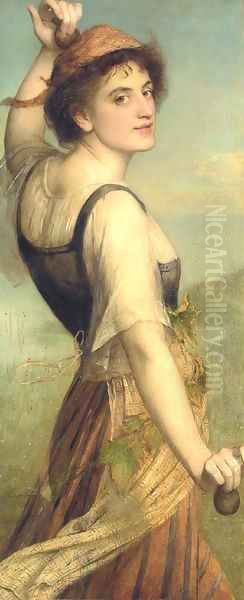
The Dancing Girl is another work that gained attention, showcasing his skill in depicting the human form in graceful movement, often with an exotic or classical flavour. Such subjects allowed for an exploration of beauty and rhythm, aligning with the tenets of the Aesthetic Movement.
Other titles attributed to him, such as The Witches' Sabbath, Ariadne, The Annunciation, Orpheus and Eurydice, and The End of the Day, suggest his continued engagement with mythological, biblical, and allegorical themes. These subjects provided ample scope for imaginative interpretation and the creation of visually rich and emotionally resonant imagery. His works often feature elongated figures, a hallmark of artists like Burne-Jones and other late Pre-Raphaelites, and a jewel-like application of paint.
Contemporaries and the Artistic Milieu
Charles Edward Hallé operated within a vibrant and complex artistic milieu. His closest collaborators in the gallery world were Joseph Comyns Carr and Sir Coutts Lindsay for the Grosvenor, and Carr and Edward Burne-Jones for the New Gallery. Burne-Jones was arguably the leading figure of the second generation of Pre-Raphaelitism and a central artist for both galleries. His ethereal figures, intricate designs, and subjects drawn from myth and legend set a particular tone.
George Frederic Watts, another towering figure, often referred to as "England's Michelangelo," created profound allegorical paintings that explored universal themes of life, death, and morality. He was a consistent exhibitor at both the Grosvenor and New Galleries. James McNeill Whistler, though his relationship with the art establishment was often fraught, was a key proponent of "art for art's sake" and his "Nocturnes" and "Symphonies" were showcased at the Grosvenor.
Frederic Leighton, President of the Royal Academy, while an establishment figure, also produced works of classical idealism and beauty that sometimes found a place or resonance with the Aesthetic Movement's ideals, even if he primarily exhibited at the RA. Lawrence Alma-Tadema, with his archaeologically precise and sun-drenched depictions of life in ancient Greece and Rome, was another popular artist whose works, while distinct, shared the Aesthetic concern with beauty and craftsmanship.
Walter Crane, a versatile artist and designer, was deeply involved in the Arts and Crafts Movement and his work, often featuring decorative patterns and allegorical figures, was frequently seen at these alternative galleries. John Roddam Spencer Stanhope, a follower of Burne-Jones, created idyllic and melancholic paintings often set in Italian landscapes. Evelyn De Morgan, one of the most significant female artists of the era, produced Symbolist works rich in spiritual and allegorical meaning, often featuring strong female figures and vibrant colours. Her husband, William De Morgan, was a celebrated ceramicist.
Other artists associated with this circle included John Melhuish Strudwick, whose meticulously detailed and jewel-like paintings are reminiscent of early Renaissance art, and Albert Moore, who focused on creating harmonious arrangements of classically draped female figures and decorative patterns, epitomizing the "art for art's sake" ideal. Even the older generation of Pre-Raphaelites, such as John Everett Millais and William Holman Hunt, though their paths diverged, had laid the groundwork for the artistic tendencies championed by Hallé and his colleagues. The influence of Dante Gabriel Rossetti, with his intense romanticism and medievalism, pervaded the atmosphere of this artistic current.
Hallé's interaction with these artists was primarily through his role as a gallery director, providing them with a sympathetic venue to showcase their work. He was part of a movement that sought to redefine the boundaries of art, emphasizing aesthetic quality, imaginative power, and emotional depth.
Later Life and Legacy
Charles Edward Hallé continued to paint and manage the New Gallery well into the early 20th century. He remained dedicated to the artistic principles that had guided his career, even as new movements like Post-Impressionism began to challenge the established order. The New Gallery continued to hold significant exhibitions, including important retrospectives and thematic shows, contributing to the cultural life of London.
He passed away in London in 1914. While his name may not be as instantly recognizable today as some of the artistic giants he championed, Charles Edward Hallé's contribution to the late Victorian art world was twofold and significant. As a painter, he produced a body of work that, while reflecting the prevailing tastes of his circle, possessed its own quiet distinction, characterized by technical skill, refined aesthetics, and a gentle, poetic sensibility. His paintings offer a window into the imaginative concerns of an era that valued beauty, narrative, and emotional expression.
Perhaps more enduringly, his legacy lies in his role as a co-founder and director of the Grosvenor Gallery and the New Gallery. These institutions were crucial in providing a platform for artists who were pushing the boundaries of British art, offering an alternative to the hegemony of the Royal Academy. By championing the Aesthetic Movement and late Pre-Raphaelitism, Hallé helped to shape the artistic landscape of his time and ensured that a diverse range of voices could be heard. His efforts fostered an environment where artists could explore more personal, imaginative, and unconventional forms of expression, thereby enriching the tapestry of British art history. His dedication to these ideals marks him as a key figure in the cultural life of late 19th and early 20th century Britain.