The name Edward Hughes resonates within the annals of British art history, yet it often leads to a confluence of identities, primarily between two distinct painters of the Victorian and Edwardian eras. This exploration seeks to delineate the life and work of Edward Hughes (1832-1908), a portrayer of Victorian society, while also giving due attention to his more widely celebrated, younger contemporary, Edward Robert Hughes RWS (1851-1914), a prominent figure in the later Pre-Raphaelite and Aesthetic movements. Understanding their individual contributions requires careful differentiation, as their paths, while both rooted in the rich artistic soil of 19th-century Britain, diverged significantly in style and subject matter.
Edward Hughes (1832-1908): Chronicler of Victorian Life
Edward Hughes, born in 1832, established himself as a painter of genre scenes and portraits that captured the essence of Victorian England. His professional life was largely centered in London, the bustling heart of the British Empire and its art world. While specific details about his early training are somewhat scarce, it is believed that he may have received initial instruction from his father, George Hughes, who was also an artist. This familial introduction to the arts was not uncommon in an era where skills were often passed down through generations.
Artistic Focus and Style
Hughes's oeuvre is characterized by its meticulous and realistic depiction of everyday Victorian life. He turned his observant eye to a variety of settings, bringing to life scenes from schools, churches, and domestic interiors. His works often possess a narrative quality, inviting viewers to ponder the lives and circumstances of the figures portrayed. This dedication to accuracy and realism aligned with a broader trend in Victorian art, where detailed representation was highly valued, partly as a reflection of the scientific and empirical spirit of the age. Artists like William Powell Frith, with his panoramic depictions of modern life such as "Derby Day" or "The Railway Station," set a precedent for this kind of detailed social observation, and Hughes operated within this tradition, albeit often on a more intimate scale.
His portraiture, another significant aspect of his career, would have catered to the burgeoning middle and upper classes eager to have their likenesses preserved. Victorian portraiture ranged from the grand statements of artists like George Frederic Watts or John Everett Millais in his later career, to more modest, personal commissions. Hughes's portraits likely emphasized not just physical resemblance but also the character and social standing of his sitters, a hallmark of successful portraitists of the period.
Exhibitions and Recognition
Throughout his career, Edward Hughes was a consistent exhibitor at prominent London venues. His works graced the walls of the prestigious Royal Academy of Arts, a key institution for any artist seeking recognition and patronage. He also showed his paintings at the British Institution, another important exhibition space, as well as at galleries in Suffolk Street (home to the Royal Society of British Artists) and the Grosvenor Gallery. The Grosvenor Gallery, in particular, became known for showcasing more avant-garde artists associated with the Aesthetic Movement, such as James McNeill Whistler and Edward Burne-Jones, suggesting Hughes's work, while perhaps more traditional, was still deemed worthy of display alongside a diverse range of contemporary art. His consistent presence in these exhibitions indicates a steady career and a degree of acceptance within the established art world of his time.
The "Other" Edward Hughes: A Note on Identity
It is crucial to address a point of potential confusion arising from the provided information. Some biographical details, such as an Edward Hughes born in Armagh, Ireland, joining the army, serving in Tasmania and India, and later emigrating to Western Australia to become an Enrolled Pensioner Guard, do not align with the known biography of Edward Hughes the painter (1832-1908). This individual, who lived in Saint George, Western Australia, and whose legacy contributed to London hospitals, appears to be an entirely different person. Such coincidences in names are not uncommon, and it's vital for historical accuracy to keep their narratives separate. Similarly, anecdotes about an Edward Hughes and his impactful teachers like J.T. Jones and Dicky Pearce, and the nurturing environment they created, seem to refer to yet another individual, possibly within an educational context, rather than the painter.
Edward Robert Hughes RWS (1851-1914): A Vision of Romance and Mysticism
To fully address the scope of artists named Edward Hughes and to incorporate all information provided, we must turn to Edward Robert Hughes, often initialed as E.R. Hughes. He was a generation younger than the aforementioned Edward Hughes and carved a distinct niche for himself within the romantic and symbolic currents of late Victorian and Edwardian art.
Early Influences and Pre-Raphaelite Connections
Born in London in 1851, Edward Robert Hughes was the nephew of Arthur Hughes, himself a significant painter associated with the Pre-Raphaelite Brotherhood. This familial connection was pivotal. Arthur Hughes, known for works like "April Love" and "The Long Engagement," undoubtedly provided early inspiration and guidance. Through his uncle, E.R. Hughes was immersed in the ideals of the Pre-Raphaelites, who, since their formation in 1848 by William Holman Hunt, John Everett Millais, and Dante Gabriel Rossetti, had sought to revitalize British art by rejecting the perceived academicism of the Royal Academy and embracing intense color, detailed observation, and subjects of serious or romantic import.
E.R. Hughes's most direct link to the founding members of the Pre-Raphaelite Brotherhood came through his association with William Holman Hunt. As Hunt's eyesight began to fail in his later years, E.R. Hughes became his trusted studio assistant. This was a role of considerable responsibility. He notably assisted Hunt in completing later versions or copies of some of his most famous works, including the iconic "The Light of the World," a painting that had captivated the Victorian public with its allegorical depiction of Christ. He also helped Hunt with "The Lady of Shalott," another subject steeped in Arthurian legend, beloved by the Pre-Raphaelites. This close working relationship with Hunt provided invaluable experience and further solidified his grounding in Pre-Raphaelite techniques and ethos.
Artistic Style: Pre-Raphaelitism, Aestheticism, and Symbolism
E.R. Hughes's artistic style is a captivating blend of late Pre-Raphaelitism and the burgeoning Aesthetic Movement, with strong Symbolist undertones. His works are often characterized by their dreamlike, ethereal quality, rich and jewel-like colors, and meticulous attention to detail, a legacy of his Pre-Raphaelite training. He frequently drew inspiration from literary sources, mythology, and romantic poetry, creating scenes imbued with a sense of magic, mystery, and poetic fantasy.
The influence of Aestheticism, which prioritized "art for art's sake" and the pursuit of beauty above all else, is evident in the decorative qualities of his compositions and the often languid, graceful figures he depicted. Artists like Albert Moore and Frederic Leighton were key proponents of the Aesthetic Movement, emphasizing harmony of color and form. E.R. Hughes absorbed these sensibilities, creating works that were visually sumptuous and emotionally evocative. His figures, often female, are typically idealized, embodying a particular type of wistful, otherworldly beauty that resonated with the Symbolist leanings of the fin-de-siècle.
He was particularly renowned for his mastery of watercolor, a medium he handled with exceptional delicacy and brilliance. He also worked in oils and gouache, often combining mediums to achieve specific luminous effects. His technique involved building up layers of color to create depth and vibrancy, resulting in surfaces that almost glow.
Representative Works
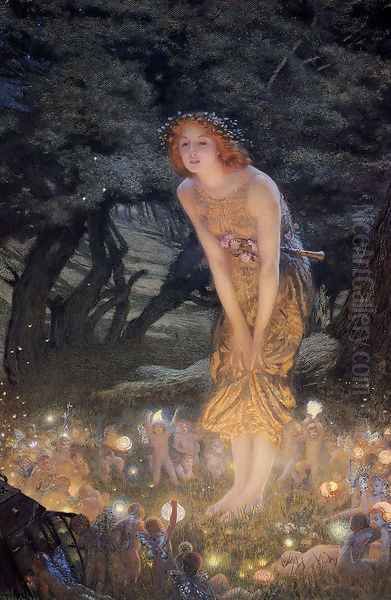
Several works stand out as emblematic of E.R. Hughes's unique vision. "Midsummer Eve" (circa 1908) is perhaps one of his most famous paintings. It depicts a young woman in a moonlit, dew-kissed landscape, surrounded by tiny fairies, capturing a sense of enchantment and the mystical power of nature. The painting showcases his skill in rendering light, particularly moonlight, and his ability to create an intensely atmospheric scene.
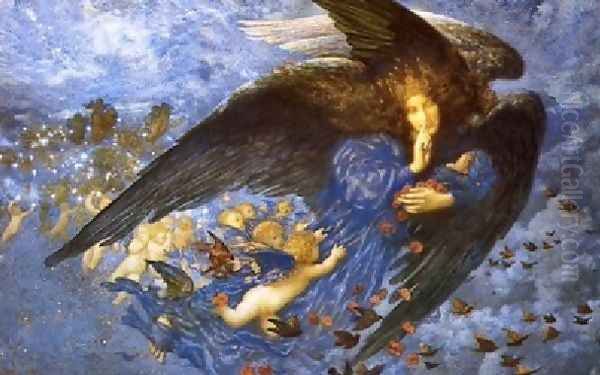
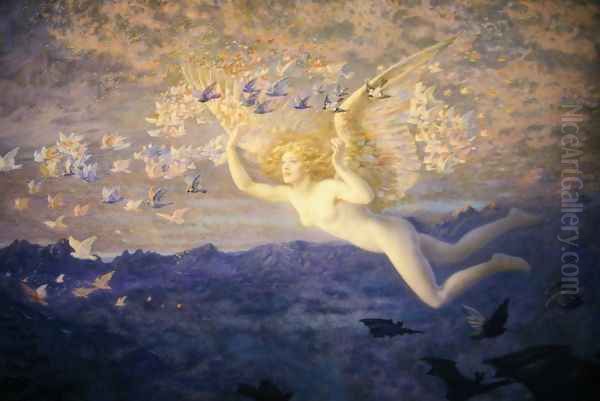
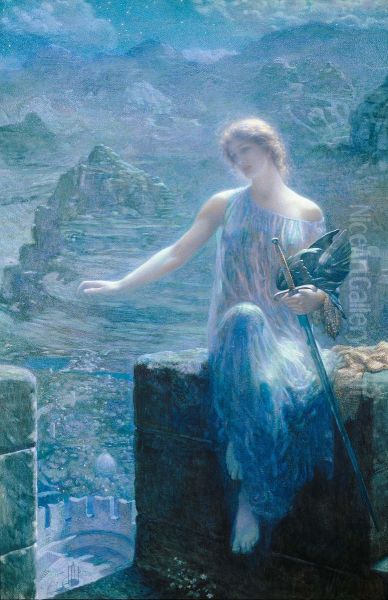
"Night With Her Train of Stars" (1912) is another quintessential work, personifying Night as a majestic, dark-robed figure, accompanied by a retinue of stars represented as ethereal beings. This piece, with its celestial theme and imaginative power, highlights his Symbolist tendencies, where figures and elements carry deeper, often poetic meanings. Other notable works include "Wings of the Morning," "The Valkyrie's Vigil," and numerous depictions of romantic and mythological subjects that allowed him to explore themes of love, loss, spirituality, and the supernatural. His ability to convey mood and emotion through color, light, and composition was exceptional.
Contemporaries and Artistic Circle
Beyond his uncle Arthur Hughes and mentor William Holman Hunt, E.R. Hughes moved within a circle of artists who shared similar sensibilities. He would have been aware of, and likely interacted with, figures such as Sir Edward Burne-Jones, a leading figure of the second wave of Pre-Raphaelitism, whose own work was deeply invested in myth, legend, and dreamlike beauty. The influence of Burne-Jones, with his elongated figures and decorative compositions, can be subtly discerned in some of Hughes's work.
He also had connections with the writer and poet George MacDonald, whose fantasy novels and fairy tales, often illustrated by Arthur Hughes, shared a similar imaginative and spiritual depth found in E.R. Hughes's paintings. The broader artistic milieu included figures like John William Waterhouse, who, like Hughes, continued to explore Pre-Raphaelite themes with a later Victorian sensibility, and Symbolist painters across Europe whose work resonated with his interest in the unseen and the imagined.
Professional Affiliations
E.R. Hughes was an active member of the Royal Watercolour Society (RWS). He was elected an Associate in 1891 and became a full Member in 1895. His dedication to the society was further demonstrated by his service as its Vice-President from 1901 to 1903. His involvement with the RWS underscores his commitment to the medium of watercolor and his standing among his peers as a master of the craft. His works were regularly exhibited at the RWS and other galleries, earning him critical acclaim and a dedicated following.
The Victorian Art Scene: A Broader Context
The careers of both Edward Hughes (1832-1908) and Edward Robert Hughes (1851-1914) unfolded against the backdrop of a dynamic and multifaceted Victorian art world. This era saw the Royal Academy of Arts as the dominant force, yet it also witnessed the rise of alternative movements and exhibition societies. Genre painting, as practiced by the elder Edward Hughes, enjoyed immense popularity, reflecting the middle-class interest in scenes of contemporary life and sentimental narratives. Artists like Thomas Webster, Frederick Daniel Hardy, and later, James Tissot, excelled in this domain.
Simultaneously, the Pre-Raphaelite Brotherhood, and its later adherents like E.R. Hughes, offered a romantic and often moralizing alternative to academic art. Their influence extended throughout the century, evolving into the Aesthetic Movement and Symbolism. The period was also marked by significant advancements in printmaking and illustration, which brought art to a wider audience. The Great Exhibition of 1851, a testament to Victorian industry and progress, also had a profound impact on design and the applied arts, fostering a climate where artistic expression in various forms flourished. The patronage system was also changing, with newly wealthy industrialists joining the traditional aristocracy as collectors, influencing artistic tastes and trends.
Conclusion: Distinct Legacies in British Art
In conclusion, while sharing a surname and a profession, Edward Hughes (1832-1908) and Edward Robert Hughes (1851-1914) represent different facets of British art in the 19th and early 20th centuries.
Edward Hughes (1832-1908) was a diligent painter of his time, contributing to the rich tapestry of Victorian genre painting and portraiture. His works offer valuable insights into the social fabric and everyday life of the period, rendered with a characteristic realism and attention to detail. He found his place within the established exhibition system, creating art that appealed to the tastes of his contemporaries.
Edward Robert Hughes (1851-1914), on the other hand, emerged as a significant figure in the twilight of the Pre-Raphaelite movement, infusing it with the sensibilities of Aestheticism and Symbolism. His enchanting, mystical, and exquisitely crafted paintings, particularly his watercolors, have earned him lasting admiration. His close association with William Holman Hunt and his familial ties to Arthur Hughes place him firmly within the Pre-Raphaelite lineage, yet his unique vision and technical brilliance allowed him to create a body of work that is distinctly his own.
By carefully distinguishing between these two artists, and acknowledging other individuals who coincidentally shared the name, we gain a clearer and more nuanced understanding of their respective contributions to the diverse landscape of British art. Both, in their own ways, reflected and shaped the artistic currents of their times, leaving behind legacies that continue to be appreciated and studied.