Charles Ethan Porter (1847-1923) stands as a significant, yet for many years overlooked, figure in American art history. An African American artist who specialized in still life painting, Porter navigated a post-Civil War America rife with racial prejudice to achieve a notable degree of success and leave behind a body of work celebrated for its technical skill, subtle beauty, and, in recent years, its nuanced social commentary. His journey from a modest upbringing in Connecticut to the art academies of New York and Paris is a testament to his talent and perseverance. This exploration delves into the life, art, and enduring legacy of a painter who masterfully captured the ephemeral beauty of fruits and flowers, securing his place as a pioneer in American still life.
Early Life and Artistic Awakening
Born in Hartford, Connecticut, around 1847 (some sources suggest 1848 or 1849, but 1847 is most commonly cited) into a free Black family, Charles Ethan Porter's early life was marked by hardship. His family experienced significant loss, with several siblings dying young. His father worked as a laborer, possibly in a mill, and his mother as a domestic servant, reflecting the limited economic opportunities available to African Americans at the time, even in the North. Despite these challenging circumstances, Porter developed an early passion for art.
Growing up in Hartford, a city with a burgeoning cultural scene, may have provided some initial exposure to artistic endeavors. He attended the North Main Street School, one of Hartford's segregated schools for Black children, and later the Hartford High School, from which he graduated in 1865. His desire to pursue art professionally was a bold ambition for a young Black man in the 19th century, a period when such paths were exceedingly rare and fraught with obstacles.
After completing his high school education, Porter moved to Wilbraham, Massachusetts, in 1868 to study art at the Wesleyan Academy (now Wilbraham & Monson Academy). This step indicated a serious commitment to formal artistic training, setting him apart from many aspiring artists of his background who might have been self-taught or apprenticed locally. His time in Wilbraham laid the foundational skills that would serve him throughout his career.
Formal Training and Emergence
Porter's ambition led him to New York City, the epicenter of the American art world. In 1869, he achieved a significant milestone by enrolling at the prestigious National Academy of Design, becoming one of the first, if not the very first, African Americans to be admitted. He studied there for four years, until 1873, honing his skills in drawing and painting. At the Academy, he would have been immersed in a curriculum that emphasized academic realism, focusing on drawing from casts and live models, and mastering traditional techniques.
During his time at the National Academy, Porter studied under influential artists, including Joseph Oriel Eaton, a respected portrait and genre painter. He also learned alongside fellow students who would go on to become notable figures in American art, such as the landscape painter J. Alden Weir and the visionary romantic painter Albert Pinkham Ryder. This environment, while likely challenging due to his race, provided him with rigorous training and exposure to the prevailing artistic currents of the day.
Porter quickly demonstrated his talent. He began exhibiting his work at the National Academy's annual exhibitions as early as 1871, a mark of his progress and acceptance within this institution. His early works, primarily still lifes, already showed a meticulous attention to detail and a sensitivity to color and texture that would become hallmarks of his style.
Establishing a Career in Hartford
After completing his studies in New York, Charles Ethan Porter returned to his hometown of Hartford, Connecticut, around 1875. He established a studio there in 1878, a bold move for an African American artist aiming to make a living from his art. Hartford, though smaller than New York, had a supportive arts community and a number of wealthy patrons. Porter began to specialize in still life paintings, particularly of fruit and flowers, a genre popular in Victorian America for its decorative appeal and moralistic undertones.
His work quickly gained recognition for its exquisite realism and vibrant, yet harmonious, color palettes. Critics praised his ability to render the textures of fruits—the fuzzy skin of a peach, the smooth sheen of an apple, the delicate bloom on grapes—with remarkable fidelity. His floral compositions were equally admired for their botanical accuracy and lush beauty. Porter's dedication to still life was notable; he became one of the few American artists, and certainly the only prominent African American artist of his generation, to focus almost exclusively on this genre.
Among his admirers was the famed author Mark Twain, a resident of Hartford, who reportedly purchased several of Porter's paintings and encouraged his work. Another prominent supporter was the Hudson River School painter Frederic Edwin Church, one of America's most celebrated artists, who also acquired Porter's work and offered him encouragement, famously stating that Porter was "the only man he knew who could paint a pear." Such endorsements from leading cultural figures were invaluable, lending credibility and visibility to Porter's burgeoning career.
European Sojourn and Artistic Evolution
Driven by a desire to further refine his skills and broaden his artistic horizons, Porter, like many ambitious American artists of his era, aspired to study in Europe, particularly Paris, then considered the capital of the art world. To fund this expensive endeavor, he organized an auction of over 100 of his paintings in Hartford in November 1881. The auction was a success, raising enough money for him to travel abroad.
Porter arrived in Paris in late 1881 or early 1882 and remained in Europe for nearly three years. He enrolled at the École des Arts Décoratifs and likely studied at other ateliers, immersing himself in the rich artistic environment. This period was crucial for his development. He was exposed to the works of the French Realists and the Barbizon School painters, such as Jean-Baptiste-Camille Corot and Jean-François Millet, whose emphasis on direct observation of nature and subdued palettes resonated with his own inclinations.
More significantly, Porter encountered Impressionism, which was then a revolutionary force in European art. While he never fully adopted the broken brushwork and light-drenched canvases of artists like Claude Monet or Camille Pissarro, the Impressionists' focus on capturing fleeting moments and their brighter color palettes undoubtedly influenced his work. After his return from Europe, his paintings often displayed a looser brushstroke, a richer chromatic range, and a greater sense of atmospheric light compared to his earlier, more tightly rendered pieces. He also spent time in London and possibly Italy, further absorbing European artistic traditions.
Return to America and Mature Period
Charles Ethan Porter returned to Hartford in 1884, his art subtly transformed by his European experiences. He reopened his studio and continued to paint, primarily still lifes, but his style now showed a greater sophistication in composition and a more nuanced handling of light and color. His fruit pieces became richer, his floral arrangements more dynamic and atmospheric. He also began to paint more landscapes, a genre he had explored before but now approached with a greater sensitivity to mood and light, likely influenced by the Barbizon painters.
Around 1889, Porter moved from Hartford to Rockville, a smaller town in Connecticut, possibly seeking a quieter environment or more affordable living. He continued to be active in the local art scene, becoming a founding member of the Connecticut Academy of Fine Arts. His work from this period demonstrates a mature command of his medium. Paintings like Peonies (c. 1885) or Apples on a Tin Pail (c. 1890) showcase his ability to combine meticulous observation with a painterly touch.
Despite his talent and the earlier recognition he had received, Porter's later career was increasingly challenging. The popularity of still life painting began to wane in the late 19th and early 20th centuries as new artistic movements gained prominence. Furthermore, the persistent racial prejudice of the era undoubtedly limited his opportunities for exhibition and patronage, especially outside of his local Connecticut sphere. While he had achieved a level of success uncommon for African American artists of his time, he never attained the widespread fame or financial security of some of his white contemporaries, such as William Michael Harnett or John F. Peto, who were also renowned still life painters.
Thematic Concerns and Symbolic Depth
While Charles Ethan Porter's still lifes are primarily celebrated for their aesthetic beauty and technical skill, contemporary scholarship has begun to explore their potential for deeper thematic and symbolic meaning, particularly in the context of his identity as an African American artist. Traditionally, still life has been a genre capable of conveying complex ideas through the careful selection and arrangement of objects – themes of abundance, transience (vanitas), and domesticity.
One of Porter's most discussed works in this regard is Cracked Watermelon (c. 1890). The watermelon, a fruit often associated with racist caricatures of African Americans, is here rendered with dignity and lushness. The "cracked" nature of the fruit, however, has invited interpretations ranging from a simple depiction of ripeness to a more complex commentary on the fractured state of Black life in America or even a subtle act of reclaiming a fraught symbol.
Another intriguing, though less common, subject for Porter was insects. A painting titled Four Flies (c. 1881) is a small, meticulously rendered study. While insect studies were part of academic training, the choice to elevate such humble creatures to the status of a finished artwork might suggest an interest in the minute and overlooked aspects of nature, or perhaps, as some scholars have suggested, a subtle commentary on societal pests or the artist's own feelings of being scrutinized or marginalized.
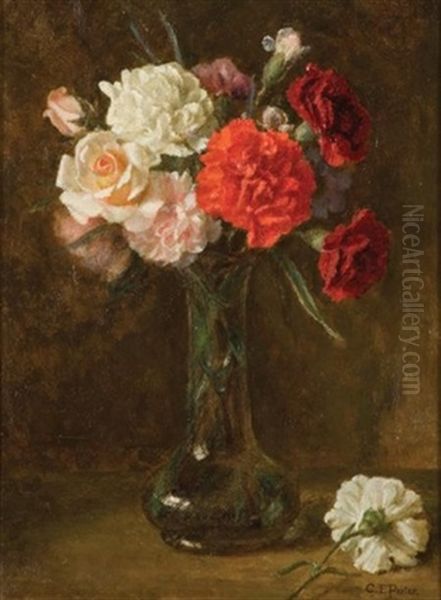
His floral paintings, often depicting cultivated garden flowers like roses, peonies, and lilacs, speak to the Victorian era's "language of flowers" and the appreciation for nature's beauty. However, viewed through the lens of his experience, these depictions of carefully cultivated beauty could also be seen as an assertion of refinement and artistic sensibility in a society that often denied such qualities to African Americans. While Porter himself left few written records about his intentions, the context of his life invites these richer readings of his work, adding layers of meaning beyond their surface appeal.
Challenges and Resilience in a Divided Society
The career of Charles Ethan Porter cannot be fully understood without acknowledging the pervasive racial discrimination he faced. As an African American artist in the late 19th and early 20th centuries, he operated in a society where opportunities were severely limited by race. While the North offered more freedom than the Jim Crow South, systemic racism was still a formidable barrier.
Porter's admission to the National Academy of Design was exceptional, but it did not guarantee an easy path. Throughout his career, he likely encountered prejudice from patrons, critics, and fellow artists. While he gained support from prominent figures like Mark Twain and Frederic Edwin Church, and achieved local recognition in Connecticut, his race may have prevented him from accessing wider markets or more prestigious commissions available to his white peers. Artists like Robert S. Duncanson and Edward Mitchell Bannister, earlier African American landscape painters, had also faced similar struggles for recognition in a predominantly white art world.
Financial insecurity was a persistent issue. Despite his talent and periods of success, Porter often struggled to make a living from his art. The 1881 auction to fund his European studies, while successful, highlights the financial pressures he faced. In his later years, as his style perhaps fell out of favor and his health declined, these economic difficulties likely intensified. He reportedly resorted to selling his paintings door-to-door or bartering them for goods and services in Rockville. This contrasts sharply with the careers of some of his white contemporaries who specialized in still life, such as Severin Roesen or Martin Johnson Heade (who also painted landscapes and hummingbirds), who often found more consistent patronage.
Despite these immense challenges, Porter's dedication to his art remained unwavering. His continued production of high-quality work, his involvement in local art organizations, and his pursuit of excellence in a demanding genre speak to his remarkable resilience and commitment. He carved out a space for himself in the American art world against considerable odds, paving the way for future generations of African American artists, including figures like Henry Ossawa Tanner, who achieved international acclaim a generation later.
Later Years and Obscurity
The final decades of Charles Ethan Porter's life were marked by declining health and increasing obscurity. He continued to live and paint in Rockville, Connecticut, but his work received less attention than it had in his earlier years. The art world was rapidly changing, with modernism beginning to take hold, and Porter's more traditional, realistic style of still life, even with its Impressionistic influences, was no longer in vogue.
Economic hardship persisted, and Porter's living conditions reportedly deteriorated. He suffered from Bright's disease, a kidney ailment, which further hampered his ability to work and support himself. Despite these difficulties, he continued to paint, driven by an inner need to create. His later works, though perhaps less numerous or ambitious than those of his prime, still demonstrate his characteristic sensitivity to color and form.
Charles Ethan Porter died on March 6, 1923, in Rockville. He was buried in an unmarked grave in the Grove Hill Cemetery, a poignant symbol of the obscurity into which this talented artist had fallen. For many decades after his death, his name and work were largely forgotten by the broader art historical narrative, a fate shared by many accomplished artists, particularly women and artists of color, whose contributions were often marginalized or overlooked by mainstream art history.
Posthumous Rediscovery and Lasting Legacy
The rediscovery of Charles Ethan Porter began in the latter half of the 20th century, fueled by a growing interest in re-evaluating American art history to include the contributions of previously marginalized artists. Scholars and curators, particularly those focused on African American art, began to unearth his story and his paintings. Exhibitions of his work, often organized by Connecticut-based institutions, started to bring his art back into public view.
A pivotal moment in his posthumous recognition was the 1987 exhibition "Charles Ethan Porter: A Black American Artist, 1847-1923" organized by the Connecticut Gallery, which helped to re-establish his reputation. Since then, his work has been included in numerous group exhibitions focusing on American still life painting and African American art. His paintings are now held in the collections of major museums, including the Metropolitan Museum of Art, the Smithsonian American Art Museum, the Wadsworth Atheneum Museum of Art in Hartford, and the New Britain Museum of American Art.
Today, Charles Ethan Porter is recognized as one of the most accomplished American still life painters of the late 19th century and a pioneering figure in African American art history. His work is admired for its technical mastery, its lyrical beauty, and its sensitive depiction of natural forms. Art historians appreciate his ability to synthesize traditional academic realism with the emerging influences of the Barbizon School and Impressionism, creating a style that was both grounded in tradition and subtly modern.
His legacy extends beyond his artistic achievements. Porter's life story is a compelling narrative of talent, ambition, and perseverance in the face of significant societal barriers. He demonstrated that an African American artist could achieve excellence in a demanding field, challenging the racial prejudices of his time and inspiring future generations. His dedication to the genre of still life, a field not commonly pursued by African American artists of his era, further distinguishes his contribution.
Conclusion: An Enduring Artistry
Charles Ethan Porter's journey from a working-class Black family in post-Civil War Connecticut to the art academies of New York and Paris, and his subsequent career as a dedicated still life painter, is a remarkable chapter in American art history. He mastered the intricate details of academic realism and subtly incorporated the atmospheric qualities of newer European movements, creating still lifes of fruit and flowers that are both exquisitely rendered and imbued with a quiet, enduring beauty.
While his lifetime saw periods of recognition, particularly from influential figures like Mark Twain and Frederic Edwin Church, Porter also faced the profound challenges of racial prejudice and economic hardship, which ultimately led to a period of posthumous obscurity. However, thanks to dedicated scholarship and a renewed appreciation for the diverse voices in American art, Charles Ethan Porter has rightfully reclaimed his place as a significant artist. His paintings, now gracing the walls of major museums, continue to captivate viewers with their technical brilliance and delicate charm, securing his legacy as a master of American still life and a testament to the resilience of the artistic spirit.