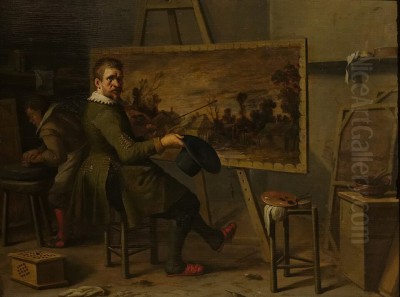
Joost Cornelisz. Droochsloot (c. 1585/1586 – 14 May 1666) stands as a significant, if sometimes overlooked, figure in the rich tapestry of Dutch Golden Age painting. Active primarily in Utrecht, he carved a distinct niche for himself with his lively and often didactic depictions of village scenes, peasant life, biblical narratives, and moral allegories. His work provides a fascinating window into the social fabric, customs, and ethical concerns of the 17th-century Netherlands, bridging the traditions of earlier Flemish masters with the burgeoning trends of Dutch genre painting. While perhaps not possessing the international fame of a Rembrandt or Vermeer, Droochsloot’s prolific output and consistent thematic focus make him an important artist for understanding the cultural landscape of his time.
Early Life and Artistic Formation in Utrecht
Born in Utrecht around 1585 or 1586, Joost Cornelisz. Droochsloot (often referred to with the patronymic "Cornelisz." to distinguish him from his son, also named Cornelis) grew up in a city that was a vibrant artistic center. While details of his earliest training remain somewhat obscure, it is evident that he was immersed in a rich artistic environment. Utrecht, at this time, was home to influential painters and maintained strong connections with artistic developments in both the Southern Netherlands (Flanders) and Italy, particularly through the Utrecht Caravaggisti like Hendrick ter Brugghen and Gerrit van Honthorst, who were slightly younger contemporaries.
Droochsloot’s artistic inclinations likely developed early, and by 1616, he was registered as a master in the Utrecht Guild of St. Luke. This membership was crucial for any artist wishing to practice professionally, take on apprentices, and sell their work. His acceptance into the guild signifies that he had achieved a recognized level of skill and was ready to establish his independent career. The artistic milieu of Utrecht would have exposed him to a variety of styles, from the late Mannerism of Abraham Bloemaert to the emerging realism that characterized much of Dutch Golden Age art.
The Guild of St. Luke and Civic Engagement
Droochsloot’s involvement with the Guild of St. Luke was not merely nominal. He rose through its ranks, serving as dean of the guild in 1623 and again in 1624. This position of leadership indicates the respect he commanded among his peers and his commitment to the artistic community of Utrecht. The guild played a vital role in regulating the art trade, maintaining standards of craftsmanship, and providing a social and professional network for its members.
Beyond his artistic endeavors, Droochsloot was an active and respected member of Utrecht society. In 1638, he became regent of the St. Jobsgasthuis (St. Job's Hospital), an institution dedicated to caring for those afflicted with syphilis and other ailments. This role underscores a commitment to charitable work, a theme that frequently appears in his paintings. Furthermore, in 1641 and 1642, he served as a hopman (captain) in the Utrecht schutterij, the civic guard or militia, a position of considerable social standing. His involvement in these civic and charitable institutions paints a picture of a well-rounded individual, deeply integrated into the life of his city. He was also documented as an officer of a theatrical group in Utrecht in 1665, suggesting a broad range of cultural interests.
Artistic Style: A Distinctive Vision of Rural Life
Joost Cornelisz. Droochsloot developed a highly recognizable artistic style, particularly in his favored genre of village scenes. His compositions typically feature a wide, receding village street, often unpaved, flanked by an assortment of rustic houses, inns, and occasionally a church. This street acts as a stage for a multitude of small, animated figures, usually peasants, engaged in a variety of activities. The perspective is often somewhat elevated, allowing for a panoramic view of the bustling scene.
A hallmark of Droochsloot's style is his distinctive palette, which frequently leans towards warm, earthy tones, with a notable prevalence of reddish-browns, ochres, and muted greens. His figures, though small in scale, are rendered with a lively, almost calligraphic touch, their gestures and postures conveying a sense of energy and spontaneity. Compared to some of his contemporaries, like the landscape and genre painter Esaias van de Velde, Droochsloot’s figures can appear somewhat more rapidly executed and less detailed, but they possess a characteristic robustness. He often employed a somewhat uniform lighting, with less emphasis on dramatic chiaroscuro than seen in the works of the Caravaggisti, though his scenes are far from flat, with a good sense of atmospheric perspective.
His compositions are often densely populated, creating a sense of communal activity and social interaction. The architecture in his paintings, while not always specific to identifiable locations, captures the vernacular building styles of Dutch villages of the period. This consistent approach to composition and subject matter made his work readily identifiable and popular with a segment of the art-buying public.
Thematic Concerns: Morality, Merriment, and Daily Life
Droochsloot’s subject matter was diverse, yet certain themes recur with notable frequency, often imbued with moral or didactic undertones. His village scenes are perhaps his most characteristic works. These are not simply idyllic portrayals of rural life but often depict specific events or social interactions. Village kermesses (fairs or festivals) were a favorite subject, allowing him to portray peasants dancing, drinking, eating, and engaging in various forms of revelry. While these scenes capture the joyous aspects of communal life, they could also carry cautionary messages about excess and unruliness, a common trope in Netherlandish art descending from Pieter Bruegel the Elder.
A significant portion of his oeuvre is dedicated to scenes illustrating acts of charity, directly reflecting his own civic engagement. Paintings depicting the "Seven Works of Mercy" (feeding the hungry, giving drink to the thirsty, clothing the naked, sheltering the homeless, visiting the sick, visiting prisoners, and burying the dead) appear regularly. These works served as visual reminders of Christian duty and social responsibility. His depictions of distributing alms to the poor, or caring for the sick, often set within his characteristic village street settings, are poignant and direct.
Biblical narratives also formed part of his output. These were often Old Testament stories or parables from the New Testament that allowed for the inclusion of numerous figures and a degree of narrative drama. Additionally, he painted historical scenes, sometimes alluding to events from the Eighty Years' War (Dutch War of Independence), which had profoundly shaped the nation. Even in these diverse subjects, his stylistic hallmarks – the crowded compositions, the earthy palette, and the animated figures – remain consistent.
Key Influences: Shaping a Career
Droochsloot’s art did not develop in a vacuum. He was clearly indebted to earlier traditions and responsive to contemporary trends. The most profound influence on his work, particularly his village scenes, comes from the Flemish master Pieter Bruegel the Elder (c. 1525-1569) and his sons, Pieter Brueghel the Younger (1564-1638) and Jan Brueghel the Elder (1568-1625). The Bruegelian tradition of depicting peasant life, kermesses, and proverbial scenes, with their crowded compositions and moralizing content, provided a foundational model for Droochsloot. The widespread dissemination of Bruegel’s imagery through prints and painted copies by his sons ensured its enduring impact.
Another significant Flemish influence was David Vinckboons (1576-c. 1632). Born in Mechelen, Vinckboons moved to Amsterdam and played a crucial role in popularizing peasant genre scenes in the Northern Netherlands. His lively compositions, often featuring outdoor gatherings and festivities, share thematic and stylistic affinities with Droochsloot's work. Vinckboons, like Droochsloot, often depicted wide village streets teeming with figures.
Among his Dutch contemporaries, Esaias van de Velde (c. 1587-1630) was an important figure in the development of realistic landscape and genre painting. While van de Velde’s work is generally characterized by a more refined touch and a greater emphasis on atmospheric effects, his outdoor genre scenes, cavalry skirmishes, and merry companies provided a contemporary context for Droochsloot’s explorations of everyday life. Droochsloot’s style, however, remained distinct, often more robust and less delicate than that of van de Velde. One might also consider the broader context of Dutch landscape painters like Jan van Goyen (1596-1656) and Salomon van Ruysdael (1602-1670), who were revolutionizing the depiction of the Dutch countryside, though Droochsloot's focus remained more on the human activity within the landscape.
Representative Works: A Closer Look
While Droochsloot was prolific, and many of his works share similar compositional structures, several paintings can be highlighted as representative of his style and thematic concerns.
Village Kermis / Village Feast: Numerous paintings by Droochsloot depict these lively village fairs. A typical example would show a broad village street, perhaps with an inn prominently featured, filled with peasants dancing, carousing, eating, and drinking. Children play, vendors sell their wares, and musicians provide accompaniment. These scenes, such as A Village Kermis (c. 1645, Rijksmuseum, Amsterdam), are characterized by their energetic figures and the sheer density of the composition, capturing the boisterous atmosphere of such events. Often, a church tower in the background might serve as a subtle reminder of piety amidst the worldly pleasures.
The Seven Works of Mercy / Distribution of Alms: Paintings on this theme, like The Distribution of Bread to the Poor or scenes explicitly titled The Seven Works of Mercy, are central to understanding Droochsloot’s moralizing intent. In these works, well-to-do burghers are shown distributing food, clothing, or money to the less fortunate. The setting is often a village street or the courtyard of a charitable institution. These paintings not only illustrate a key Christian virtue but also reflect the social structures and charitable practices of the time. An example is The Works of Mercy (1618, Centraal Museum, Utrecht).
Skaters on a Frozen Canal / Winter Landscape with Skaters: Droochsloot also contributed to the popular Dutch genre of winter landscapes. Works like Skaters on the City Moat or Winter Landscape with Skaters near a Town (c. 1620-1630) depict figures enjoying themselves on the ice, a common pastime in the Netherlands. These scenes allowed for the depiction of lively human activity against a backdrop of snow-covered landscapes and frozen waterways. While perhaps less renowned for these than specialists like Hendrick Avercamp (1585-1634), Droochsloot’s winter scenes are charming and fit within his broader interest in communal life.
Biblical Scenes: Droochsloot painted various biblical subjects, often choosing those that allowed for large crowds and narrative action. Examples include Christ Healing the Sick or parables like The Parable of the Great Supper. These works translated sacred stories into familiar, contemporary settings, making them relatable to his audience.
Historical and Allegorical Scenes: He also produced works with historical or allegorical content, such as scenes from the Eighty Years' War or allegories of the months. These further demonstrate the breadth of his thematic range, though always interpreted through his characteristic stylistic lens. For instance, The Disbanding of the 'Waardgelders' by Prince Maurice in Utrecht, 31 July 1618 (Rijksmuseum, Amsterdam) is a significant historical piece.
Droochsloot and the Utrecht School
While the Utrecht Caravaggisti (Ter Brugghen, Van Honthorst, Dirck van Baburen) are often the most internationally recognized members of the "Utrecht School," the city's artistic output was far more diverse. Droochsloot, along with artists like Paulus Moreelse (portraiture and historical scenes) and Roelant Savery (landscapes and animal paintings, though Savery also worked elsewhere), contributed to this broader artistic environment. Droochsloot’s focus on local genre scenes provided a distinct counterpoint to the Italianate influences of the Caravaggisti. His work represents a more indigenous Netherlandish tradition, rooted in the observation of local life and customs.
His workshop in Utrecht must have been a busy place, given his prolific output. The consistency of his style suggests a well-organized studio practice. He trained several pupils, ensuring the continuation of his artistic approach, at least for a time.
A Family of Painters and a Workshop Legacy
Joost Cornelisz. Droochsloot’s artistic legacy was continued, most directly, by his son, Cornelis Droochsloot (baptized 1630, active until at least 1673). Cornelis worked in a style very similar to his father's, often making it difficult to distinguish between their hands, especially for works produced in the mid-century. This similarity suggests that Cornelis was trained by his father and likely worked in his studio for a considerable period. Many paintings attributed generally to "Droochsloot" could potentially be by either father or son, or collaborative workshop productions.
One of Joost's most notable pupils was Jacob Duck (c. 1600-1667). Duck went on to become a significant genre painter in his own right, known for his depictions of guardroom scenes (cortegaardjes), merry companies, and brothel scenes. While Duck developed his own distinct style, characterized by a more polished finish and often a more overtly satirical or moralizing tone (akin to contemporaries like Jan Steen), his early training with Droochsloot would have provided him with a solid grounding in figure painting and compositional principles.
The existence of a workshop and pupils indicates Droochsloot's standing and success as an artist. His particular brand of village scene clearly found a ready market, allowing him to maintain a productive studio over several decades.
Later Career and Enduring Reputation
Joost Cornelisz. Droochsloot remained active as a painter throughout his long life. He continued to produce his characteristic village scenes, biblical narratives, and allegories well into his later years. He passed away in Utrecht on May 14, 1666, and was buried in the Buurkerk, a prominent church in the city.
In the centuries since his death, Droochsloot's reputation has perhaps been somewhat overshadowed by some of his more famous Dutch Golden Age contemporaries. His style, with its somewhat rustic figures and repetitive compositional formulas, did not always align with later aesthetic preferences that favored greater naturalism or classical refinement. However, in more recent times, there has been a renewed appreciation for his work, particularly for its value as a social document and for its distinctive artistic qualities.
His paintings are now found in numerous major museums across the world, including the Rijksmuseum in Amsterdam, the Centraal Museum in Utrecht, the Louvre in Paris, and the Hermitage in St. Petersburg, as well as many regional museums and private collections. The sheer number of surviving works attests to his productivity and contemporary popularity. Art historians and collectors recognize his unique contribution to the genre of village scenes and his role in depicting the social and moral landscape of 17th-century Utrecht. His influence on artists like his son and Jacob Duck also solidifies his place in the lineage of Dutch genre painting.
Conclusion: A Vivid Chronicler of His Time
Joost Cornelisz. Droochsloot was more than just a painter of quaint village scenes. He was a keen observer of human nature, a moralist, and a chronicler of the everyday life and festive traditions of his community. His art, deeply rooted in the Netherlandish tradition of Bruegel and Vinckboons, yet distinctly his own, offers a vibrant and often didactic glimpse into the world of 17th-century Utrecht. Through his bustling compositions, his characteristic reddish-brown palette, and his animated figures, he captured the energy, the piety, the charity, and the occasional boisterousness of Dutch society.
His active participation in civic life, from his leadership in the Guild of St. Luke to his charitable work with the St. Jobsgasthuis, provides a context for the themes that permeate his art. Joost Cornelisz. Droochsloot may not have sought the dramatic intensity of Rembrandt or the serene interiority of Vermeer, but his consistent vision and prolific output have left an invaluable record of his time, securing his place as a significant and engaging master of the Dutch Golden Age. His works continue to fascinate, not only for their artistic merit but also for the rich historical and cultural narratives they convey.