David Emile Joseph de Noter: A Master of Detail and Emotion in Belgian Art
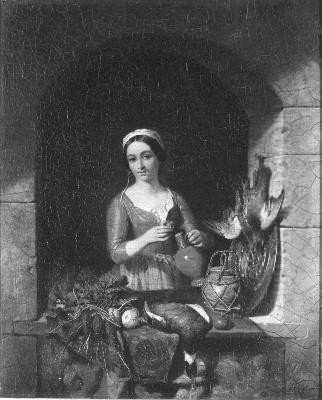
David Emile Joseph de Noter stands as a significant figure in 19th-century Belgian art. Born in 1825 and passing away in 1892, his career spanned a dynamic period in European art history. He distinguished himself through his meticulous attention to detail, his sensitive handling of light and color, and his ability to imbue everyday scenes and still lifes with a quiet emotional depth. Though perhaps not as globally renowned as some of his contemporaries, De Noter carved a distinct niche for himself, particularly celebrated for his depictions of interiors and intricate still life arrangements.
Early Life and Artistic Formation
Born in Belgium, David Emile Joseph de Noter received his foundational artistic training in Brussels. This early immersion in the Belgian art scene provided him with the technical skills and potentially exposed him to the prevailing artistic currents of the time. Belgium, particularly Brussels and Antwerp, was a vibrant center for art, boasting a rich tradition that blended influences from Northern European realism with broader continental trends. This environment likely shaped De Noter's initial approach to painting, fostering an appreciation for craftsmanship and careful observation.
The specifics of his teachers or academy attendance in Brussels are not detailed in the provided sources, but the quality of his later work suggests a rigorous and comprehensive education. He would have studied drawing, composition, and oil painting techniques, likely engaging with the works of earlier Flemish and Dutch masters known for their interior scenes and still lifes, as well as contemporary Belgian artists who were reviving historical and genre painting.
Relocation to Paris and Salon Success
Seeking broader opportunities and exposure, De Noter eventually relocated and settled in Paris, the undisputed capital of the art world in the 19th century. This move placed him at the heart of artistic innovation and competition. He became a regular participant in the prestigious Paris Salon, the official art exhibition sponsored by the French state, which was the primary venue for artists to gain recognition, attract patrons, and establish their reputations.
His frequent inclusion in the Salon exhibitions demonstrates a consistent level of quality and appeal that met the standards of the jury. It also indicates his engagement with the Parisian art market and his ambition to succeed on an international stage. Exhibiting alongside the leading French and international artists of the day provided both challenges and opportunities, pushing him to refine his style while allowing his work to be seen by a wide and influential audience.
Artistic Style: Meticulous Detail and Elegant Realism
De Noter's artistic signature lies in his extraordinary ability to render detail with precision and care. His paintings, particularly his interiors and still lifes, are characterized by a meticulousness that invites close inspection. He captured the textures of fabrics, the gleam of polished wood or metal, the delicate structure of flowers, and the specific qualities of fruits and vegetables with remarkable fidelity. This attention to detail aligns him with a tradition of realism prevalent in both Belgian and French art of the period.
However, his realism was not merely photographic. De Noter skillfully blended this detailed observation with a sense of elegance and often a touch of rustic charm. His interiors, while accurately depicted, often possess a warm, inviting atmosphere. He carefully arranged objects within his compositions, creating harmonious and visually pleasing scenes that went beyond simple documentation. This fusion of detailed realism with an eye for composition and atmosphere defines his unique approach.
Themes: Interiors, Still Life, and Genre Scenes
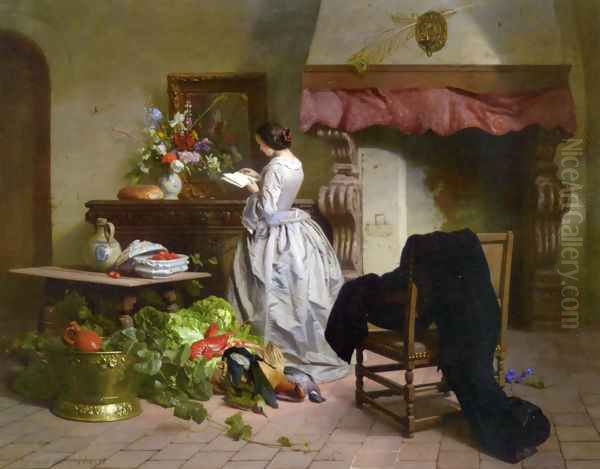
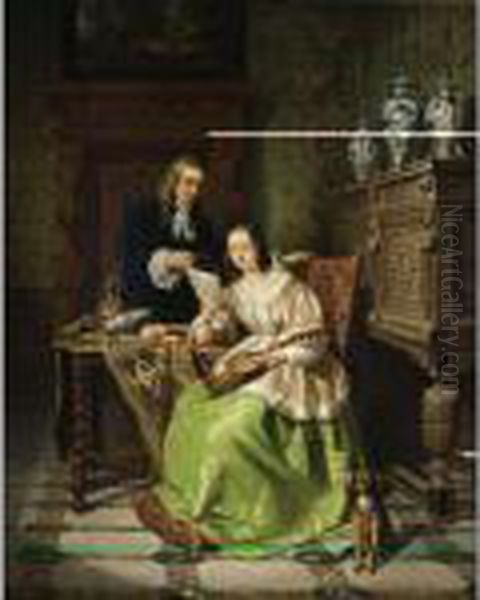
De Noter was particularly renowned for his paintings depicting interior scenes and intricate still lifes. His interiors often feature comfortable, well-appointed rooms, sometimes with figures engaged in quiet domestic activities like reading, sewing, or contemplation. These scenes evoke a sense of peace and intimacy, reflecting the 19th-century appreciation for domestic life as a subject for art. The careful rendering of furniture, textiles, and decorative objects plays a crucial role in establishing the mood and social context of these scenes.
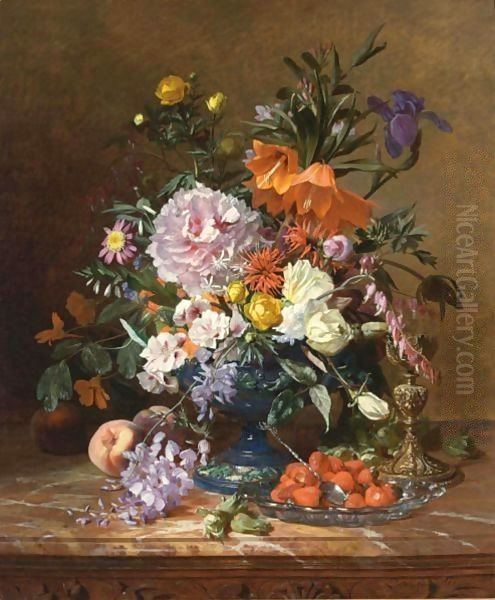
His still life paintings are equally accomplished. He possessed a remarkable talent for depicting fruits, vegetables, flowers, and tableware. These were not just technical exercises; De Noter imbued his still lifes with a sense of abundance, freshness, and often a subtle narrative quality. The arrangements feel natural yet artfully composed, showcasing his understanding of form, color, and texture. This specialization earned him specific commissions and contributed significantly to his reputation.
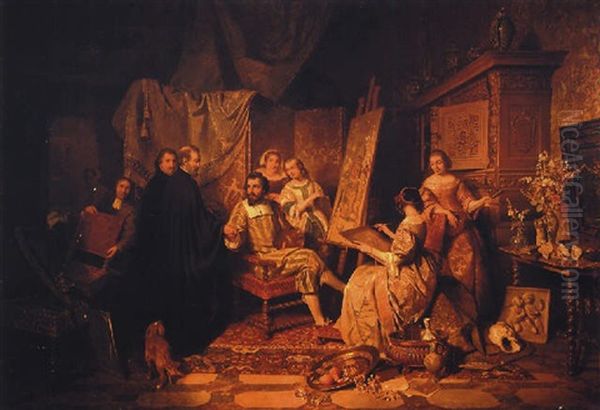
While primarily known for interiors and still lifes, De Noter also explored landscapes and figure painting. His landscapes, according to some descriptions, served as vehicles for emotion, using nature to convey mood and feeling. Similarly, his figure paintings aimed to capture the inner life or "soul" of the subject through subtle expressions and gestures, rendered with his characteristic delicate brushwork.
Mastery of Color, Light, and Atmosphere
A key element of De Noter's artistry was his sophisticated use of color and light. He demonstrated a profound understanding of how light interacts with surfaces, creating convincing illusions of depth and texture. His palettes often employed a harmonious balance of warm and cool tones, and he skillfully used contrasts of light and shadow (chiaroscuro) to model forms and create focal points within his compositions.
This mastery extended beyond mere technical accuracy; De Noter used color and light to establish the specific atmosphere of each painting. Whether depicting the soft glow of lamplight in an evening interior, the crisp daylight illuminating a kitchen scene, or the vibrant hues of fresh produce, his control over these elements was crucial in evoking the desired emotional response from the viewer. His works are often described as creating a dual impact – a visual delight stemming from the skillful execution and an emotional resonance derived from the carefully crafted mood.
The Art of Still Life: A Specialized Pursuit
De Noter's dedication to still life painting warrants special attention. In the 19th century, while historical and portrait painting often held higher status in academic hierarchies, still life remained a popular and respected genre, particularly in Northern Europe. De Noter excelled in this field, bringing a level of refinement and sensitivity that elevated his work.
His skill in this area was recognized by prominent figures, notably Baron Henri Leys (Hendrik Leys), a leading Belgian historical painter. De Noter was specifically employed by Leys to paint the still life elements – vegetables, fruits, and flowers – within Leys's larger compositions. This type of collaboration, where specialists contributed specific parts to a painting, was not uncommon at the time and speaks volumes about De Noter's recognized expertise in rendering these particular subjects. It highlights his reputation among fellow artists for this specific skill set.
Representative Works: 'La lecture' and Beyond
While a comprehensive catalogue of his works requires further research, one specific painting mentioned is La lecture (Reading). This work, with recorded dimensions of 32 x 41 inches and a significant auction estimate in the past (£35,000-£50,000), likely exemplifies his characteristic style. One can imagine a scene depicting a figure, perhaps a woman, absorbed in a book within a meticulously rendered interior setting, bathed in carefully controlled light, showcasing De Noter's skill in both genre painting and detailed execution.
Beyond this specific example, his oeuvre consists of numerous variations on his preferred themes. Kitchen interiors brimming with copper pots, vegetables, and game; elegant parlors with figures; standalone still lifes celebrating the beauty of flowers or the bounty of the harvest – these subjects form the core of his artistic output. Each work, whether grand or modest in scale, typically displays his commitment to craftsmanship and his nuanced understanding of his subjects.
Collaborations and Contemporary Circles
De Noter's career unfolded within a rich network of artistic relationships. His work for Baron Henri Leys is a prime example of direct collaboration. Furthermore, he is mentioned in connection with other Belgian artists like Henry Campotosto and Louis Pervis. These connections place him within the orbit of influential figures and collaborative systems active in the Belgian art scene.
One significant figure mentioned is Eugène Verboeckhoven, a highly successful Belgian painter primarily known for his animal scenes and landscapes. Verboeckhoven established a cooperative system or workshop in the 1830s and beyond, involving various artists. De Noter's association with artists like Campotosto and Pervis, who were part of this network, suggests his integration into these collaborative circles, which aimed to promote Belgian art and potentially streamline production through specialization.
His participation in the Paris Salon also placed him in dialogue, direct or indirect, with the leading artists of France and beyond. He exhibited alongside giants like Jean-Léon Gérôme, William-Adolphe Bouguereau, and Ernest Meissonier, masters of academic precision and popular narrative. He would have also been aware of the rising tide of Realism led by Gustave Courbet and the landscape innovations of Jean-Baptiste-Camille Corot and the Barbizon School painters.
In Belgium itself, he was contemporary to other significant artists like Gustave Wappers and Nicaise de Keyser, key figures in Belgian Romanticism and historical painting, and Alfred Stevens and Florent Willems, who gained international fame for their elegant depictions of fashionable women and genre scenes, sharing some thematic ground with De Noter's interior focus. Jan August Hendrik Leys, the son of Baron Henri Leys, also continued the family's artistic legacy. While De Noter may not have formally joined a specific 'movement' like Impressionism, he was clearly an active participant in the artistic life of his time, navigating the expectations of the Salons and engaging with the styles and networks available to him. Dutch contemporaries working in similar genres, like Johannes Bosboom (church interiors) or David Adolph Constant Artz (genre scenes), provide further context for the type of detailed, evocative realism De Noter practiced.
Awards and Recognition
De Noter's talent did not go unrecognized during his lifetime. He received several awards, testifying to the esteem in which his work was held by official art institutions. Notably, he was awarded a Bronze Medal at the Paris Salon in 1845. This early success in the competitive Parisian environment was a significant achievement. Later, he received a Gold Medal in Brussels in 1854, indicating high recognition in his home country as well.
These medals were important markers of success for a 19th-century artist. They enhanced prestige, attracted patrons, and could lead to state purchases or further commissions. Winning awards at major exhibitions like the Paris Salon and the Brussels Salon confirmed his status as an accomplished professional artist, respected for his technical skill and artistic vision.
Artistic Network and Individual Path
While connected to artists like Campotosto, Pervis, and the Verboeckhoven network, and having worked for Leys, the available information does not suggest that David Emile Joseph de Noter was a core member of a defined artistic group or movement with a specific manifesto. He seems to have pursued a more individual path, focusing on perfecting his chosen genres – interior scenes and still life – and developing his distinct style characterized by meticulous detail, atmospheric lighting, and quiet elegance.
His participation in the Salons and his collaborations indicate he was not isolated, but rather a well-integrated professional within the Belgian and Parisian art worlds. He navigated these environments successfully, gaining recognition and commissions based on the quality and appeal of his work, rather than through alignment with a particular avant-garde or academic faction. His approach represented a skillful blend of traditional craftsmanship and contemporary sensibilities.
Legacy and Conclusion
David Emile Joseph de Noter left behind a body of work that celebrates the beauty of the everyday, the richness of texture and light, and the quiet moments of domestic life. As a Belgian artist who found success both at home and in the demanding art center of Paris, he holds a firm place in the history of 19th-century European genre and still life painting. His meticulous technique, combined with his ability to create evocative atmospheres, distinguishes his paintings.
His specialization in still life, recognized even by prominent contemporaries like Baron Henri Leys, highlights his exceptional skill in rendering the intricate details of nature and man-made objects. The awards he received further attest to the high regard for his artistry during his lifetime. Though perhaps overshadowed in broader art historical narratives by artists associated with more revolutionary movements, De Noter's work endures, appreciated by collectors and connoisseurs for its technical brilliance, its blend of realism and elegance, and its sensitive portrayal of intimate worlds. He remains an important representative of the strong tradition of genre and still life painting in Belgium during the 19th century.