Adrien Ferdinand de Braekeleer: A Belgian Master of Genre and Realism
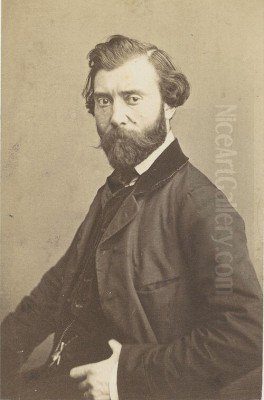
Adrien Ferdinand de Braekeleer (1818–1904) stands as a significant figure in 19th-century Belgian art. Born into an artistic family in the vibrant city of Antwerp, he dedicated his long career to painting, becoming particularly renowned for his detailed and engaging genre scenes, historical depictions, and religious works. Operating primarily within the framework of Realism, de Braekeleer captured the nuances of everyday life in Flanders, often infusing his canvases with subtle humour, warmth, and narrative depth. Though his name might have faded slightly from mainstream art historical discourse for a time, recent interest has helped reaffirm his position as a skilled observer and painter whose work offers valuable insights into the social and cultural fabric of his era.
Early Life and Artistic Formation
Born in Antwerp in 1818, Adrien Ferdinand de Braekeleer was immersed in the world of art from a young age. He was the son of the notable painter Ferdinand de Braekeleer the Elder (1792–1883), a respected artist in his own right, known for historical and genre paintings. This familial connection undoubtedly provided Adrien with early exposure to artistic techniques and the professional life of a painter. His initial training likely occurred under his father's guidance, within the environment of the Antwerp art scene which was experiencing a resurgence of interest in its rich artistic past, particularly the legacy of Flemish masters like Peter Paul Rubens.
To further hone his skills, de Braekeleer pursued formal art education. The provided information indicates he received training initially in Amsterdam, broadening his horizons beyond his native city. Subsequently, he deepened his academic grounding by studying at the prestigious Brussels Royal Academy of Fine Arts. This combination of familial instruction and academic training equipped him with the technical proficiency and historical awareness necessary to embark on his own successful career, navigating the artistic currents of the mid-19th century.
The Essence of Realism: Style and Influences
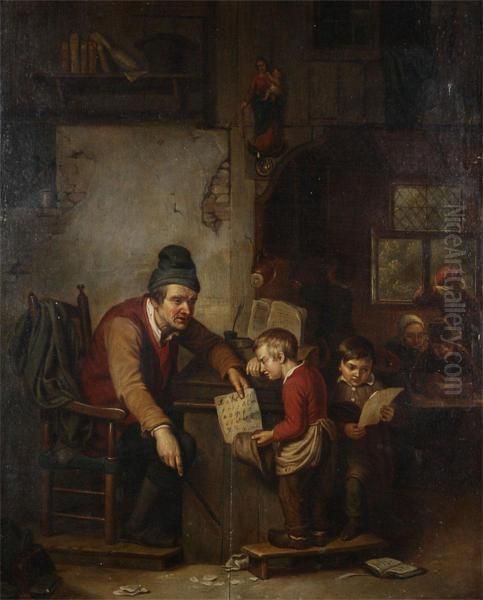
Adrien Ferdinand de Braekeleer's artistic output is predominantly characterized by Realism, with a strong focus on genre painting – scenes of everyday life. He possessed a keen eye for detail and a remarkable ability to render textures, objects, and human figures with convincing accuracy. His work often invites viewers into intimate domestic interiors, bustling workshops, quiet schoolrooms, or convivial tavern scenes, capturing the atmosphere and activities of ordinary people in 19th-century Belgium.
A significant source of inspiration for de Braekeleer was the art of the 17th-century Dutch Golden Age masters. He clearly admired painters like Pieter de Hooch and Johannes Vermeer, particularly their masterful handling of light and shadow to create mood and define space within interior settings. De Braekeleer often employed similar techniques, carefully orchestrating the play of light filtering through windows to illuminate specific areas of a room, highlight textures, and draw attention to the narrative focus of the scene. This careful attention to light imbues his paintings with a sense of tranquility and verisimilitude.
While grounded in realistic observation, de Braekeleer's paintings are rarely mere objective recordings. He often incorporated a gentle humour or a sense of anecdotal storytelling into his compositions. His figures, whether peasants, artisans, or schoolchildren, are depicted with empathy and psychological insight, engaged in activities that reveal aspects of their character and social context. This narrative element, combined with his technical skill, makes his works engaging and accessible.
Chronicler of Everyday Life
A substantial portion of Adrien Ferdinand de Braekeleer's oeuvre is dedicated to the depiction of everyday life, particularly scenes set within domestic interiors and rural contexts. He excelled at capturing the quiet rhythms and routines of households, workshops, and community spaces. His paintings often feature humble settings – kitchens, living rooms, artisan studios – populated by ordinary individuals engaged in their daily tasks or moments of leisure.
Works like A Peasant Family Gathered at the Table exemplify this focus. Such paintings provide a glimpse into the lives of the working classes, portraying moments of familial connection or simple sustenance. De Braekeleer rendered the details of the environment – the worn furniture, the simple crockery, the textures of clothing – with meticulous care, adding to the authenticity of the scene. These depictions contribute significantly to our understanding of the material culture and social conditions of 19th-century Flanders.
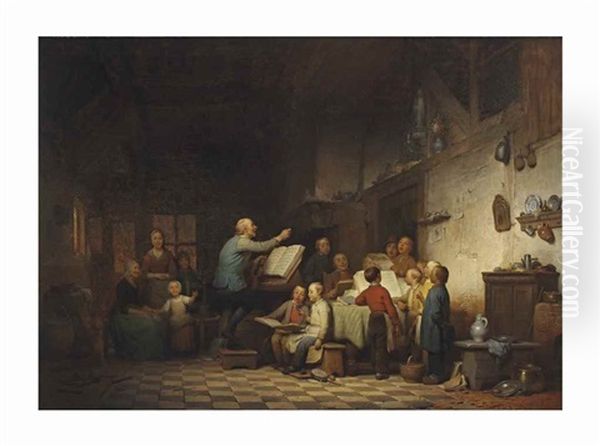
His interior scenes are particularly noteworthy for their atmospheric quality. Using the lessons learned from Dutch masters, he skillfully manipulated light to create intimate and often contemplative moods. Paintings like The Man in the Chair showcase his ability to focus on a single figure within a carefully rendered setting, using light and shadow to convey a sense of presence and perhaps introspection. These works demonstrate his commitment to realism not just in detail, but also in capturing the intangible qualities of a moment.
Windows into Education
Adrien Ferdinand de Braekeleer displayed a particular interest in themes related to childhood and education, producing several notable works set in school environments. These paintings offer fascinating insights into the nature of schooling in the 19th century, often blending detailed observation with elements of humour and psychological drama. They reflect not only the physical setting of the classroom but also the dynamics between students and teachers.
His painting The Classroom is a prime example of this thematic focus. It presents a lively, perhaps chaotic, scene filled with students engaged in various activities – some attentive, others distracted or mischievous. De Braekeleer captures the individual personalities of the children and the overall atmosphere of the learning environment with characteristic detail and a touch of gentle humour. Such works go beyond simple depiction, offering a commentary on childhood behaviour and the challenges of education during the period.
Another work mentioned, The Teacher, reportedly depicts a scene involving student punishment. This suggests de Braekeleer did not shy away from showing the sterner aspects of 19th-century pedagogy. By tackling such subjects, he provided a rounded view of educational practices, reflecting contemporary attitudes towards discipline and learning. His The Village-School, likely set in or near Antwerp, further underscores his interest in documenting local life and institutions, contributing to a visual record of regional culture.
Historical and Religious Dimensions
While best known for his genre scenes, Adrien Ferdinand de Braekeleer also engaged with historical and religious subjects, aligning with the broader academic traditions of the time. Historical painting was highly regarded in the 19th century, often carrying nationalistic or moralistic messages. De Braekeleer contributed to this genre, sometimes choosing subjects related to Belgian history or the lives of famous artists.
One such example is his work Rubens in the Garden Pavilion Drawing a Hat. This painting depicts the celebrated Antwerp master Peter Paul Rubens, connecting de Braekeleer's work to the rich artistic heritage of his own city. By choosing Rubens as a subject, he paid homage to a towering figure in Flemish art history, while also indulging his skill in detailed representation and historical setting reconstruction. Such works helped solidify the cultural identity and artistic pride prevalent in Antwerp during the 19th century.
Religious themes also formed part of his output. The commission for a painting of Saint Sebastian for the Church of Our Lady of the Vineyards in Wijnegem demonstrates his capacity to work within traditional religious iconography. Although genre scenes dominate his known work, these historical and religious paintings show the breadth of his skills and his ability to meet the demands of different types of patronage, including ecclesiastical commissions. They round out the picture of a versatile artist working within the established conventions of his time.
An Artist Amidst Contemporaries
Adrien Ferdinand de Braekeleer did not work in isolation. He was part of a dynamic art world, particularly in Antwerp, and his career intersected with those of several other important figures. His most immediate artistic connection was, of course, his father, Ferdinand de Braekeleer the Elder, who served as his first teacher and a lifelong influence. The de Braekeleer name itself represented a significant artistic lineage in 19th-century Belgium.
Another key figure in his circle was Hendrik Leys (also known as Jan August Hendrik Leys), a prominent Belgian painter known for his historical scenes and revival of 16th and 17th-century styles. Leys was not only a contemporary but also became Adrien's brother-in-law, marrying his sister. They both studied under Ferdinand the Elder, and likely shared artistic ideas and professional connections within the Antwerp school. Leys's own success and distinct historical style provided a point of comparison and perhaps friendly rivalry.
The broader artistic environment included figures like Baron Gustave Wappers, a leading proponent of Belgian Romanticism and an influential director of the Antwerp Academy during the period when the de Braekeleers were active. While their styles differed, Wappers's prominence shaped the institutional context in which Adrien worked. Furthermore, Adrien Ferdinand's nephew, Henri de Braekeleer (son of Ferdinand the Elder), became arguably the most famous member of the family, developing a highly sensitive and atmospheric style influenced by Realism and potentially artists like Édouard Manet, while still showing the imprint of his family's artistic traditions.
Beyond fellow artists, de Braekeleer maintained practical professional relationships. His long-term collaboration with the notable Belgian art dealer Gustave Coûteux was crucial. Coûteux helped promote and sell de Braekeleer's work, ensuring its dissemination to collectors both within Belgium and potentially across Europe. This relationship highlights the importance of the burgeoning art market for artists' careers in the 19th century.
Late Innovations and Van Gogh's Observation
Towards the end of his long life, during his final decade, Adrien Ferdinand de Braekeleer reportedly began experimenting with his technique, moving towards a somewhat different style. Sources suggest he adopted a looser, more 'pointillé' or dot-like brushstroke and employed bolder colour contrasts. This late-career shift indicates an enduring artistic curiosity and a willingness to explore new modes of expression, even within his established realist framework. This experimental phase, described as perhaps risky or unfinished, hints at an engagement with newer artistic ideas emerging at the time.
Intriguingly, this aspect of his work caught the attention of none other than Vincent van Gogh. In a letter to his brother Theo, Van Gogh mentioned de Braekeleer, praising him as an "innovative painter." Van Gogh specifically noted qualities in his work that he perceived as akin to "impressionist-like colour decomposition" and "pointillist-like techniques." While this was a private observation and doesn't necessarily classify de Braekeleer as an Impressionist or Pointillist, it is a remarkable testament to the perceived modernity and technical interest of his later work, coming from a pivotal figure of Post-Impressionism.
This observation by Van Gogh has led some to draw comparisons, perhaps hyperbolically referring to de Braekeleer as a "Belgian Monet." While such a label might overstate the case, Van Gogh's comment underscores that de Braekeleer, even while rooted in 19th-century Realism and influenced by the Dutch Golden Age, was not merely repeating old formulas. His sensitivity to colour and light, and his late-career experimentation with brushwork, demonstrated an engagement with painterly concerns that resonated with avant-garde developments.
Legacy and Reappraisal
Adrien Ferdinand de Braekeleer enjoyed a successful career during his lifetime, exhibiting his work and gaining recognition, including commissions and likely sales through dealers like Coûteux. His influence extended through his role as a teacher, guiding younger artists, although specific prominent pupils beyond his family are not widely documented in easily accessible sources. His most significant impact arguably lies within his own family, particularly on his talented nephew, Henri de Braekeleer, who built upon the family's tradition of genre painting to achieve even greater renown.
Despite his contemporary success and the quality of his work, Adrien Ferdinand de Braekeleer's reputation experienced a period of relative obscurity in the 20th century, overshadowed perhaps by his nephew Henri or by the major movements of Modernism. However, recent years have seen a renewed appreciation for his contributions. Exhibitions and scholarly research have begun to re-evaluate his place within Belgian art history, highlighting his skill as a realist painter, his sensitive depictions of everyday life, and his role within the Antwerp art scene.
His works are preserved in various museum collections, likely including the Royal Museum of Fine Arts in Antwerp and other Belgian institutions, allowing contemporary audiences to engage with his art. The praise from Van Gogh, though brief, also serves as a compelling point of interest, suggesting qualities in his work that transcended conventional academicism. He is now increasingly recognized as a key figure in Belgian 19th-century genre painting, a meticulous craftsman, and a valuable chronicler of his time.
Conclusion
Adrien Ferdinand de Braekeleer occupies an important place in the narrative of 19th-century Belgian art. As a painter deeply rooted in the traditions of Realism and inspired by the Dutch Golden Age masters like Vermeer and de Hooch, he created a body of work characterized by meticulous detail, atmospheric lighting, and insightful observations of everyday life. His genre scenes, particularly those depicting domestic interiors, peasant life, and educational settings like The Classroom, offer intimate and valuable glimpses into the social fabric of Flanders during his era.
While also proficient in historical and religious subjects, his most enduring contribution lies in his sensitive and often humorous portrayal of ordinary people and their environments. His connection to a prominent artistic family, including his father Ferdinand the Elder and his nephew Henri, places him centrally within the Antwerp school. Furthermore, his late-career experimentation, noted with interest by Vincent van Gogh, suggests an artist who continued to explore the possibilities of paint even in his later years. Though once somewhat overlooked, Adrien Ferdinand de Braekeleer is rightfully being reappraised as a significant Belgian master of realism and genre painting.