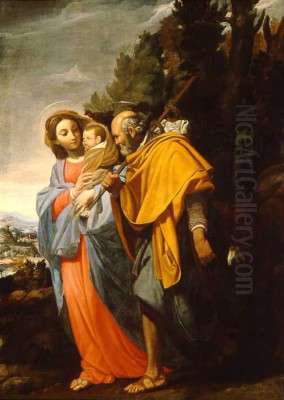
Domenico Fiasella, often affectionately nicknamed "Il Sarzana" after his birthplace, stands as a pivotal figure in the vibrant tapestry of Italian Baroque art, particularly within the distinguished Genoese school of painting. Born in Sarzana, a town near La Spezia then under Genoese influence, in 1589, and passing away in Genoa in 1669, Fiasella's career spanned a period of rich artistic exchange and innovation. His extensive body of work, characterized by its dramatic intensity, refined classicism, and luminous palette, reflects a masterful synthesis of diverse influences, most notably the tenebrism of Caravaggio and the opulent dynamism of Flemish masters like Peter Paul Rubens and Anthony van Dyck, all filtered through a distinctly Ligurian sensibility. This article aims to explore the life, artistic development, key works, and lasting legacy of this remarkable painter.
Early Life and Artistic Formation in Liguria
Domenico Fiasella's journey into the world of art began in his hometown of Sarzana. His father, Giovanni Fiasella, was a goldsmith, an artisan trade that often provided a foundational understanding of design and meticulous craftsmanship. It is likely that young Domenico received his initial artistic exposure and perhaps rudimentary training within this familial environment. However, recognizing his burgeoning talent for painting, he was sent to Genoa around the age of eleven to further his artistic education.
In Genoa, a bustling maritime republic with a rich tradition of artistic patronage, Fiasella entered the workshop of Giovanni Battista Paggi. Paggi was a significant figure in Genoese art, a nobleman and painter who had returned to Genoa in 1599 after a period of exile in Florence. Paggi's studio was a hub of artistic activity, and his teachings, which emphasized drawing and a refined, somewhat late-Mannerist elegance, would have provided Fiasella with a solid academic grounding. Under Paggi, Fiasella would have honed his skills in composition, anatomy, and the traditional techniques of oil painting, preparing him for the next crucial phase of his development.
The Roman Sojourn: A Crucible of Influences
Around 1607, at the age of approximately eighteen, Domenico Fiasella embarked on a journey to Rome, the undisputed artistic capital of Europe at the time. This decade-long stay, lasting until about 1617, proved to be transformative. Rome was a melting pot of artistic currents, where the revolutionary naturalism of Michelangelo Merisi da Caravaggio was still sending shockwaves through the art world, even after Caravaggio's flight from the city in 1606. Simultaneously, the classical ideals revived by Annibale Carracci and his academy were gaining prominence, offering a more ordered and idealized counterpoint to Caravaggio's raw drama.
Fiasella immersed himself in this dynamic environment. He diligently studied the works of the great Renaissance masters, particularly Raphael, whose clarity of form and harmonious compositions left a lasting impression. However, it was the more contemporary innovations that most profoundly shaped his evolving style. He is documented as having frequented the Accademia del Nudo, where artists could draw from live models, a practice crucial for developing anatomical accuracy and capturing naturalistic poses.
The influence of Caravaggio on Fiasella is undeniable, particularly in his early Roman works and in his lifelong penchant for dramatic lighting (chiaroscuro) and a certain palpable realism in his figures. He would have seen Caravaggio's public altarpieces, such as those in San Luigi dei Francesi and Santa Maria del Popolo, and absorbed their lessons in theatrical staging and emotional intensity. Fiasella also associated with the circle of Orazio Gentileschi, one of Caravaggio's most gifted followers, whose refined interpretation of Caravaggism, characterized by elegant figures and a luminous palette, likely resonated with Fiasella's own inclinations.
During his Roman period, Fiasella also encountered the grandeur of Bolognese classicism, as championed by artists like Guido Reni and Domenichino. Their emphasis on idealized beauty, graceful lines, and balanced compositions provided a tempering influence to the starkness of Caravaggism. It was in Rome that Fiasella began to forge his signature style: a sophisticated blend of Caravaggesque naturalism and dramatic lighting with a more classical sense of order and elegance. One notable commission from this period was a Nativity (now lost) for Marchese Vincenzo Giustiniani, a prominent patron of Caravaggio. He also painted a Saint Luke, a work that already showcased his ability to combine robust figural representation with expressive lighting.
Return to Genoa and Rise to Prominence
Around 1616 or 1617, Fiasella returned to Sarzana for a brief period before establishing himself definitively in Genoa. His Roman experiences had equipped him with a versatile and sophisticated artistic language that quickly found favor among Genoese patrons, including the powerful Doria and Lomellini families. Genoa, at this time, was experiencing a period of immense wealth and cultural flourishing, and its aristocracy was eager to adorn their palaces and churches with works of art that reflected their status and piety.
Fiasella's style, which skillfully balanced drama with decorum, was well-suited to the tastes of the Genoese elite. He received numerous commissions for large-scale altarpieces, private devotional paintings, and decorative frescoes. His workshop became one of the most active and respected in the city. The arrival of Anthony van Dyck in Genoa in 1621, and his subsequent stays until 1627, further invigorated the local art scene. Van Dyck's elegant portraiture and his rich, Venetian-inspired color palette had a noticeable impact on many Genoese artists, including Fiasella, who absorbed elements of Van Dyck's refined sensibility and fluid brushwork into his own mature style. Similarly, the earlier visits of Peter Paul Rubens to Genoa (1604-1608) had left a legacy of dynamic compositions and vibrant color that continued to resonate.
Fiasella's ability to synthesize these diverse influences—Caravaggesque drama, Bolognese classicism, and Flemish opulence—allowed him to create works that were both emotionally engaging and aesthetically pleasing. He became a leading figure in the Genoese school, alongside contemporaries such as Bernardo Strozzi, whose robust, painterly style offered a different, yet equally compelling, interpretation of the Baroque.
Artistic Style and Thematic Concerns
Domenico Fiasella's artistic style is characterized by several key elements. His compositions are typically well-structured, often employing diagonal lines to create a sense of dynamism and depth. He possessed a strong command of human anatomy, rendering figures with a sense of solidity and naturalism, yet often imbuing them with a classical grace. His use of color evolved throughout his career, from the more somber tones of his early, Caravaggesque-influenced works to a richer, more luminous palette in his maturity, likely reflecting the influence of Rubens, Van Dyck, and Venetian painting.
A hallmark of Fiasella's style is his masterful handling of light and shadow. While he adopted Caravaggio's chiaroscuro, he generally avoided its extreme harshness, opting instead for a more nuanced interplay of light that models forms effectively and creates a specific mood. His lighting often serves to highlight the emotional focal points of a scene, drawing the viewer's eye to key figures and gestures.
Thematically, Fiasella's oeuvre is dominated by religious subjects, reflecting the strong Counter-Reformation piety of the era and the demands of his patrons. He painted numerous scenes from the Old and New Testaments, as well as depictions of saints and martyrs. These works often convey a sense of intense devotion and spiritual drama, but they are also tempered by a certain dignity and restraint. Notable examples include his depictions of the Madonna and Child with Saints, scenes from the Passion of Christ, and episodes from the lives of saints.
In addition to religious paintings, Fiasella also executed historical and mythological subjects, often for private patrons seeking to adorn their palaces with edifying or allegorical imagery. These works allowed him to explore more dynamic compositions and to showcase his skill in rendering complex narratives and a wide range of human emotions. He also undertook significant fresco projects, demonstrating his versatility across different media.
Major Works and Commissions
Domenico Fiasella's prolific career yielded a substantial body of work, much of which still adorns churches and collections in Genoa and Liguria, as well as museums worldwide.
One of his early masterpieces, painted shortly after his return from Rome, is Christ Healing the Blind Man (c. 1615-1620, John and Mable Ringling Museum of Art, Sarasota). This painting beautifully demonstrates his assimilation of Roman lessons. The dramatic lighting, the realistic depiction of the figures, and the emotional intensity of the scene are clearly indebted to Caravaggio. Yet, the composition is balanced, and the figures possess a certain classical nobility.
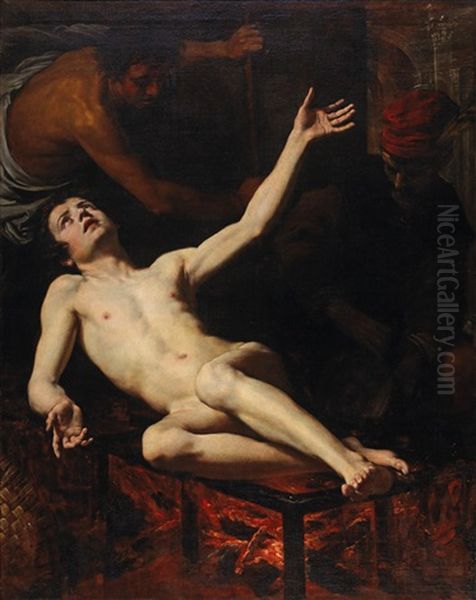
Another significant work is The Martyrdom of Saint Andrew (c. 1620s-1630s), created for the church of Sant'Andrea in Sarzana. This large altarpiece showcases Fiasella's ability to handle complex, multi-figure compositions and to convey intense religious fervor. The dynamic arrangement of the figures, the expressive gestures, and the dramatic use of light all contribute to the painting's powerful impact. A later version of this subject, for the Basilica di San Lorenzo in Genoa (c. 1653), further exemplifies his mature style.
Fiasella was also a skilled fresco painter. His most important fresco cycle is the Stories of Esther (c. 1650s) in the Palazzo Lomellini-Alamèzer (now Palazzo Nicola Lomellini) in Genoa. These frescoes, which decorate the main salon, depict scenes from the biblical story of Esther with a narrative clarity and decorative elegance that are characteristic of his mature style. The compositions are lively, the colors are rich, and the figures are rendered with a graceful dynamism. This commission highlights his status as one of Genoa's leading painters, entrusted with decorating the residences of its most prominent families.
Other notable paintings include:
Saint Luke Painting the Virgin (mentioned earlier as Saint Luke, c. 1615-1620, Accademia Ligustica di Belle Arti, Genoa): This work, sometimes identified with the painting he created in Rome, showcases his early mastery and perhaps a self-referential nod to the art of painting itself.
Cain and Abel (various versions, e.g., private collection): A theme that allowed Fiasella to explore dramatic action and intense emotion, often with strong Caravaggesque lighting.
The Assumption of the Virgin (Cathedral of Sarzana): A major altarpiece for his native city, demonstrating his continued connection to Sarzana and his skill in creating large-scale devotional works.
Christ Raising the Son of the Widow of Nain (c. 1615, Ringling Museum of Art, Sarasota): Another example of his early Genoese period, showing his ability to convey pathos and divine power.
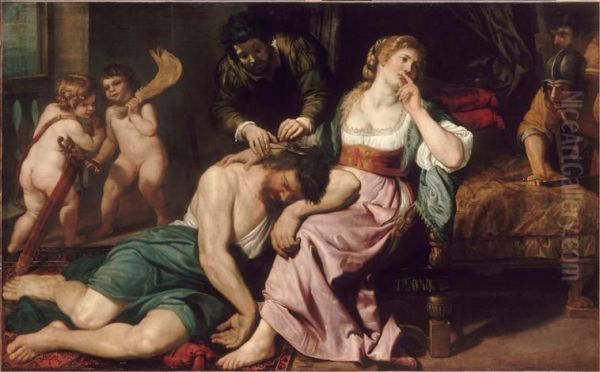
Samson and Delilah (Galleria Nazionale di Palazzo Spinola, Genoa): A dramatic Old Testament scene, handled with Fiasella's characteristic blend of narrative clarity and emotional intensity.
The Banquet of Ahasuerus (Palazzo Bianco, Genoa): This work, part of the Esther cycle, is noted for its rich detail and complex figural arrangement, possibly involving collaboration with specialists in still life or architecture, a common practice at the time. Giovanni Bonechi is sometimes mentioned in connection with such collaborations, though Bonechi was a later artist, suggesting potential confusion or Fiasella's influence on later collaborative practices.
His contribution to the imagery of the "Madonna della Città" (Madonna Queen of Genoa) was also significant. In 1637, the Virgin Mary was proclaimed Queen of Genoa, and artists like Fiasella were commissioned to create images that reinforced this civic and religious identity, often depicting the Virgin enthroned, protecting the city.
The Workshop and His Pupils
Like most successful artists of his time, Domenico Fiasella maintained an active workshop to help him manage the numerous commissions he received. This workshop served as a training ground for a new generation of Genoese painters. While the precise extent of his teaching activities and the full list of his pupils are not always definitively documented, several artists are known to have been associated with his studio or influenced by his style.
Among his most notable pupils was Valerio Castello (1624-1659). Although Castello's career was tragically short, he became one of the most innovative and dynamic painters of the Genoese Baroque, developing a highly personal style characterized by fluid brushwork, vibrant colors, and energetic compositions. While Castello quickly forged his own path, his early training with Fiasella would have provided him with a solid foundation.
Gregorio De Ferrari (1647-1726), another prominent Genoese painter known for his elegant and airy frescoes, also spent time in Fiasella's workshop before moving on to study with Domenico Piola. De Ferrari's style, with its emphasis on grace and decorative lightness, represents a later phase of the Genoese Baroque, but his formative years with Fiasella would have exposed him to a rigorous artistic discipline.
Other artists associated with Fiasella's circle or influenced by him include Giovanni Andrea Carlini, Giovanni Vincenzo Zerbi, and Francesco Capurro. The presence of a thriving workshop ensured the dissemination of Fiasella's artistic principles and contributed to the overall vitality of the Genoese school. His influence can also be seen in the work of lesser-known painters active in Liguria during the 17th century. The legacy of a master is often measured not only by his own works but also by the artists he trains and inspires.
Collaborations and Contemporary Interactions
The artistic environment of 17th-century Genoa was characterized by a lively exchange of ideas and, at times, direct collaborations between artists. Fiasella, as a leading figure, would have interacted with many of his contemporaries.
He is known to have collaborated with Giacomo Legi (Liegi), a Flemish painter active in Genoa who specialized in still lifes and market scenes. Together, they reportedly produced works such as Market con ritratto di bimbo and Mercato con la buona ventura, where Fiasella would typically paint the figures and Legi the surrounding still life elements or genre details. Such collaborations were common, allowing artists to combine their respective strengths.
Fiasella was part of a generation of Genoese painters who built upon the foundations laid by earlier masters like Luca Cambiaso and Giovanni Battista Paggi, and who responded to the new artistic currents emanating from Rome and beyond. His contemporaries in Genoa included the aforementioned Bernardo Strozzi, whose earthy realism and rich impasto offered a contrast to Fiasella's more classical refinement, and Giovanni Benedetto Castiglione, known for his pastoral scenes and innovative monotype prints.
He also worked alongside other prominent artists on large decorative projects. For instance, the fresco decoration of Genoese palaces and churches often involved multiple artists, each contributing to different parts of the overall scheme. Fiasella's involvement in the "fresco revival" in Genoa, alongside painters like Giovanni Battista Carlone and Giovanni Battista Carbone (not to be confused with the sculptor), underscores his importance in this aspect of Genoese art. These interactions, whether direct collaborations or simply the shared experience of working within the same artistic milieu, fostered a dynamic and competitive environment that spurred innovation and excellence.
Later Years and Enduring Legacy
Domenico Fiasella remained active as a painter well into his later years, continuing to receive important commissions and to exert a significant influence on the Genoese art scene. His style in his later works maintained its characteristic balance of naturalism, classicism, and restrained drama, though perhaps with a growing softness and a more introspective quality in some pieces.
His death in Genoa in 1669 marked the end of a long and distinguished career. He left behind a rich artistic legacy that significantly shaped the course of Genoese Baroque painting. His ability to synthesize diverse influences into a coherent and personal style, his technical mastery, and his prolific output secured his reputation as one of the leading painters of his generation.
Fiasella's influence extended beyond his immediate pupils. His works served as models for subsequent generations of Ligurian artists, and his paintings continued to be admired and studied. He played a crucial role in defining the character of the Genoese school in the 17th century, a school that was distinguished by its openness to external influences (particularly Flemish and Roman) and its ability to integrate them into a distinctive local tradition.
In the broader context of Italian Baroque art, Fiasella is recognized as a significant regional master whose work exemplifies the artistic vitality that flourished outside the major centers of Rome and Venice. While perhaps not as revolutionary as Caravaggio or as internationally renowned as Rubens, Fiasella made a lasting contribution to the richness and diversity of Baroque painting. His works are prized for their technical skill, their emotional depth, and their elegant synthesis of naturalism and classicism. Art historians continue to study his oeuvre, reassessing his contributions and further illuminating his place within the complex artistic landscape of 17th-century Italy. His paintings remain a testament to a period of extraordinary artistic achievement in Genoa, a city whose cultural splendor was brilliantly captured and enhanced by artists like Domenico Fiasella. His legacy is also evident in the works of later Genoese painters such as Alessandro Magnasco, whose dramatic style, though different, emerged from the rich artistic soil Fiasella helped to cultivate.
Conclusion
Domenico Fiasella, "Il Sarzana," was a formidable talent whose career bridged several important phases of Baroque art. From his early training in Genoa to his formative years in Rome, where he absorbed the lessons of Caravaggio, the Carracci, and the classical tradition, and his long and successful career back in Genoa, where he responded to the influence of Flemish masters, Fiasella forged a distinctive and influential artistic voice. His paintings, characterized by their dramatic lighting, strong figural compositions, rich color, and emotional resonance, represent a high point of Genoese Baroque painting.
Through his numerous altarpieces, private devotional works, and grand fresco decorations, Fiasella not only met the demands of his patrons but also significantly enriched the artistic heritage of Liguria. His workshop nurtured new talents, and his example inspired his contemporaries and successors. Today, Domenico Fiasella is rightly regarded as a key figure in the Genoese school, an artist whose sophisticated and expressive works continue to captivate and impress, securing his enduring place in the annals of Italian art history. His ability to blend narrative clarity with profound emotional depth, and dramatic intensity with classical poise, marks him as a true master of the Baroque era.