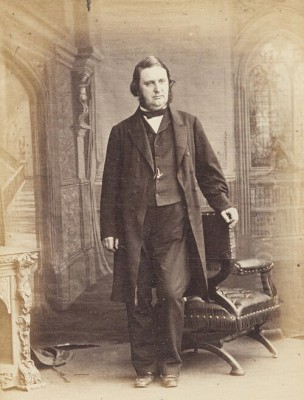
Edward Matthew Ward stands as a significant figure in the landscape of British Victorian art. A painter renowned for his vivid and meticulously researched historical scenes, Ward captured the imagination of his contemporaries by bringing to life pivotal moments from British and European history. His canvases were not mere illustrations but dramatic narratives, imbued with emotional depth and a keen eye for authentic detail. This exploration delves into the life, career, artistic style, and enduring legacy of a painter who dedicated his talents to chronicling the past for a rapidly changing present.
Early Life and Artistic Inclinations
Born in Pimlico, London, on July 14, 1816, Edward Matthew Ward was immersed in an environment that, while not directly artistic, did not stifle his burgeoning talents. His father, Charles James Ward, held a position at Coutts's bank, and his mother, Mary, was the sister of the celebrated comic actors James and Horace Smith, authors of "Rejected Addresses." This familial connection to the world of literature and performance perhaps sowed early seeds of interest in narrative and character.
From a young age, Ward displayed a precocious talent for drawing. His early artistic leanings were encouraged, and he received initial instruction from John Cawse, a painter known for his portraits and theatrical scenes. This early exposure likely honed Ward's observational skills and his ability to capture character. He was a keen student, absorbing lessons not only in technique but also in the art of storytelling through visual means. His youthful passion was such that he reportedly created illustrations for his uncles' works and even for Washington Irving's writings, showcasing an early ambition to connect art with narrative.
The Royal Academy and Continental Sojourn
Ward's formal artistic education began in earnest when he sought entry into the prestigious Royal Academy Schools. His talent was recognized, and with the influential support of the sculptor Sir Francis Leggatt Chantrey and the acclaimed painter Sir David Wilkie, he was admitted as a student in 1835. Wilkie, in particular, known for his genre scenes and historical paintings, would become a significant influence on Ward's developing style, especially in terms of narrative clarity and the depiction of everyday human emotion within historical contexts.
At the Royal Academy, Ward would have been exposed to the rigorous academic training of the time, focusing on drawing from the antique and the live model, and studying the principles of composition and perspective. He was a diligent student, and his time at the Academy laid a solid foundation for his future career. Among his contemporaries and near-contemporaries at the Academy or exhibiting there were artists who would also make their mark, such as William Powell Frith, Augustus Egg, and Richard Dadd, with whom he would later form the artistic group known as "The Clique."
In 1836, eager to broaden his artistic horizons, Ward embarked on a journey to the continent, a customary step for aspiring artists of the era. He travelled through Paris and Venice, eventually settling in Rome for approximately three years. This period was crucial for his artistic development. In Rome, he studied under the Nazarene painter Peter von Cornelius, who, though primarily known for his large-scale frescoes and religious subjects, would have reinforced the importance of strong draughtsmanship and monumental composition. More importantly, Ward immersed himself in the study of Italian Renaissance masters like Raphael and Michelangelo, and the works of earlier figures such as Giotto, whose narrative power he deeply admired. His painting Cimabue and Giotto, exhibited at the Royal Academy in 1839 upon his return, directly reflects these Italian studies and his interest in the historical lineage of art itself.
Establishing a Reputation: Historical Narratives
Upon his return to England in 1839, Ward began to establish himself as a painter of historical subjects. The Victorian era was a period of intense national pride and a burgeoning interest in history, providing a fertile ground for artists specializing in this genre. Ward's meticulous approach to research, ensuring accuracy in costume, architecture, and historical detail, resonated with the public and critics alike.
His style, while rooted in academic tradition, was also infused with a dramatic sensibility. He was influenced by the narrative clarity of William Hogarth and the anecdotal charm of David Wilkie, but also by the more theatrical historical paintings of French artists like Paul Delaroche. Delaroche's ability to depict poignant historical moments with a blend of realism and pathos found an echo in Ward's own work. Ward sought to make history accessible and engaging, often choosing subjects that allowed for the exploration of human drama and emotion.
One of his early successes that cemented his reputation was Dr. Johnson reading the manuscript of 'The Vicar of Wakefield' in Goldsmith's Lodgings (1843). This painting, depicting a famous literary anecdote, showcased Ward's skill in character portrayal and his ability to create a convincing historical interior. It was followed by Goldsmith on his Travels (1844) and Dr. Johnson in the Ante-room of Lord Chesterfield (1845), the latter being a particularly popular work that captured a moment of wounded pride and literary independence. These works demonstrated his affinity for the 18th century, a period he returned to frequently.
The Clique and the Victorian Art Scene
During the 1840s, Ward became associated with "The Clique," a group of young artists that included Richard Dadd, Augustus Egg, William Powell Frith, Henry Nelson O'Neil, and John Phillip. They were friends who had largely studied together at the Royal Academy and shared a dissatisfaction with the perceived high-mindedness and elitism of academic art. They favored genre painting and subjects drawn from literature and history that had popular appeal, often with a narrative or anecdotal focus.
The Clique did not issue manifestos or adhere to a strict stylistic dogma in the way that the later Pre-Raphaelite Brotherhood would. Instead, they represented a more informal association of like-minded individuals who sought to create art that was engaging, relatable, and often imbued with a subtle moral or social commentary, much in the vein of Hogarth. Ward's work, with its emphasis on storytelling and historical detail, aligned well with the general aims of this group. His paintings, like those of Frith (who would later achieve immense fame with works like Derby Day and The Railway Station), appealed to a broad middle-class audience eager for art that reflected their interests and values.
The Victorian art world was vibrant and diverse. While The Clique carved out its niche, other movements and artists were also prominent. The Pre-Raphaelites, including Dante Gabriel Rossetti, John Everett Millais, and William Holman Hunt, were challenging academic conventions with their bright palettes, meticulous detail, and subjects drawn from literature and religion, often with a symbolic intensity. Academic painters like Sir Charles Lock Eastlake and Daniel Maclise continued to produce grand historical and allegorical works. Ward navigated this complex scene, maintaining his focus on narrative historical painting, a genre that remained highly esteemed.
Themes of British History: Civil War and Revolution
A significant portion of Edward Matthew Ward's oeuvre was dedicated to depicting dramatic episodes from British history, particularly the tumultuous periods of the English Civil War and the Glorious Revolution. These subjects offered rich material for exploring themes of loyalty, betrayal, sacrifice, and political upheaval – themes that resonated with Victorian sensibilities about national identity and progress.
His paintings from this period are characterized by their careful staging, dramatic lighting, and attention to the psychological state of his figures. Works such as The Disgrace of Lord Clarendon (1846), depicting the fallen statesman after his dismissal by Charles II, and The South Sea Bubble, a Scene in Change Alley in 1720 (1847), which captured the frenzy and ruin of the infamous financial crisis, showcased his ability to translate complex historical events into compelling visual narratives. The latter, in particular, with its Hogarthian echoes of social satire and moral consequence, was widely acclaimed.
Ward's depictions of the Stuart era were particularly notable. He painted scenes like Charles II and Nell Gwyn (1860s), exploring the more personal aspects of royal life, but also more somber moments. The Last Sleep of Argyll (1854), showing the Earl of Argyll on the eve of his execution for his role in the Monmouth Rebellion, is a powerful example of Ward's ability to convey pathos and dignity in the face of death. The painting focuses on the quiet courage of the condemned man, a theme that had broad appeal.
The Westminster Palace Frescoes: A National Commission
Perhaps the most prestigious undertaking of Ward's career was his commission to paint a series of eight large frescoes for the Corridor of the House of Commons in the newly rebuilt Palace of Westminster. This was part of a grand scheme, overseen by a Royal Commission headed by Prince Albert, to decorate the new Houses of Parliament with scenes from British history and literature, intended to inspire patriotism and reflect national values. Other artists involved in this monumental project included Daniel Maclise, Charles West Cope, and William Dyce.
Ward was assigned subjects from the period of the English Civil War and the Glorious Revolution. Between 1853 and 1868, he executed these demanding works, which included:
The Execution of Montrose
The Last Sleep of Argyll (a fresco version of his earlier oil painting)
Alice Lisle concealing the Fugitives after the Battle of Sedgemoor
General Monk declaring for a Free Parliament
The Landing of Charles II at Dover
The Acquittal of the Seven Bishops
William and Mary receiving the Lords and Commons
The Sleep of Argyll (this appears to be a repetition or a specific focus, often cited alongside The Last Sleep of Argyll)
These frescoes, executed in the challenging medium of true fresco (buon fresco) or later, often using waterglass (stereochromy) for greater durability in the British climate, were a testament to Ward's skill and ambition. They required immense historical research, compositional mastery on a grand scale, and the ability to convey complex narratives to a public audience. The corridor became a visual chronicle of a crucial period in the shaping of British parliamentary democracy. While the overall decorative scheme of the Palace of Westminster has had its critics over the years, Ward's contributions were generally well-received for their narrative power and historical integrity.
French Revolution and Other European Themes
While British history formed the core of his subject matter, Edward Matthew Ward also turned his attention to dramatic events in French history, particularly the French Revolution. This period, with its intense human drama, ideological conflict, and tragic figures, provided ample material for his narrative talents.
One of his most famous paintings in this vein is Charlotte Corday being led to Execution (1852). The painting captures the defiant Girondin sympathizer on her way to the guillotine after assassinating Jean-Paul Marat. Ward focuses on Corday's stoic resolve amidst the jeering mob, creating a powerful image of female courage in the face of revolutionary terror. The meticulous rendering of the crowd, the historical setting, and Corday's expression make this a compelling piece.
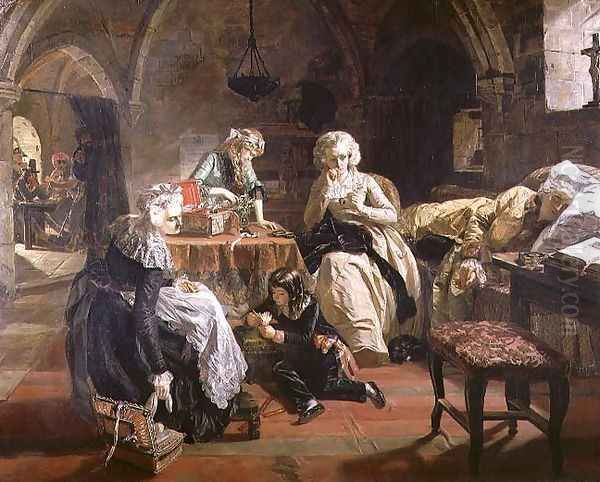
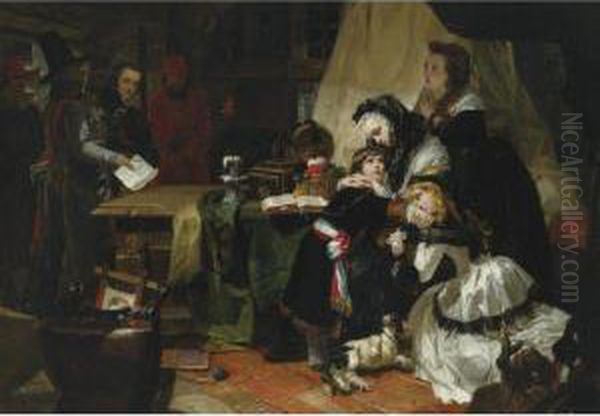
He also painted scenes such as The Royal Family of France in the Prison of the Temple (1851), depicting Louis XVI and his family during their captivity. These works often highlighted the suffering and dignity of the victims of revolutionary excess, reflecting a common Victorian ambivalence towards the French Revolution – an admiration for its ideals of liberty but a horror at its violence. Another work, The Last Parting of Marie Antoinette and Her Son (1856), further explored the tragic human cost of these historical upheavals. These paintings demonstrate Ward's ability to evoke empathy for historical figures, regardless of their political affiliations, by focusing on their shared humanity.
Artistic Style: Detail, Drama, and Didacticism
Edward Matthew Ward's artistic style was characterized by several key elements. Firstly, his commitment to historical accuracy was paramount. He undertook extensive research into costumes, settings, and historical accounts to ensure the authenticity of his scenes. This appealed to the Victorian desire for verisimilitude and art that could be seen as educational as well as entertaining. His studio would have been filled with historical artifacts, costume books, and prints to aid this process.
Secondly, his compositions were carefully constructed to maximize narrative clarity and dramatic impact. He often employed theatrical lighting, with strong contrasts of light and shadow (chiaroscuro), to highlight key figures and create a sense of atmosphere. Figures were arranged in a way that guided the viewer's eye through the story, and their gestures and expressions were designed to convey their emotions and roles within the narrative. This approach owed something to the stagecraft of the theatre, a field with which his family had connections.
Thirdly, there was often an underlying didactic or moral element to his work, though usually subtly conveyed. By depicting historical events, particularly those involving moral choices, heroism, or suffering, Ward's paintings encouraged viewers to reflect on the past and its lessons for the present. This aligned with the broader Victorian belief in art's capacity to edify and improve society. However, his primary aim was always to tell a compelling story, and the moral dimension usually arose naturally from the subject matter rather than being overtly preached.
His technique involved smooth brushwork and a rich, often somber palette, appropriate for the gravity of many of his historical subjects. While not an innovator in terms of painterly technique in the way some of his contemporaries like J.M.W. Turner or later, James McNeill Whistler were, Ward was a highly skilled craftsman who mastered the academic conventions of his time and used them effectively to achieve his narrative goals.
Later Life, Illness, and Tragic End
Edward Matthew Ward achieved considerable success during his lifetime. He was elected an Associate of the Royal Academy (ARA) in 1846 and a full Royal Academician (RA) in 1855. His works were popular with the public and often reproduced as engravings, further disseminating his images and reputation. He married fellow artist Henrietta Ward (née Ward, no relation before marriage) in 1848, who was herself a successful historical painter, and they had a large family. Their son, Leslie Ward, would later become famous as the caricaturist "Spy" for Vanity Fair magazine.
Despite his professional success, Ward's later years were marred by ill health and depression. He suffered from painful illnesses, and the strain of his demanding work, coupled with his melancholic temperament, took its toll. His mental health deteriorated significantly in his final years. Tragically, on January 15, 1879, at his home in Windsor, Edward Matthew Ward died by suicide. His death was a shock to the art world and a sad end to a distinguished career.
Legacy and Enduring Appeal
Edward Matthew Ward's legacy lies in his contribution to the genre of historical painting in Victorian Britain. He was a master storyteller in paint, bringing the past to life for his contemporaries with a combination of meticulous research, dramatic flair, and empathetic portrayal of human experience. His works helped to shape popular understanding of key historical events and figures.
Today, his paintings can be found in major public collections, including Tate Britain, the Royal Collection, and various regional galleries throughout the United Kingdom. The frescoes in the Palace of Westminster, though subject to the wear of time and environmental conditions, remain a significant public monument to his skill and dedication.
While artistic tastes have shifted since the Victorian era, and the grand historical narratives of painters like Ward may not hold the same central position in contemporary art discourse, there is a renewed appreciation for the skill, ambition, and cultural significance of Victorian painting. Ward's work offers a fascinating window into the mindset of his era – its preoccupations, its values, and its understanding of history. He remains an important figure for anyone studying 19th-century British art, a dedicated chronicler who used his considerable talents to make the past vivid, relatable, and profoundly human. His influence can be seen in the continued interest in historical subjects in art and popular culture, and his ability to combine accuracy with drama set a standard for narrative painting in his time.