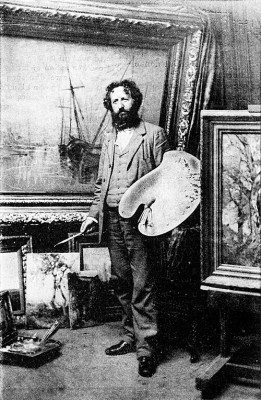
Émile Noirot, a name perhaps not as universally recognized as some of his contemporaries, nonetheless carved a significant niche for himself within the rich tapestry of French art during the late 19th and early 20th centuries. Born in 1853 and passing away in 1924, Noirot dedicated his artistic life primarily to the depiction of landscapes, carrying forward the traditions of plein air painting while infusing his works with a personal sensitivity and a profound appreciation for the natural world. His canvases often celebrate the serene beauty and sometimes rugged grandeur of the French countryside, particularly the Loire Valley, leaving behind a legacy of works that speak to a deep connection with his native land.
Early Life and Artistic Formation
Émile Noirot was born on June 5, 1853, in Roanne, a town nestled in the Loire department of central France. His artistic inclinations were nurtured from a young age, significantly by his father, Louis Noirot (1820–1902). Louis was himself an artist, a painter and lithographer of merit, who provided Émile with his foundational training in the visual arts. This paternal guidance undoubtedly instilled in the young Noirot a respect for craftsmanship and a keen observational eye, skills that would become hallmarks of his later work. The elder Noirot's own artistic practice, likely grounded in the academic traditions of the time but also open to the burgeoning interest in landscape, would have exposed Émile to the fundamental principles of drawing, composition, and color.
Seeking to broaden his artistic horizons and immerse himself in the vibrant art scene of the capital, Émile Noirot made the pivotal move to Paris in 1874. This was a period of immense artistic ferment in France. The Impressionist movement was just beginning to challenge the established Salon system, and the legacy of the Barbizon School, with its emphasis on direct observation of nature, was still profoundly influential. In Paris, Noirot would have encountered a dazzling array of artistic styles and philosophies, providing him with ample opportunity to refine his technique and define his own artistic voice.
The Barbizon Influence and a Focus on Nature
During his time in Paris and in the subsequent development of his style, Émile Noirot was notably influenced by the Barbizon School. This group of painters, active from roughly the 1830s to the 1870s, had revolutionized landscape painting by advocating for working directly from nature (en plein air) in the Forest of Fontainebleau, near the village of Barbizon. Artists like Jean-Baptiste-Camille Corot, with his poetic and light-filled landscapes, Théodore Rousseau, known for his detailed and often melancholic depictions of trees and forests, and Charles-François Daubigny, who famously used a studio-boat to capture river scenes, were central figures.
The Barbizon painters sought to imbue their landscapes with a sense of truthfulness and emotional depth, moving away from the idealized, classical landscapes that had long dominated academic art. They were interested in the specific character of a place, the effects of light and atmosphere, and the humble beauty of rural life. Jean-François Millet, another key Barbizon figure, focused more on peasant figures within the landscape, but his profound respect for nature and rural existence resonated with the broader ethos of the school. Other artists associated with this movement, such as Narcisse Virgilio Díaz de la Peña, Jules Dupré, and Constant Troyon, each contributed to this rich tradition of naturalistic landscape painting.
Noirot absorbed these influences, developing a particular affinity for outdoor landscape painting. He learned to observe nature with an almost scientific precision, yet his work was rarely a mere transcription of reality. Instead, he sought to capture the essence and mood of the landscapes he encountered, often imbuing them with a lyrical quality. His commitment to plein air painting allowed him to study firsthand the subtle shifts in light and color, the textures of the earth and foliage, and the ever-changing atmospheric conditions that bring a landscape to life.
Return to Roanne and Dedication to the Loire
In 1881, after his formative years in Paris, Émile Noirot chose to return to his roots, settling in Roanne in the Rhône Valley, near the Loire River. This decision was significant, as it marked a deep commitment to the landscapes of his home region. He became, in many ways, a painter of place, dedicating much of his career to capturing the diverse scenery of the Loire Valley, its gorges, riverbanks, and rolling hills. This region, with its rich history, picturesque villages, and the majestic presence of the river itself, provided him with an inexhaustible source of inspiration.
Noirot quickly established himself as a prominent figure in the local art scene. He was not merely a painter working in isolation but an active promoter of the arts in Roanne and the surrounding area. His dedication to his craft and his deep connection to the region made him a respected and influential artist locally. He was seen as a pioneer, tirelessly working to elevate the appreciation of art and to encourage other artists in the region. His studio likely became a point of interest, and his regular sketching and painting expeditions into the countryside would have made him a familiar sight.
His focus on the Loire was not exclusive, as he also traveled and painted in other parts of France and reportedly in Italy, but the Loire remained his spiritual and artistic anchor. The river, in its many moods – tranquil and reflective, or powerful and carving through stone – became a recurring motif in his work. He explored its banks, the surrounding forests, and the unique geological formations of its gorges, always seeking to convey their particular character.
Artistic Style and Thematic Concerns
Émile Noirot’s artistic style can be characterized as a form of lyrical naturalism. While firmly rooted in the observational principles of the Barbizon School, his work often transcends mere representation, evoking a palpable sense of atmosphere and a personal, emotional response to the landscape. He possessed a remarkable ability to render fine details without sacrificing the overall coherence and mood of the scene. His brushwork, while precise, could also be expressive, adapting to the textures and forms he was depicting.
A key element in Noirot's paintings is his masterful handling of light and shadow. He was acutely sensitive to the way light interacts with the natural world – how it filters through leaves, reflects off water, or illuminates a distant hillside. This sensitivity allowed him to create a strong sense of depth and volume in his compositions, and to capture the specific time of day or season. Whether depicting the soft glow of dawn, the bright clarity of midday, or the melancholic light of dusk, Noirot used light to define form and to establish the emotional tone of his paintings.
His thematic concerns were almost exclusively centered on the landscape. He painted forests, rivers, valleys, and coastal scenes. While human figures occasionally appear in his works, they are typically small and integrated into the larger natural setting, serving to emphasize the scale and grandeur of nature rather than being the primary subject. This approach aligns with the Barbizon tradition, where humanity is often depicted as part of, rather than dominant over, the natural world. His paintings of the Loire gorges, for example, often emphasize the ruggedness of the terrain and the enduring power of nature.
Noirot's palette was generally naturalistic, reflecting the true colors of the landscapes he observed. However, he was not afraid to use color to enhance the emotional impact of a scene, sometimes employing richer, more saturated hues or subtle tonal harmonies to convey a particular mood. His compositions are typically well-balanced, leading the viewer's eye through the scene with a clear sense of perspective and spatial depth.
Notable Works and Recognition
Throughout his career, Émile Noirot produced a significant body of work, and several paintings stand out as representative of his style and preoccupations. Among these, Vue du Puy-en-Velay avec la statue de Notre-Dame-de-France (View of Le Puy-en-Velay with the statue of Notre-Dame-de-France), painted in 1913, is a notable example. This work likely captures the distinctive volcanic landscape of Le Puy-en-Velay, crowned by the prominent statue, showcasing his ability to integrate man-made structures within a dominant natural setting while conveying a strong sense of place.
Another significant piece is Vue sur La Favière, Le Lavandou (View of La Favière, Le Lavandou) from 1907. This painting would depict a coastal scene, demonstrating his versatility in capturing different types of French landscapes, from the river valleys of the interior to the Mediterranean coast. Such works highlight his interest in the varied topographies and atmospheres of France.
His painting La roche du Madon (The Madon Rock) reportedly received an honorable mention at the World's Columbian Exposition in Chicago in 1893. International recognition of this kind was significant for any artist and speaks to the quality and appeal of Noirot's work beyond French borders. This success would have bolstered his reputation and affirmed his artistic path.
While perhaps not achieving the widespread fame of the leading Impressionists like Claude Monet or Camille Pissarro, whose explorations of light and color took landscape painting in a more radical direction, Noirot earned considerable respect and admiration, particularly for his faithful yet poetic renderings of the French countryside. His works were appreciated for their technical skill, their sincerity, and their ability to evoke the beauty and tranquility of nature.
Noirot in the Context of His Time
Émile Noirot operated during a dynamic period in French art. The Barbizon School had laid crucial groundwork for later movements. By the time Noirot was establishing his career, Impressionism was in full swing, with artists like Monet, Pissarro, Alfred Sisley, and Berthe Morisot revolutionizing the way light, color, and fleeting moments were captured. Their emphasis on subjective perception and optical effects marked a significant departure from more traditional landscape painting.
While Noirot shared the Impressionists' commitment to plein air painting and their interest in the effects of light, his style remained more closely aligned with the detailed naturalism and structured compositions of the Barbizon tradition, particularly artists like Corot and Daubigny. He did not fully embrace the broken brushwork or the high-keyed palette that characterized much Impressionist work. Instead, his paintings often exhibit a more solid sense of form and a more traditional approach to perspective and finish.
Later in his career, Post-Impressionist artists such as Paul Cézanne, Vincent van Gogh, and Paul Gauguin were further pushing the boundaries of art, exploring structure, emotion, and symbolism in ways that diverged significantly from both Barbizon naturalism and Impressionist opticality. Cézanne's rigorous analysis of form in landscape, van Gogh's intensely expressive use of color and line, and Gauguin's turn towards symbolism and non-Western art forms represented new directions that Noirot, by and large, did not follow.
Noirot can be seen as part of a continuing tradition of French landscape painting that valued careful observation, technical skill, and a deep affection for the native scenery. He might be compared to other accomplished landscape painters of his era who, while aware of modernist developments, continued to work in a more established, though still evolving, naturalistic vein. Artists like Henri Harpignies, for instance, had a long and successful career painting landscapes that, like Noirot's, were admired for their truthfulness and poetic charm, bridging the gap between the Barbizon School and later trends. Léon-Augustin Lhermitte, though more focused on rural genre scenes, also shared a commitment to depicting French country life with realism and empathy.
Noirot's position was thus one of an accomplished and respected artist working within a strong landscape tradition, rather than a radical innovator. His contribution lies in the consistent quality of his work, his dedication to his chosen subject matter, and his role in celebrating and preserving the visual character of the French regions he loved.
Travels and Broader Inspirations
While the Loire Valley remained his primary muse, Émile Noirot's artistic vision was also broadened by travel. He is known to have journeyed through various parts of France, capturing the diverse beauty of its regions. These excursions would have provided him with fresh motifs and new challenges in terms of light, color, and topography. Each new landscape encountered would have offered an opportunity to apply his observational skills and artistic sensibility.
His travels reportedly extended to Italy, a country that has long been a magnet for artists due to its rich artistic heritage, stunning classical ruins, and varied, luminous landscapes. For a landscape painter like Noirot, Italy would have offered a wealth of inspiration, from the rolling hills of Tuscany to the dramatic coastlines and the ancient cityscapes. Encounters with Italian light, which is often different in quality from that of northern Europe, and the unique Italian scenery would likely have left an imprint on his work, perhaps influencing his palette or his approach to composition, even if his core style remained consistent.
These travels, whether within France or abroad, served to enrich his understanding of landscape and to prevent his art from becoming overly localized or repetitive. They allowed him to test his skills in new environments and to bring a broader perspective back to his depictions of his beloved Loire region. The experience of different climates, geological formations, and qualities of light would have sharpened his eye and deepened his appreciation for the universal aspects of nature's beauty.
Public Commissions and Local Legacy
Émile Noirot's reputation and skill also led to public commissions, further cementing his status as a significant artist, particularly within his home region. He is noted for creating large mural works for the city of Roanne and for the prefecture of the Loire department. Such commissions were prestigious and allowed him to work on a grander scale than typical easel paintings. These murals, likely depicting local landscapes or allegorical scenes related to the region, would have been seen by a wide public and contributed to the civic pride and cultural identity of the area. The fact that these works received recognition at international exhibitions underscores their quality and importance.
Furthermore, his art was used to decorate significant local buildings, such as the Château de la Roche. This integration of his art into the architectural heritage of the region speaks to the esteem in which he was held. His paintings were not just confined to private collections or galleries but became part of the lived environment of his community.
Today, Émile Noirot's works are preserved in various collections, notably in the Musée des Beaux-Arts et d'Archéologie Joseph Déchelette in Roanne. This museum, named after a prominent local archaeologist, serves as an important repository of regional art and history, and its holdings of Noirot's paintings ensure that his contribution to French art, and particularly to the artistic heritage of the Roannais area, is remembered and accessible to future generations. His legacy is that of a dedicated and skilled painter who captured the soul of his region with sensitivity and artistry.
A Note on Historical Identity
It is worth noting that in some historical records or discussions, there can occasionally be confusion between Émile Noirot the painter (1853-1924) and another individual named Émile Noirot who was a French colonial administrator, notably active in West Africa (Senegal, Guinea) during a similar period (roughly the 1880s to the early 1900s). Any references to colonial service, administrative roles in Africa, or incidents related to colonial affairs pertain to this other Émile Noirot, the administrator, and not to Émile Noirot, the artist whose life and work were centered in France and dedicated to landscape painting. This distinction is crucial for an accurate understanding of the painter's biography and career. The painter's life was one dedicated to art, to the observation and depiction of the French landscape, far removed from the complexities and controversies of colonial administration in Africa.
Conclusion: An Enduring Vision of the French Landscape
Émile Noirot stands as a testament to the enduring appeal of landscape painting and the deep connection an artist can forge with their native environment. Working in the wake of the Barbizon School and concurrently with the Impressionists and Post-Impressionists, he charted his own course, remaining true to a vision of nature that was both meticulously observed and poetically rendered. His paintings of the Loire Valley, in particular, offer a timeless glimpse into the beauty and character of this iconic French region.
While he may not have been a revolutionary figure in the grand narrative of art history, his skill, dedication, and the sheer beauty of his work secure his place as a significant French landscape painter of his generation. He was a master of capturing light, atmosphere, and the subtle nuances of the natural world, creating canvases that invite contemplation and evoke a sense of peace and admiration for the enduring splendor of the French countryside. His legacy lives on in his paintings, which continue to be appreciated for their technical mastery, their lyrical naturalism, and their heartfelt celebration of the landscapes he knew and loved so well. Through his art, Émile Noirot offers a quiet but profound dialogue with nature, one that still resonates with viewers today.