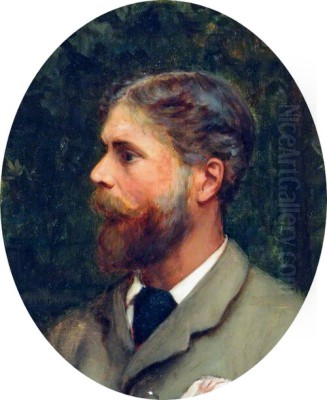
Ernest Albert Waterlow, a distinguished figure in the annals of British art, carved a significant niche for himself as a painter of landscapes and, to a lesser extent, animal subjects. Born in London on May 24, 1850, he emerged during a vibrant period of artistic evolution in Britain, navigating the currents of late Victorian and Edwardian aesthetics. His career was marked by a profound dedication to capturing the nuanced beauty of the natural world, rendered with a sensitivity that earned him widespread acclaim, prestigious memberships, and ultimately, a knighthood.
Early Life and Artistic Inclinations
The young Waterlow demonstrated an early aptitude for art. While detailed accounts of his earliest childhood are not extensively documented, a notable piece from his youth provides a glimpse into his burgeoning talent. At the tender age of fourteen, he produced a watercolour painting of Heidelberg Castle. This work, measuring 29.2 cm x 42.9 cm, already hinted at the observational skills and delicate handling of the medium that would characterize his mature style. Such an accomplishment at a young age suggests a supportive environment or an innate drive towards artistic expression.
His formative years coincided with a period where landscape painting in Britain was still deeply influenced by the towering legacies of J.M.W. Turner and John Constable, whose revolutionary approaches to light and atmosphere had reshaped the genre. The Pre-Raphaelite Brotherhood, with their emphasis on truth to nature and meticulous detail, also cast a long shadow, influencing a generation of artists to look closely at the natural world. It was within this rich artistic milieu that Waterlow began to hone his craft.
Formal Training and Influences
Waterlow's formal artistic education was thorough and grounded in the academic traditions of the time. He studied at Cary's School of Art before progressing to the prestigious Royal Academy Schools in London in 1872. His talent was quickly recognized, and in 1873, he was awarded the Turner Gold Medal for a landscape painting titled "A Land Storm." This accolade, named in honour of the great Romantic painter J.M.W. Turner, was a significant early endorsement of his abilities and likely set the trajectory for his specialization in landscape.
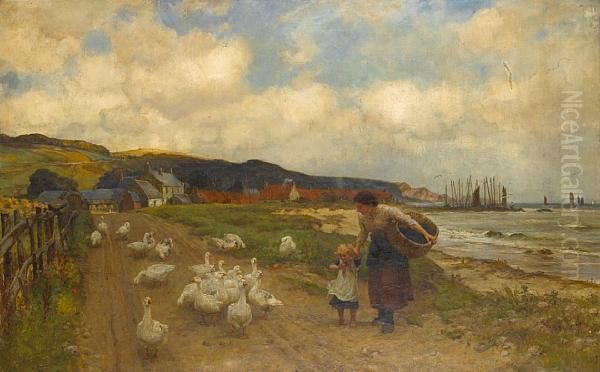
During his time at the Royal Academy Schools, he would have been exposed to the teachings and works of established Academicians. The prevailing ethos encouraged a blend of direct observation from nature with principles of classical composition. Artists like Frederic Leighton, President of the Royal Academy from 1878, and John Everett Millais, a founding member of the Pre-Raphaelite Brotherhood who later became a celebrated RA, were dominant figures whose influence permeated the institution. While Waterlow's style would develop its own distinct characteristics, the rigorous training of the Academy provided a solid foundation.
His travels also played a crucial role in shaping his artistic vision. He journeyed through Switzerland, France, and Ireland, seeking out picturesque scenery. His work "Winter in the Lauterbrunnen Valley, Switzerland," mentioned as one of his notable creations, is a testament to these excursions, showcasing his ability to capture the specific atmosphere and grandeur of different terrains. These experiences abroad broadened his palette and compositional strategies, allowing him to depict a diverse range of natural environments.
Artistic Style and Thematic Focus
Waterlow's art is predominantly characterized by its gentle lyricism and faithful representation of nature. He excelled in both oil and watercolour, demonstrating a mastery of light, atmosphere, and the subtle gradations of colour found in the British landscape. His style, while rooted in the academic tradition, often displayed a sensitivity to the transient effects of weather and season, reminiscent of the Barbizon School painters in France, such as Jean-Baptiste-Camille Corot or Charles-François Daubigny, though Waterlow's work generally retained a more detailed finish.
His landscapes often evoke a sense of tranquility and pastoral charm. He was particularly drawn to the rustic scenery of southern England, with its rolling hills, meandering rivers, and ancient woodlands. Works like "Walking in a river landscape," a watercolour dated 1915 and measuring 29 cm x 23 cm, exemplify this aspect of his oeuvre. The piece, signed with his initials and dated, likely captures a quiet moment in a familiar English setting, rendered with his characteristic delicacy.
Another work, "River with Ancient Ruins, Sunset," exhibited at the Shipley Art Gallery (then possibly associated with Heeley Library as per the provided information), points to his interest in the picturesque, where elements of human history, like ruins, are integrated into the natural scene, often imbued with the romantic glow of a sunset. This aligns with a long tradition in British landscape painting, seen in the works of artists from Richard Wilson to Turner, who often incorporated classical or historical elements into their compositions.
Waterlow's handling of light was a key feature of his style. He adeptly captured the soft, diffused light of the British Isles, as well as the more dramatic effects of sunrise and sunset. His colour palette was typically naturalistic, favoring harmonious greens, blues, and earthy tones, but he could also employ richer hues to convey the warmth of evening light or the crispness of an autumn day. His brushwork, particularly in his oil paintings, was often fluid yet controlled, allowing for both broad atmospheric effects and finer details.
Representative Works and Exhibitions
Throughout his career, Waterlow was a prolific exhibitor. He began showing his work at the Royal Academy in 1872, the same year he entered the RA Schools, and continued to do so regularly for the rest of his life. He also exhibited at the Royal Society of British Artists, the Grosvenor Gallery, the New Gallery, and importantly, at the Royal Watercolour Society (then known as the Royal Society of Painters in Water Colours).
Some of his notable exhibited works at the Royal Academy include "The Close of a Stormy Day" (1876), "The Orphan" (1881), "An Old Mill" (1882), "Friends or Foes?" (1883), "The Breezy Blue" (1886), "St. MacDara's Day" (1888), "The Misty Morn" (1891), "The Water-mill" (1894), "The Glow of Evening" (1897), "Forest Oaks" (1902), "A Sussex Homestead" (1906), "Windy Weather" (1907), and "The Last of the Shower" (1912). These titles suggest a consistent focus on landscape, often with an emphasis on specific atmospheric conditions or times of day.
His painting "Galway Gossips" (1887), which was acquired by the Chantrey Bequest for the Tate Gallery, was a significant achievement. The Chantrey Bequest was a fund used to purchase modern British art for the nation, and selection was a mark of considerable prestige. This work, depicting figures in a rural Irish setting, showcases his ability to integrate figures naturally within a landscape, adding a narrative or human element to the scene.
The aforementioned "Winter in the Lauterbrunnen Valley, Switzerland" and the early "Heidelberg Castle" watercolour are also important markers in his development. His watercolour "Walking in a river landscape" (1915) demonstrates his continued dedication to the medium late in his career. The fact that his works, such as this watercolour, have appeared in auction catalogues, including one listing a sale on December 15, 2023, for a postcard featuring his work, speaks to his enduring appeal among collectors.
Recognition and Honours
Waterlow's contributions to British art did not go unrecognized. He was elected an Associate of the Royal Academy (ARA) in 1890 and became a full Royal Academician (RA) in 1903. These distinctions placed him among the elite of the British art establishment. His peers in the Academy during this period included prominent figures like Sir Lawrence Alma-Tadema, known for his classical scenes, John Singer Sargent, the celebrated portraitist, and landscape painters such as Benjamin Williams Leader and Alfred Parsons, whose works often shared a similar affinity for the British countryside.
His involvement with the Royal Society of Painters in Water Colours (RWS) was particularly significant. He was elected an Associate of the RWS in 1880, became a full member in 1882, and served as its President from 1897 until 1914. This long tenure as President underscores his standing within the watercolourist community and his commitment to promoting the medium. During his presidency, he would have worked alongside other notable watercolourists such as Helen Allingham, known for her charming cottage scenes, and Birket Foster, a master of rustic genre.
The culmination of his public recognition came in 1902 when he was knighted for his services to art, thereafter being known as Sir Ernest Albert Waterlow. This honour reflected not only his artistic merit but also his respected position within the cultural life of the nation.
Contemporaries and Artistic Context
Waterlow worked during a period of diverse artistic trends. While he remained largely faithful to a traditional, representational style of landscape painting, he was contemporary with artists exploring new avenues. The influence of French Impressionism was beginning to be felt in Britain, championed by artists like Philip Wilson Steer and Walter Sickert, who formed the New English Art Club as an alternative to the Royal Academy. While Waterlow's work did not embrace the broken brushwork or high-keyed palette of Impressionism in its purest form, his sensitivity to light and atmosphere suggests an awareness of these evolving concerns.
His landscape contemporaries at the Royal Academy included artists like Benjamin Williams Leader, whose popular depictions of English and Welsh scenery often featured silver birches and reflective waters, and George Vicat Cole, known for his lush harvest scenes and views of the Thames. John MacWhirter, a Scottish painter, was celebrated for his dramatic Highland landscapes. Alfred Parsons, a close friend of American expatriate artists like Edwin Austin Abbey and John Singer Sargent, was another distinguished landscape painter and garden designer. These artists, along with Waterlow, largely catered to the Victorian and Edwardian taste for accessible, beautifully rendered views of nature.
The older generation, such as Myles Birket Foster, whose idyllic watercolour scenes of rural life were immensely popular, had set a precedent for the kind of charming, detailed landscape that appealed to a wide audience. Waterlow built upon this tradition but often brought a broader, more atmospheric treatment to his subjects, particularly in his oils.
Further afield, artists like George Clausen and Henry Herbert La Thangue were associated with the Newlyn School and later developed a British form of rural naturalism or social realism, sometimes with Impressionistic influences, focusing on agricultural life. While Waterlow's work was generally more picturesque and less overtly concerned with social commentary, he shared their commitment to depicting the British countryside.
Later Career and Legacy
Sir Ernest Albert Waterlow continued to paint and exhibit actively into the early 20th century. His dedication to his craft remained unwavering. The watercolour "Walking in a river landscape" from 1915, created when he was 65, shows his sustained skill and engagement with his preferred subjects. He passed away on October 25, 1919, in Hampstead, London, leaving behind a substantial body of work that documents the beauty he found in the natural world.
His legacy is that of a highly accomplished and respected landscape painter who captured the quintessential charm of the British and European scenery with skill and sensitivity. While perhaps not as revolutionary as some of his contemporaries who embraced modernism, Waterlow represented the enduring strength of the academic landscape tradition in Britain. His paintings offered an idyll, a peaceful retreat into nature that resonated deeply with the sensibilities of his time and continues to be appreciated for its technical finesse and gentle beauty.
His works are held in numerous public collections, including the Tate Britain, the Royal Academy of Arts, and various regional galleries throughout the United Kingdom. The continued appearance of his paintings in auctions and their presence in these collections attest to his lasting significance. He was a key figure in the Royal Watercolour Society, guiding it for nearly two decades, and a respected member of the Royal Academy, contributing to the rich tapestry of British art at the turn of the 20th century. His art serves as a beautiful and enduring record of the landscapes he loved, viewed through the eyes of a dedicated and talented observer.