Federico de Madrazo y Kuntz: A Paragon of 19th-Century Spanish Portraiture
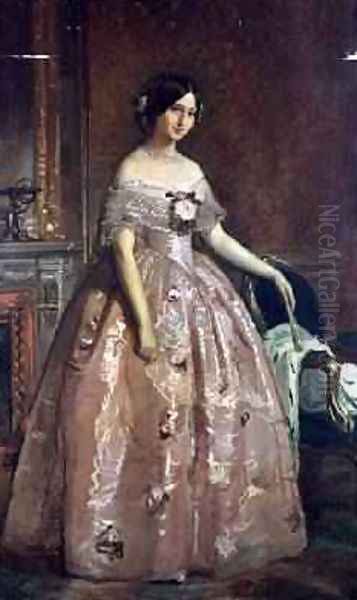
Federico de Madrazo y Kuntz (1815-1894) stands as one of the most distinguished and influential figures in 19th-century Spanish art. A master of portraiture, he navigated the complex artistic and social currents of his time with remarkable skill, leaving behind a legacy of works that not only capture the likenesses of his sitters but also reflect the cultural and political milieu of Spain during a transformative era. His career was marked by prestigious appointments, international training, and a profound impact on the artistic institutions of his country, solidifying his place as a central pillar of Spanish Neoclassicism and academic painting.
Early Life and Artistic Lineage
Born in Rome on February 9, 1815, Federico de Madrazo y Kuntz was destined for a life in art. He was the son of José de Madrazo y Agudo (1781-1859), himself a prominent Neoclassical painter and later the director of the Prado Museum. His mother, Isabel Kuntz Valentini, was the daughter of the Silesian painter Tadeusz Kuntz. This rich artistic heritage provided Federico with an immersive environment from his earliest years. The Madrazo family was a veritable dynasty of artists, with Federico’s brothers, Pedro and Luis, also pursuing artistic and literary careers, and his own sons, Raimundo de Madrazo y Garreta and Ricardo de Madrazo, becoming notable painters.
The family relocated to Madrid in 1819 when José de Madrazo was appointed court painter to King Ferdinand VII. Federico's prodigious talent became evident at a young age. He received his initial artistic instruction from his father, who instilled in him the rigorous principles of Neoclassicism, emphasizing clarity of line, balanced composition, and idealized form, drawing heavily from the examples of classical antiquity and Renaissance masters like Raphael.
His formal education commenced at the Royal Academy of Fine Arts of San Fernando in Madrid, a bastion of academic tradition in Spain. Even as a teenager, his abilities were exceptional. In 1831, at the remarkably young age of sixteen, he was admitted as an honorary academician to the Royal Academy, a testament to his early mastery of painterly techniques. His early works from this period already demonstrated a sophisticated understanding of anatomy, draughtsmanship, and composition.
Formative Years in Paris and Rome
To further refine his skills and broaden his artistic horizons, Federico de Madrazo embarked on a period of study abroad, a common practice for aspiring artists of the era. In 1833, he traveled to Paris, then a vibrant epicenter of European art. There, he had the invaluable opportunity to study under the tutelage of Jean-Auguste-Dominique Ingres (1780-1867), one of the leading figures of French Neoclassicism and a staunch defender of the academic tradition against the rising tide of Romanticism, championed by artists like Eugène Delacroix (1798-1863).
Ingres's influence on Madrazo was profound. The French master’s emphasis on the primacy of line, his meticulous rendering of detail, and his pursuit of an almost sculptural perfection in form deeply resonated with Federico’s own inclinations, which had been nurtured by his father. Madrazo absorbed Ingres's techniques for creating smooth, polished surfaces and his approach to portraiture, which combined psychological insight with an air of dignified elegance. During his time in Paris, Madrazo also associated with other artists and intellectuals, further enriching his artistic perspective. He even painted a portrait of Ingres, a mark of their close association.
Following his Parisian sojourn, Madrazo traveled to Rome, the city of his birth and a crucial site for any artist steeped in the classical tradition. Rome offered direct exposure to the masterpieces of antiquity and the High Renaissance. He immersed himself in studying these works, further solidifying his Neoclassical foundations. He also came into contact with the Nazarene movement, a group of German Romantic painters, including artists like Johann Friedrich Overbeck (1789-1869) and Peter von Cornelius (1783-1867), who sought to revive Christian art through a style inspired by early Renaissance masters. While Madrazo remained primarily a Neoclassicist, his exposure to diverse artistic currents in Rome and Paris undoubtedly contributed to the nuanced richness of his mature style.
Ascent to Prominence in Madrid
Federico de Madrazo returned to Madrid in 1842, his skills honed and his reputation already growing. He quickly established himself as a leading figure in the Spanish art world. His refined technique, combined with an innate ability to capture both the likeness and the character of his sitters, made him highly sought after, particularly for portraiture.
A pivotal moment in his career came with his appointment as a court painter. He received significant royal patronage, most notably from Queen Isabella II. His portraits of the Queen and other members of the Spanish aristocracy cemented his status as the preeminent portraitist of his generation in Spain. These royal commissions were not merely artistic endeavors; they were also statements of power and prestige, and Madrazo excelled at imbuing his subjects with an aura of regal authority and sophisticated grace.
His success was not limited to royal circles. He became the favored painter of Madrid's burgeoning bourgeoisie, a class eager to have their status and achievements immortalized in paint. Madrazo’s portraits from this period are characterized by their impeccable draughtsmanship, elegant compositions, and meticulous attention to the details of costume and setting, which often served to signify the sitter's social standing.
Artistic Style: Neoclassicism with a Romantic Sensibility
Federico de Madrazo y Kuntz is primarily identified with Neoclassicism, an artistic movement that sought inspiration from the art and culture of ancient Greece and Rome, emphasizing order, clarity, and idealized beauty. His training under his father and Ingres firmly rooted him in this tradition. This is evident in the precise linearity of his drawing, the smooth, almost enameled finish of his canvases, and the balanced, harmonious compositions he favored.
However, to label Madrazo solely as a Neoclassicist would be to overlook the subtle Romantic undercurrents that permeate his work, particularly his portraits. While he adhered to academic conventions of form and technique, his depictions of individuals often reveal a keen psychological insight and an ability to convey emotion that aligns with Romantic sensibilities. He was adept at capturing the personality and inner life of his sitters, moving beyond mere formal representation.
His color palette, while often restrained in keeping with Neoclassical tastes, could also be rich and nuanced, particularly in his rendering of luxurious fabrics and intricate details. He masterfully handled light and shadow to model form and create a sense of volume, lending his figures a tangible presence. His approach can be seen as a sophisticated fusion, blending the formal rigor of Ingres with a sensitivity to character that perhaps drew from the legacy of Spanish masters like Diego Velázquez (1599-1660) and Francisco Goya (1746-1828), whose works he would have intimately known, especially later as Director of the Prado.
Compared to the more overtly dramatic and emotional style of Romantic painters like his Spanish contemporary Eugenio Lucas Velázquez (1817-1870) or the French master Théodore Géricault (1791-1824), Madrazo’s work appears more controlled and refined. Yet, within this control, he found space for individuality and expressive depth. His style contrasted with the more flamboyant and painterly approach of artists like his brother-in-law, Mariano Fortuny y Marsal (1838-1874), whose work leaned towards Orientalism and a vibrant, almost impressionistic technique.
Masterpieces of Portraiture
Federico de Madrazo’s oeuvre is dominated by portraits, and it is in this genre that his genius truly shines. He produced a vast number of portraits, capturing the likenesses of royalty, aristocracy, politicians, intellectuals, and fellow artists.
One of his most celebrated works is the Portrait of Amalia de Llano y Dotres, Countess of Vilches (1853). This painting is a quintessential example of Madrazo’s mature style. The Countess is depicted with an air of sophisticated elegance and quiet confidence. Madrazo’s meticulous rendering of her white satin gown, the intricate lace, and the subtle play of light on the fabric is breathtaking. Beyond the technical virtuosity, the portrait conveys a sense of the Countess's personality – intelligent, poised, and perhaps a little enigmatic. This work is often compared to the portraits of Ingres, such as the Portrait of Madame Moitessier, in its combination of classical composure and luxurious detail.
His numerous portraits of Queen Isabella II are also significant. These works, such as the full-length Queen Isabella II (c. 1844-1845), served an important state function, projecting an image of monarchical stability and grandeur during a politically turbulent period in Spanish history. Madrazo depicted the Queen with the requisite dignity and regalia, but often managed to infuse these official portraits with a degree of human warmth.
Another notable work is the Portrait of Luisa Fernanda de Borbón, Duchess of Montpensier (1851). The Infanta, sister of Queen Isabella II, is portrayed with a youthful charm and aristocratic bearing. The painting showcases Madrazo's skill in capturing delicate features and the richness of her attire, set against a landscape backdrop that adds a touch of Romantic sensibility.
Other important portraits include those of prominent figures such as the writer Gertrudis Gómez de Avellaneda, the politician Segismundo Moret, and members of his own family, including his father José and his son Raimundo. Each portrait is a testament to his ability to adapt his style to the individual sitter while maintaining his characteristic elegance and technical polish. For instance, the Portrait of María Cristina de Borbón, Queen Regent, in Nun's Habit by the Bedside of the Deceased Ferdinand VII (c. 1833-1834) is an earlier, more historical piece, showcasing his ability to handle complex narrative compositions as well. His depiction of Concepción Remisa de Moret (1856) and Saturnina Canaleta de Girona (1856) further exemplify his mastery in portraying the leading women of Spanish society with grace and psychological depth.
Institutional Roles and Influence
Beyond his prolific output as a painter, Federico de Madrazo played a crucial role in the artistic institutions of Spain. In 1860, he was appointed Director of the Museo del Prado, a position his father had also held. He served as director, with some interruptions due to political changes, until 1868, and then again from 1881 until his death in 1894. During his tenures, he worked to conserve and organize the museum's vast collections, contributing significantly to its development as one of the world's leading art institutions.
He was also deeply involved with the Royal Academy of Fine Arts of San Fernando, serving as its director multiple times. In this capacity, he influenced art education in Spain, upholding the principles of academic training while also being open to certain evolutions in artistic practice. His leadership positions placed him at the center of the Spanish art world, allowing him to mentor younger artists and shape artistic tastes.
His influence extended to his role as a tastemaker and a figure of authority in cultural matters. He was a respected member of Madrid's intellectual and social elite, and his opinions on art carried considerable weight. He also contributed to art publications, further disseminating his views.
Relationships with Contemporaries
Federico de Madrazo’s life was intertwined with many of the leading artistic and intellectual figures of his time. His early tutelage under Ingres in Paris was a defining relationship. He maintained connections with French artistic circles throughout his career, and his work was recognized in Paris Salons.
In Spain, his family connections were significant. His father, José de Madrazo, was a guiding force. His brother, Pedro de Madrazo, was an art critic and historian. His marriage to Cecilia de Madrazo, daughter of the renowned painter José de Madrazo, further solidified his position within this artistic dynasty. His son, Raimundo de Madrazo y Garreta (1841-1920), became a highly successful portrait and genre painter, particularly popular in Paris and the United States, carrying on the family tradition.
His relationship with his brother-in-law, Mariano Fortuny y Marsal, is particularly interesting. Fortuny, a brilliant and innovative artist, represented a different artistic path, one characterized by vibrant color, exotic subjects, and a more spontaneous technique that prefigured aspects of Impressionism. While their styles differed, there was mutual respect, and Madrazo recognized Fortuny's exceptional talent.
Madrazo also maintained friendships and professional associations with writers, politicians, and other cultural figures. He had a close relationship with the Romantic poet and art scholar Valentín Carderera y Solano (1796-1880), for whom he painted several portraits. Carderera, an important collector and connoisseur, often provided historical references for Madrazo's works. He also painted portraits of figures like the Italian actress Adelaide Ristori, indicating his engagement with the broader European cultural scene. He received commissions from individuals like Francisco Van Halen, and he guided students such as Fernando Ferriz. His circle included artists who, while perhaps not as internationally famous, contributed to the rich tapestry of 19th-century Spanish art, such as Antonio Gisbert Pérez (1834-1901), known for his historical paintings.
The Madrazo Dynasty
The Madrazo family holds a unique place in the history of Spanish art, often compared to artistic dynasties like the Bellinis in Venice or the Peale family in America. José de Madrazo y Agudo laid the foundation with his Neoclassical works and his influential institutional roles. Federico built upon this foundation, achieving even greater fame as a portraitist and institutional leader.
Federico’s sons, Raimundo de Madrazo y Garreta and Ricardo de Madrazo y Garreta (1852-1917), continued the artistic lineage. Raimundo, in particular, achieved international acclaim, adapting the family's refined portrait style to suit the tastes of the Belle Époque. His works, often characterized by a brighter palette and a more sensuous rendering of textures, show an evolution from his father's more formal Neoclassicism, yet the underlying commitment to elegant draughtsmanship and sophisticated representation remains. The Madrazo name thus became synonymous with artistic excellence in Spain for much of the 19th and early 20th centuries.
Later Years and Enduring Legacy
Federico de Madrazo remained active as a painter and institutional figure well into his later years. He continued to produce portraits of remarkable quality, adapting subtly to changing tastes while remaining true to his core artistic principles. He witnessed significant shifts in the art world, including the rise of Realism, championed by artists like Gustave Courbet (1819-1877) in France, and later, Impressionism, pioneered by Claude Monet (1840-1926) and Pierre-Auguste Renoir (1841-1919). While Madrazo's own style did not embrace these radical departures, his work provided a standard of technical excellence and refined taste against which new movements were often measured in Spain.
He passed away in Madrid on June 10, 1894, at the age of 79, leaving behind an immense body of work and an indelible mark on Spanish art. His death was mourned as the loss of one of Spain's greatest artistic figures.
Federico de Madrazo y Kuntz's legacy is multifaceted. As a painter, he elevated Spanish portraiture to a level of international distinction, creating iconic images of his era's leading personalities. His technical mastery, his ability to combine formal elegance with psychological insight, and his meticulous attention to detail set a benchmark for academic painting in Spain. His works are prized possessions in major museums, including the Prado Museum, the Museum of Romanticism in Madrid, and numerous private collections.
As an institutional leader, his contributions to the Prado Museum and the Royal Academy of Fine Arts of San Fernando were substantial, helping to shape these institutions and foster artistic talent. He played a key role in preserving and promoting Spain's artistic heritage.
His influence on subsequent generations of Spanish painters was significant, both through his direct teaching and through the example of his work. While later artists would explore new stylistic paths, Madrazo's commitment to craftsmanship and his sophisticated understanding of the portrait genre remained an important point of reference. Artists like Joaquín Sorolla (1863-1923), though developing a very different, luminist style, would have been aware of Madrazo's towering presence in the preceding generation of Spanish portraitists.
Conclusion
Federico de Madrazo y Kuntz was more than just a painter; he was a cultural institution in 19th-century Spain. Born into an artistic dynasty, trained by masters like Ingres, and patronized by royalty, he rose to the pinnacle of his profession. His portraits are not merely records of faces but are windows into the society, aspirations, and aesthetic values of his time. His elegant Neoclassicism, tempered with a Romantic sensitivity to character, created a distinctive and enduring style. Through his art and his leadership, he left an indelible mark on the cultural landscape of Spain, securing his place as one of the nation's most important 19th-century masters. His works continue to be admired for their technical brilliance, their aesthetic refinement, and their insightful portrayal of an era.