Frank Charles Peyraud (1858–1948) stands as a significant figure in the annals of American art, a Swiss-born painter who carved a distinguished career primarily in Chicago, Illinois. His legacy is built upon a foundation of evocative landscape paintings and impressive large-scale murals, which not only captured the nuanced beauty of the American Midwest but also contributed to the burgeoning cultural identity of Chicago in the late 19th and early 20th centuries. Trained in the rigorous academic traditions of Germany and France, Peyraud brought a sophisticated European sensibility to his depictions of the American scene, becoming a pioneering force among Chicago landscape artists and leaving an indelible mark on the artistic fabric of his adopted nation.
Early Life and Artistic Formation
Born in Bulle, in the Gruyère district of Switzerland, in 1858, Frank Charles Peyraud's artistic inclinations were nurtured from a young age. His parents, French immigrants to Switzerland, fostered an environment where cultural pursuits were valued, and his father, in particular, is noted to have influenced his son's burgeoning interest in the visual arts. This early exposure set the stage for a more formal artistic education. Peyraud pursued studies at the prestigious Polytechnikum in Zurich, a leading institution for technical and scientific education that also offered robust artistic training.
During his time in Zurich, Peyraud came under the tutelage of Professor François Bonnet, an encounter that would prove formative. Bonnet's guidance likely instilled in Peyraud a disciplined approach to drawing and composition, fundamental skills that would underpin his later, more expressive works. Following his Swiss education, Peyraud sought to broaden his artistic horizons further, undertaking training in both Germany and France. This period of European study was crucial, exposing him to diverse artistic movements and techniques, from the meticulous realism prevalent in German academies to the revolutionary stirrings of Impressionism and Post-Impressionism emanating from Paris. This comprehensive European training equipped him with a versatile skill set and a deep understanding of art history and contemporary practices.
Arrival in America and the Chicago Art Scene
The decision to immigrate to the United States marked a pivotal turning point in Peyraud's life and career. He settled in Chicago, a city rapidly transforming into a major metropolitan and cultural hub, especially in the decades following the Great Chicago Fire of 1871. The city was rebuilding with vigor and ambition, and this energy extended to its artistic community. The Art Institute of Chicago, founded in 1879, was quickly establishing itself as a central institution for art education and exhibition, and it was here that Peyraud would further hone his craft and become deeply integrated into the local art world.
Chicago's art scene at the time was dynamic, with artists striving to define a distinctly American, and specifically Midwestern, artistic voice. Landscape painting was a particularly fertile ground for this exploration. Peyraud arrived at a time when artists like George Inness were popularizing Tonalism, with its emphasis on mood and atmosphere, and American Impressionism, championed by artists such as Childe Hassam and William Merritt Chase, was gaining traction. Peyraud's European training, combined with his immersion in this evolving American artistic environment, allowed him to synthesize various influences into a unique style. He became recognized as one of the early and leading figures among Chicago landscape painters, contributing significantly to the city's artistic reputation.
Artistic Style and Thematic Focus
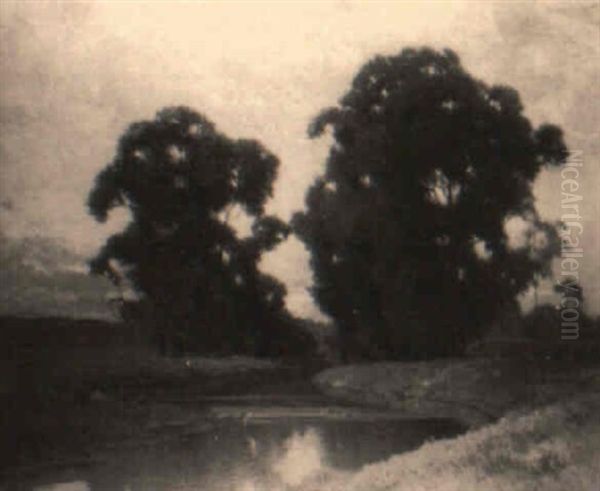
Frank Charles Peyraud's artistic style is predominantly characterized by his profound engagement with landscape. He was not merely a transcriber of scenery but an interpreter of nature's moods and emotional resonances. His work often emphasizes a subjective feeling, seeking to convey the artist's personal response to the environment. This approach aligns him with painters who valued emotional expression and atmospheric effects over purely objective representation. He demonstrated a remarkable ability to capture the ephemeral qualities of light and weather, infusing his canvases with a palpable sense of place and time.
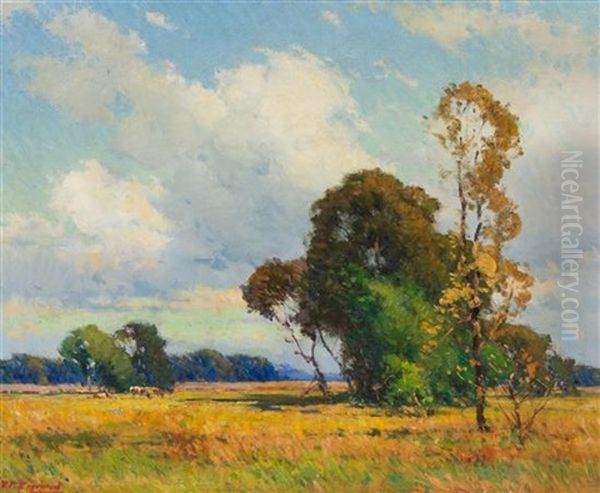
Peyraud was particularly adept at portraying the subtle harmonies and dramatic shifts within the natural world. His subjects frequently included the serene beauty of summer skies, punctuated by billowing clouds, the radiant glow of sunsets, and the tranquil stillness of nocturnal scenes. He explored the changing seasons with keen sensitivity, depicting the fresh promise of an "April Morning" or the rich, melancholic hues of an autumn evening. Through his masterful use of color and light, Peyraud could evoke a wide spectrum of emotions, from happiness and hope, often found in his sunlit pastoral scenes, to a gentle sadness or contemplative melancholy in his twilight or moonlit compositions. This capacity to imbue landscapes with deep feeling was a hallmark of his oeuvre. His paintings often possess a Tonalist quality, emphasizing soft edges, muted palettes, and an overall sense of quietude, though he could also employ a more vibrant, Impressionistic touch when the subject demanded.
Major Works and Commissions
Peyraud's artistic output was diverse, encompassing easel paintings, large-scale panoramas, and significant mural commissions. Each of these areas showcases different facets of his talent and ambition.
Landscape Paintings
Among his most celebrated easel paintings are works that capture the essence of the Midwestern landscape and the urban environment of Chicago. "After Rain, Chicago," for which he received the Clyde M. Carr Prize in 1912-1913 from the Art Institute of Chicago, exemplifies his ability to find beauty in the everyday. The painting likely depicted the city transformed by a recent shower, with glistening streets and a cleansed atmosphere, showcasing his skill in rendering light and reflection.
"Summer Evening," which earned him an Honorable Mention at the Art Institute of Chicago in 1908, and "April Morning," recipient of the prestigious Edward B. Butler Purchase Prize in 1911, further attest to his mastery of landscape. These titles suggest a focus on specific times of day and seasons, allowing Peyraud to explore varied light conditions and atmospheric effects. His work "Moon Over the Illinois River," mentioned in "Peoria's Public Art: A Comprehensive Survey," highlights his interest in nocturnal scenes and the romantic qualities of moonlight on water. These paintings were not just topographical records but poetic interpretations of nature, reflecting a deep connection to the American land.
The Gettysburg Cyclorama
One of Frank Charles Peyraud's most ambitious and widely recognized undertakings was his involvement with cycloramas, specifically his series depicting the Battle of Gettysburg. Cycloramas, or panoramas, were immense, 360-degree paintings housed in specially constructed circular buildings, designed to create an immersive viewing experience. They were a hugely popular form of entertainment and historical education in the late 19th century, akin to modern-day IMAX cinema.
Peyraud's "Gettysburg" series was exhibited in Chicago and toured other American cities, drawing large crowds and achieving considerable popular acclaim. Creating such a work required not only artistic skill on a grand scale but also meticulous historical research and the ability to manage a complex, collaborative project. Artists like Paul Philippoteaux had already achieved fame with Gettysburg cycloramas, and Peyraud's contribution to this genre further solidified his reputation. These works demonstrated his versatility and his capacity to engage with subjects of national historical significance, moving beyond purely personal landscape expression.
Mural Projects
Peyraud also made significant contributions to public art through his mural commissions. He often collaborated with fellow artist Hardesty G. Maratta on these large-scale projects. Their most notable joint ventures were in Peoria, Illinois, where they created murals for the Peoria Public Library and the Peoria City Hall. These commissions were important civic projects, intended to beautify public spaces and instill a sense of local pride and cultural aspiration.
The murals likely depicted historical scenes, allegorical figures, or idealized landscapes relevant to the region or the function of the buildings they adorned. Peyraud's experience with landscape and his strong compositional skills would have been invaluable in designing and executing these expansive works. He was also involved in creating murals for an exhibition hall that was repurposed after the World's Columbian Exposition (Chicago World's Fair of 1893), further indicating his engagement with large-scale decorative painting. These mural projects underscore his standing as a versatile artist capable of working in various formats and contributing to the broader artistic and civic life of his community. His collaboration with W. L. Jenney, the pioneering Chicago skyscraper architect, though the specifics are less detailed, suggests his involvement in the architectural and decorative arts sphere of the rapidly growing city.
Exhibitions and Recognition
Frank Charles Peyraud's talent did not go unnoticed by his contemporaries or by the established art institutions of his time. The Art Institute of Chicago played a central role in showcasing his work and providing him with significant accolades. He was a regular participant in the museum's influential annual exhibitions, which were major events in the American art calendar.
In 1906, the Art Institute hosted a special exhibition dedicated to Peyraud's work, featuring twenty-five of his paintings. Such solo or focused exhibitions were a clear indication of an artist's established reputation. His consistent success in the juried annuals further cemented his standing. As mentioned, "Summer Evening" received an Honorable Mention in 1908. A few years later, in the 1911-1912 season, his landscape "April Morning" was awarded the Edward B. Butler Purchase Prize, a significant honor that often meant the work was acquired for a public collection, in this case, for Chicago's public schools. The prize also came with a monetary award of $200.
The following year, 1912-1913, his painting "After Rain, Chicago" won the Clyde M. Carr Prize. These awards from the Art Institute of Chicago, one of the nation's leading art museums, were not only prestigious but also provided crucial validation and support for artists. Peyraud's work was also included in publications such as "THE ART INSTITUTE OF CHICAGO HANDBOOK OF PAINTINGS AND DRAWINGS" and exhibition catalogs like "AMERICAN PAINTINGS AND SCULPTURE," indicating his recognized place within the broader American art scene. His participation in these exhibitions placed him alongside other prominent artists of the day, such as fellow Chicago painters Charles Francis Browne, Pauline Palmer, Adam Emory Albright, and Karl Albert Buehr, all of whom were active exhibitors at the Art Institute.
Collaborations and Relationships
Throughout his career, Frank Charles Peyraud engaged in numerous collaborations and formed relationships that shaped his artistic journey and extended his influence. His early studies under François Bonnet in Zurich provided a foundational teacher-student relationship. Later, in America, Peyraud himself would take on the role of mentor.
One of his most notable students was Edward B. Butler, a prominent Chicago businessman and philanthropist who was also an avid amateur painter. Butler studied with Peyraud, and the two reportedly embarked on painting and sketching trips together across Chicago and various parts of the United States for a period of eight years. Butler, exhibiting under the name "Edward Burgess," clearly benefited from Peyraud's guidance, and his patronage, exemplified by the Edward B. Butler Purchase Prize, was instrumental in supporting Chicago artists and art education.
Peyraud's collaborative spirit is most evident in his mural projects with Hardesty G. Maratta. Their work in Peoria on the Public Library and City Hall murals demonstrates a successful artistic partnership, combining their respective strengths to create significant public artworks. Maratta himself was an interesting figure, known later for his color theory system that influenced some modernist painters.
Peyraud also collaborated with Thomas G. Moses, a prominent scenic painter known for his work in theatrical design. While the specifics of their joint projects are not extensively detailed, this connection points to Peyraud's engagement with artists working in related fields, potentially involving large-scale painted environments. His association with architect W. L. Jenney, a key figure in the development of the skyscraper, further suggests Peyraud's integration into Chicago's dynamic architectural and artistic circles, possibly contributing decorative elements to Jenney's innovative buildings. These interactions highlight a career characterized by both independent creation and fruitful artistic partnerships.
Influence and Legacy
Frank Charles Peyraud's influence extends from his direct impact as a teacher to his broader role as a pioneer of landscape painting in Chicago. His dedication to capturing the unique atmospheric conditions and scenic beauty of the Midwest helped to foster a regional artistic identity. By bringing a sophisticated, European-honed technique to American subjects, he elevated the genre and inspired his contemporaries.
His role as an instructor, particularly to figures like Edward B. Butler, demonstrates a commitment to nurturing artistic talent. The success of his students and the respect he garnered from institutions like the Art Institute of Chicago speak to the quality of his work and his standing in the community. The acquisition of his paintings by public collections, facilitated by awards like the Butler Purchase Prize, ensured that his art would be accessible to future generations and would continue to contribute to the cultural heritage of Chicago.
Peyraud's work can be seen as part of a broader movement of American artists who, at the turn of the 20th century, were seeking to define an authentic American voice in painting. While some, like Mary Cassatt or John Singer Sargent, achieved fame in Europe, Peyraud, like many of his Midwestern contemporaries, focused on the American scene. His landscapes, with their blend of realism, Tonalism, and Impressionistic sensibility, offered a distinct perspective. He was part of a generation that included artists like John Henry Twachtman and J. Alden Weir, who adapted Impressionist principles to American landscapes, often with a more poetic and introspective mood than their French counterparts.
Peyraud in Context: Comparisons and Artistic Milieu
To fully appreciate Frank Charles Peyraud's contributions, it is useful to consider his work in the context of his contemporaries and the prevailing artistic trends. His landscape paintings, with their emphasis on mood and light, share affinities with the Tonalist movement, exemplified by artists like George Inness and Dwight Tryon. Tonalism favored subtle gradations of color and a focus on evocative atmosphere, qualities evident in many of Peyraud's depictions of dawn, dusk, and overcast days.
While not a purely Impressionist painter in the French mold of Claude Monet or Camille Pissarro, Peyraud certainly absorbed elements of Impressionism, particularly in his handling of light and color and his practice of painting en plein air, or outdoors, to capture immediate sensory experiences. His work can be compared to that of American Impressionists like Childe Hassam or Willard Metcalf, who also depicted American landscapes with a concern for light and atmospheric effects, though Peyraud's style often retained a more structured, academic underpinning.
In the Chicago art scene, Peyraud was a contemporary of figures like Lorado Taft, the influential sculptor and arts advocate, and painters such as Charles Francis Browne, who also focused on landscape. The Art Institute of Chicago served as a nexus for these artists, providing opportunities for exhibition, competition, and exchange of ideas. The comparison of Manierre Dawson's "Rocky Pool" to a "Summer Landscape" by Peyraud suggests that while Dawson would move towards abstraction, there were points of stylistic intersection or shared interest in landscape interpretation among Chicago artists of different trajectories. Dawson, an early American abstractionist, often drew inspiration from natural forms, and it's plausible that representational landscape painters like Peyraud formed part of the artistic environment from which more avant-garde styles emerged.
Peyraud's dedication to mural painting also places him within a broader revival of muralism in America, a movement that gained momentum with the decorations for the World's Columbian Exposition in 1893. Artists like Edwin Howland Blashfield, Kenyon Cox, and Elihu Vedder were prominent in this field, often creating allegorical and historical murals for public buildings, libraries, and capitols across the country. Peyraud's work in Peoria aligns with this national trend, emphasizing art's public role and its capacity to convey civic values.
Conclusion: An Enduring Vision
Frank Charles Peyraud's career spanned a period of significant transformation in American art. From his European training to his establishment as a leading painter in Chicago, he consistently produced work that was both technically accomplished and emotionally resonant. His landscapes offer a sensitive and enduring vision of the American Midwest, capturing its subtle beauties and varied moods with a painterly grace that continues to appeal. His contributions to public art through murals further demonstrate his versatility and his commitment to the cultural enrichment of his community.
As a pioneer of Chicago landscape painting, an award-winning exhibitor at the Art Institute, a respected teacher, and a skilled muralist, Frank Charles Peyraud left a rich and multifaceted legacy. His paintings remain testaments to his deep appreciation for the natural world and his ability to translate that appreciation into compelling visual poetry. While perhaps not as widely known today as some of his East Coast contemporaries, his work holds an important place in the history of American regional art, reflecting the talent and dedication of an artist who found his voice in the heartland of his adopted country. His life and art serve as a valuable window into the vibrant artistic culture of Chicago at the turn of the twentieth century and the enduring allure of the American landscape.