George James Howard, the 9th Earl of Carlisle (1843–1911), stands as a fascinating figure in the landscape of late Victorian and Edwardian art. A man of aristocratic lineage, he was not content to merely be a passive inheritor of titles and estates. Instead, Howard actively pursued a life deeply immersed in the creation, appreciation, and promotion of art, alongside a notable political career. His story is one of a passionate amateur who evolved into a respected painter, a discerning collector, and an influential patron, bridging the worlds of high society, political reform, and the avant-garde artistic movements of his time.
Early Life and Artistic Awakening
Born in London on August 12, 1843, George Howard was the son of Charles Wentworth George Howard, the fifth son of George Howard, 6th Earl of Carlisle, and Mary Priscilla Harriet Parke. His upbringing within a prominent Whig aristocratic family provided him with a classical education, first at Eton College and later at Trinity College, Cambridge. It was during these formative years that his artistic inclinations began to surface. While at Eton, he received drawing lessons from W. Evans, and his talent was further encouraged at Cambridge. A significant early influence was the celebrated art critic John Ruskin, whose writings, particularly "Modern Painters," profoundly shaped Howard's aesthetic sensibilities. Indeed, Howard won a prize at Cambridge for drawing, an award judged by Ruskin himself, which must have been a considerable encouragement.
His formal artistic training was somewhat eclectic, typical for a gentleman artist of his era. He did not attend a formal art academy in the traditional sense but sought instruction from various artists. He studied briefly at Leigh's art school and later received guidance from Alphonse Legros and the Italian painter Giovanni Costa. This blend of influences would prove crucial in shaping his artistic style, steering him away from the more rigid academicism of the period towards a more personal and poetic form of expression.
The Influence of Giovanni Costa and the Etruscan School
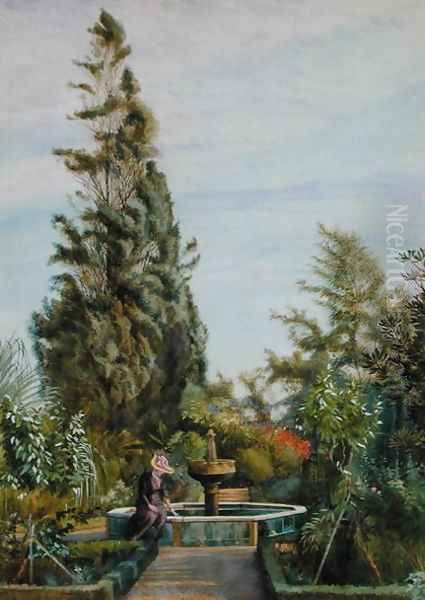
Perhaps the most pivotal artistic relationship in George Howard's life was with Giovanni Costa (1826–1903), often known as Nino Costa. They met in 1866, and Costa became a mentor and close friend. Costa was a key figure in the Italian Macchiaioli movement and later founded the "Etruscan School," a group of artists, both Italian and foreign, who were drawn to his principles of painting directly from nature with a focus on capturing light, atmosphere, and poetic sentiment, often in the Roman Campagna and other Italian landscapes.
Howard was deeply impressed by Costa's approach, which emphasized sincerity, a deep connection to the landscape, and a subtle, tonal palette. Under Costa's tutelage, Howard honed his skills, particularly in oil painting and watercolour. He embraced Costa's plein air methods and his belief in the emotional power of landscape. Howard became not only Costa's pupil but also his most significant English patron, championing his work in Britain and helping to introduce his style to a wider audience. This connection placed Howard firmly within a circle of artists who sought an alternative to the prevailing academic and highly finished narrative styles popular in Victorian Britain. Other artists associated with Costa or sympathetic to his aims included Frederic Leighton, who, despite his classical subjects, admired Costa's landscape work, and Matthew Ridley Corbet.
Artistic Style and Thematic Concerns
George Howard's art is characterized by its lyrical quality, its sensitivity to atmosphere, and its often melancholic beauty. He worked proficiently in both oils and watercolours, and his subject matter was diverse, though landscapes predominated. His travels provided a rich source of inspiration. Italy, with its classical ruins, sun-drenched countryside, and historic cities, was a recurring theme, reflecting his deep affection for the country and the influence of Costa. Works such as "The Baths of Caracalla, Rome" (1886) exemplify his ability to capture the grandeur and poetic decay of ancient sites, imbued with a soft, harmonious light.
Beyond Italy, Howard painted scenes from his extensive travels, which included Egypt, India, and the West Indies. These works often display a keen eye for local colour and atmospheric effects, rendered with a delicate touch. However, he was equally adept at capturing the more subdued beauty of the British landscape, particularly the scenery around his ancestral homes, Naworth Castle in Cumberland and Castle Howard in Yorkshire. These estates, with their rugged moorlands, ancient woodlands, and historic architecture, provided endless inspiration.
While primarily a landscape painter, Howard also produced portraits and figure studies. His portraits, often of family and friends, are noted for their intimacy and psychological insight. He was associated with the Pre-Raphaelite Brotherhood's later phase and the Aesthetic Movement, not as a core member, but as a sympathetic contemporary whose work shared certain sensibilities. His circle included figures like Edward Burne-Jones, William Morris, and Philip Webb, the architect who designed his London residence at 1 Palace Green, Kensington. This house became a notable example of Aesthetic interior design, with decorations by Morris & Co. and Burne-Jones. His early work "Emilia," exhibited at the Dudley Gallery in 1867, is cited as a piece that marked his transition towards a more professional artistic standing.
The terracotta sculpture titled "George Howard," exhibited at the Royal Academy in 1877, mentioned in the initial information, was likely a portrait of him by another artist, perhaps someone like Jules Dalou or Joseph Edgar Boehm, who were prominent sculptors of the era creating portraits of distinguished individuals. As a collector and patron, having one's likeness captured by a leading sculptor was common. Howard himself was more focused on painting and drawing.
Exhibitions and Artistic Circles
George Howard was a regular exhibitor at several of the most important progressive art venues in London. He showed his work at the Royal Academy, but he was more closely associated with the Dudley Gallery, the Grosvenor Gallery, and later the New Gallery. The Grosvenor Gallery, founded by Sir Coutts Lindsay and his wife Blanche, was particularly significant. It opened in 1877 and quickly became the premier venue for artists of the Aesthetic Movement, including Burne-Jones, James McNeill Whistler, G.F. Watts, Albert Moore, and Walter Crane. Howard's participation in these exhibitions placed him at the heart of the artistic avant-garde.
His involvement was not limited to exhibiting. He was elected an associate of the Royal Society of Painters in Water Colours in 1869, a testament to his skill in that medium. He was also involved with the Burlington Fine Arts Club, an exclusive club for artists and connoisseurs, which held specialist exhibitions. His connections were wide-ranging, encompassing not only the aforementioned artists but also figures like Dante Gabriel Rossetti, whose poetic intensity resonated with the broader romanticism of the era, and Val Prinsep, a contemporary who also navigated the worlds of art and society.
Patronage and Public Service
Beyond his personal artistic practice, George Howard was a significant patron of the arts and played an important role in public art administration. He inherited the Earldom of Carlisle in 1889 upon the death of his uncle, William George Howard, the 8th Earl. This position brought with it considerable wealth and influence, which he used to support artists and artistic causes. His patronage of Giovanni Costa was particularly notable, providing crucial financial and moral support.
He served as a trustee for the National Gallery for many years, contributing his expertise and discerning eye to the development of the national collection. He was also instrumental in the founding of the Tate Gallery (originally the National Gallery of British Art), advocating for a dedicated space for British art. His commitment to preserving and promoting art extended to his involvement with the Society of Antiquaries. These roles underscore his deep commitment to the cultural life of Britain. Artists like Edward Poynter, who later became President of the Royal Academy, would have interacted with Howard in these official capacities.
Political Life and Personal Character
Parallel to his artistic pursuits, George Howard had an active political career. He served as a Liberal Member of Parliament for East Cumberland from 1879 to 1880 and again from 1881 to 1885. His political views were progressive, aligning with the reforming spirit of the Liberal party of his day. He was a supporter of various social causes, a commitment shared and often amplified by his wife, Rosalind Frances Stanley (1845–1921), a formidable figure in her own right.
Rosalind, daughter of Edward Stanley, 2nd Baron Stanley of Alderley, was a passionate advocate for temperance, women's suffrage, and Irish Home Rule. Their marriage in 1864 was a union of two strong personalities, and Rosalind's influence on the management of the Carlisle estates and her active role in political and social campaigning were considerable. She was known as the "Radical Countess" for her outspoken views. Their life together, whether at Naworth, Castle Howard, or their London home, was one filled with art, intellectual debate, and political engagement.
Howard was described by contemporaries as a man of charm, culture, and integrity. His dedication to art was genuine and profound, not merely a dilettante's pastime. He approached his painting with seriousness and a constant desire to learn and improve, evident in his lifelong engagement with mentors like Costa and his active participation in the leading artistic circles of his day.
Legacy and Conclusion
George Howard, 9th Earl of Carlisle, died on April 16, 1911, at Brackland, Hindhead, Surrey. He left behind a significant body of work that, while perhaps overshadowed by some of his more famous contemporaries like Burne-Jones or Leighton, holds an important place in the story of British art in the late 19th century. His paintings are valued for their poetic sensibility, their subtle handling of light and atmosphere, and their sincere engagement with the landscape.
His legacy, however, extends beyond his own canvases. As a patron, he provided vital support to artists like Giovanni Costa, helping to foster cross-cultural artistic exchange. As a public figure, his work with institutions like the National Gallery and the Tate Gallery contributed to the preservation and promotion of art for future generations. He exemplified a model of the aristocratic artist-patron, one who actively participated in the creative process while also using his position to nurture the broader artistic ecosystem.
In an era of significant artistic change, George Howard navigated the currents of Pre-Raphaelitism, Aestheticism, and the burgeoning influence of continental landscape traditions. He forged a personal style that, while indebted to his influences, particularly Costa, possessed its own quiet distinction. His life and work remind us that artistic contribution can take many forms, from the creation of individual masterpieces to the vital work of patronage and the stewardship of cultural institutions. The 9th Earl of Carlisle excelled in all these areas, leaving an indelible mark on the art world of his time, a world populated by such diverse talents as William Holman Hunt, John Everett Millais, Lawrence Alma-Tadema, and many others whose paths he would have crossed in galleries, studios, and stately homes. His dedication ensured that his was a voice, and a brush, that contributed meaningfully to the rich artistic tapestry of Victorian and Edwardian Britain.