The Dutch Golden Age, spanning roughly the 17th century, was a period of extraordinary artistic efflorescence in the Netherlands. Amidst the towering figures of Rembrandt, Vermeer, and Hals, a constellation of specialized masters flourished, catering to the tastes of a newly affluent merchant class. Among these was Gerrit van Vucht (c. 1610–1697), a painter who carved his niche in the popular genre of still life, particularly the contemplative and symbolic vanitas compositions. While not as widely celebrated today as some of his contemporaries, Van Vucht’s work offers a valuable window into the artistic, cultural, and philosophical currents of his time.
The Artistic Landscape of the Dutch Golden Age
To understand Gerrit van Vucht, one must first appreciate the unique environment in which he worked. The Dutch Republic, having thrown off Spanish rule, was experiencing unprecedented economic prosperity fueled by international trade, maritime dominance, and burgeoning industries. This wealth created a broad middle and upper class eager to adorn their homes with art. Unlike in Catholic countries where the church and aristocracy were primary patrons, in the Protestant Netherlands, patronage was more democratized. Burghers, merchants, and guilds commissioned portraits, landscapes, genre scenes, and, significantly, still lifes.
The Calvinist ethos, while generally austere, did not entirely suppress the desire for worldly goods or their depiction. However, it often imbued art with a moralizing undertone. Still life painting, in particular, became a vehicle for complex symbolism, reminding viewers of the transience of life, the futility of earthly pleasures, and the importance of spiritual contemplation. This cultural backdrop was the fertile ground from which artists like Van Vucht emerged. His likely place of birth or primary activity, Schiedam, a city near Rotterdam known for its distilleries, would have placed him within this vibrant economic and artistic sphere.
The Allure and Variety of Still Life
Still life painting, or stilleven in Dutch, achieved an unprecedented level of sophistication and popularity during the Golden Age. It was not a monolithic genre but encompassed various sub-types. There were pronkstilleven (ostentatious or sumptuous still lifes) filled with luxurious objects, silver, and exotic foods, often painted by masters like Willem Kalf or Abraham van Beyeren. Flower paintings, executed with botanical precision by artists such as Ambrosius Bosschaert the Elder, Balthasar van der Ast, and later, the celebrated female painter Rachel Ruysch, were immensely popular. Breakfast pieces (ontbijtjes) and banquet scenes, depicting more modest or elaborate table settings, were perfected by artists like Pieter Claesz and Willem Claesz. Heda.
Within this diverse field, Gerrit van Vucht appears to have specialized in compositions that often leaned towards, or directly embraced, the vanitas theme. The term vanitas, derived from the biblical Book of Ecclesiastes ("Vanity of vanities, all is vanity"), refers to still lifes designed to remind the viewer of the fleeting nature of earthly existence and the inevitability of death. These paintings were visual sermons, encouraging piety and a detachment from worldly possessions.
Gerrit van Vucht’s Oeuvre: The Vanitas Tradition
Gerrit van Vucht’s known period of activity, roughly from the mid-17th century until his death in 1697, places him firmly within the mature phase of the Dutch Golden Age. His most emblematic work, and one that clearly defines his contribution to the vanitas tradition, is his Vanitas Still Life, dated between 1658 and 1697 and now housed in the prestigious Rijksmuseum in Amsterdam.
This small yet potent painting, measuring approximately 9.3 cm by 12 cm, is a quintessential example of the genre. It features a carefully arranged collection of objects, each laden with symbolic meaning. A human skull, the most direct memento mori, often takes center stage or a prominent position in such works. Books might symbolize the transience of human knowledge or worldly learning. Other common vanitas symbols, though not all necessarily present in every single one of Van Vucht's works, include snuffed candles (life extinguished), hourglasses or clocks (the passage of time), soap bubbles (the brevity of life), musical instruments (the fleeting nature of pleasure), and wilting flowers or decaying fruit (the decay of beauty and life). The inclusion of a "rider" or equestrian figure, as noted in some descriptions of his Vanitas Still Life, could symbolize the journey of life or the fleeting nature of power and glory.
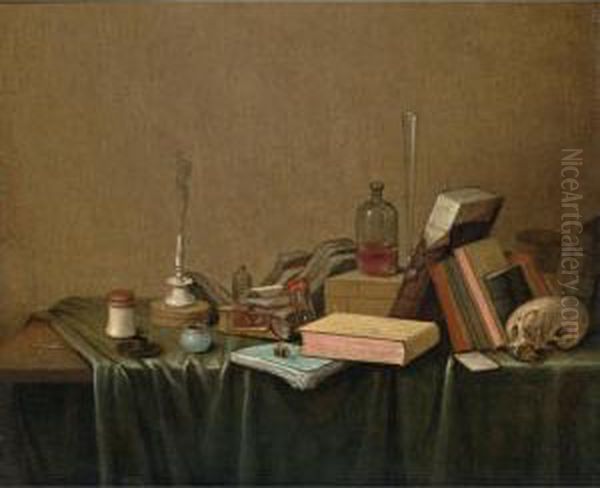
Van Vucht's approach to these themes would have involved meticulous attention to detail, a hallmark of Dutch still life painting. The rendering of textures – the cold smoothness of a skull, the crinkled pages of a book, the gleam of a glass – was a testament to the artist's skill and a source of delight for the viewer, even as the subject matter prompted somber reflection. His palette, typical for many vanitas paintings, likely favored subdued, earthy tones, enhancing the contemplative mood.
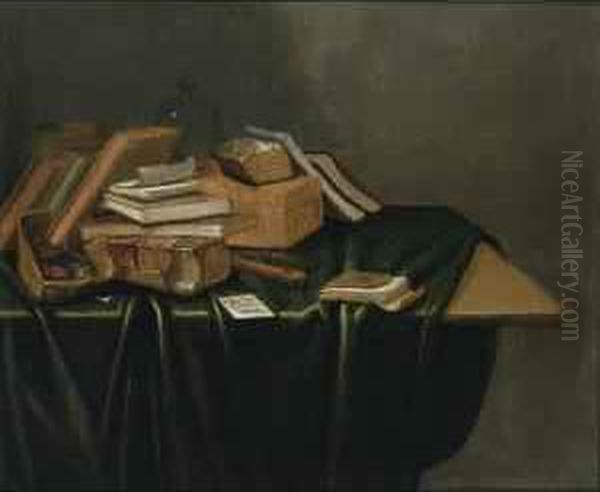
Other works attributed to Van Vucht, such as Still Life with Books, further underscore his engagement with scholarly and vanitas themes. Books, often open or stacked, were common motifs, representing learning, wisdom, or, in a vanitas context, the ultimate futility of worldly knowledge in the face of eternity. Pieces like Still Life with Fish and Cat or Flower Still Life in a Vase suggest he may have also explored other subgenres of still life, showcasing his versatility in depicting different textures and subjects, from the slick scales of fish to the delicate petals of flowers.
Artistic Style and Technique
While detailed biographical information about Van Vucht's training remains scarce, his works demonstrate a command of techniques common among Dutch still life painters. He would have employed oil paints, likely on wood panel for smaller works or canvas for larger ones, building up images with careful layers of glaze to achieve depth and luminosity. The precise rendering of objects, a high degree of realism, and a sophisticated understanding of light and shadow (chiaroscuro) would have been central to his practice.
His compositions, though often dense with objects, would have been carefully balanced, guiding the viewer's eye through the symbolic narrative. The interplay of light on different surfaces – the dullness of bone, the sheen of polished wood, the transparency of glass – was a key element in creating a convincing and engaging illusion of reality. This dedication to verisimilitude was not merely for show; it made the symbolic message all the more impactful.
An Encounter with Peter Paul Rubens: A Glimpse into the Art World
A fascinating anecdote connects Gerrit van Vucht with one of the titans of Baroque art, Peter Paul Rubens (1577-1640). Although Rubens was primarily active in Flanders (Southern Netherlands) and belonged to an earlier generation, his fame and influence were immense. According to records, Van Vucht sought to acquire works by Rubens, perhaps hoping for a bargain. Rubens reportedly informed him that the amount a merchant was willing to pay would likely only secure smaller pieces.
Several months later, Rubens mentioned a specific painting he had discussed with Van Vucht, a deal that ultimately did not materialize due to disagreements over price. This interaction, if accurately recorded and pertaining to our painter, offers several insights. It suggests Van Vucht was not only a creator but also an interested party in the art market, possibly a collector or dealer to some extent. It also hints at the financial realities faced by artists, even those aspiring to own works by renowned masters. The art market of the 17th century was vibrant and complex, with artists, dealers, and collectors navigating issues of attribution, quality, and price, much like today. This places Van Vucht within the practical, commercial side of the art world, beyond just his studio practice.
Contemporaries and Artistic Milieu
Gerrit van Vucht worked during a period teeming with exceptional talent. In the realm of still life, he would have been aware of, and perhaps influenced by, or influencing, numerous other painters. The aforementioned Pieter Claesz (c. 1597–1660) and Willem Claesz. Heda (1594–c. 1680) were masters of the "monochrome banketje," subtle arrangements in muted tones. Jan Davidsz. de Heem (1606–c. 1684), and his son Cornelis de Heem, were celebrated for their lavish pronkstilleven, bursting with color and texture. The works of Johannes Hannot, another contemporary still life painter, might offer points of comparison.
Beyond still life specialists, the broader artistic environment was dominated by figures whose influence was pervasive. Rembrandt van Rijn (1606–1669) was revolutionizing portraiture, historical painting, and printmaking with his dramatic use of light and profound psychological insight. Johannes Vermeer (1632–1675), though producing a relatively small oeuvre, created genre scenes of unparalleled serenity and luminous beauty. Landscape painters like Jacob van Ruisdael and portraitists like Frans Hals also contributed to the richness of the era. While Van Vucht’s specialization was distinct, the overall artistic climate of innovation, technical mastery, and keen observation would have undoubtedly shaped his development. The demand for specialized genres allowed artists like Van Vucht to thrive alongside these giants. Other notable still life painters of the broader period include Clara Peeters, an early pioneer in the genre, and Adriaen van Utrecht, known for his elaborate market and kitchen scenes often incorporating still life elements.
The Question of Identity: Painter and Naval Officer?
It is important to address a point of potential confusion that sometimes arises in discussions of Gerrit van Vucht. Historical records also mention a Gerrit van Vucht who served as a naval officer, specifically a "marine de 1ste klas" (first-class seaman or petty officer), in the Dutch navy. This individual was reportedly buried with naval honors, including the flying of flags at half-mast.
While the name is identical, and it's tempting to imagine a painter who also served at sea, current art historical consensus generally treats Gerrit van Vucht the painter and Gerrit van Vucht the naval officer as two distinct individuals. The skills, lifestyle, and career paths of a professional painter in 17th-century Holland and a naval seaman were typically quite different. Unless compelling evidence emerges to definitively link the two, it is prudent to consider the painter's biography separately from the naval records. The focus for art history remains on the Gerrit van Vucht whose legacy is preserved in his meticulously crafted still life paintings. The information regarding the naval officer, while part of the historical record for the name, does not directly illuminate the life or work of the artist.
Legacy and Appreciation
Gerrit van Vucht may not have achieved the posthumous superstar status of a Rembrandt or Vermeer, but his contributions to the Dutch Golden Age are significant within his chosen specialty. He was a skilled practitioner of still life painting, particularly the vanitas genre, which encapsulated many of the moral and philosophical preoccupations of his society. His works, found in collections like the Rijksmuseum, continue to be studied for their technical proficiency, their rich symbolism, and the insights they offer into 17th-century Dutch culture.
Like many "minor masters" of the period, Van Vucht's paintings catered to a specific market demand. The desire for art that was both aesthetically pleasing and intellectually stimulating was strong, and vanitas still lifes perfectly met this need. They allowed patrons to display their taste and erudition while simultaneously affirming their piety. Van Vucht’s ability to render objects with convincing realism, combined with his thoughtful arrangement of symbolic elements, ensured his relevance in a competitive art market.
The rediscovery and appreciation of artists like Van Vucht have enriched our understanding of the Dutch Golden Age, revealing its depth and breadth beyond the most famous names. Each artist, with their unique focus and skill, adds another facet to the glittering mosaic of 17th-century Dutch art. His paintings serve as quiet reminders of a time when art was intimately woven into the fabric of daily life, offering beauty, reflection, and a profound commentary on the human condition.
Conclusion: A Quiet Voice in a Golden Age
Gerrit van Vucht stands as a testament to the specialized mastery that characterized the Dutch Golden Age of painting. His dedication to the still life genre, particularly his evocative vanitas compositions, provided his contemporaries with art that was both visually engaging and spiritually resonant. Through his detailed renderings of symbolic objects, he explored universal themes of transience, mortality, and the pursuit of meaning, concerns that remain relevant centuries later.
While the grand narratives of history often focus on the most prominent figures, the contributions of artists like Gerrit van Vucht are essential for a complete understanding of an era's artistic output. His surviving works, though perhaps modest in number compared to some, continue to speak to us of the quiet beauty, intricate symbolism, and profound introspection that defined one of the most remarkable periods in the history of art. His paintings invite us to pause, to look closely, and to reflect – a timeless invitation from a skilled hand of the Dutch Golden Age.