The late nineteenth and early twentieth centuries in France represented one of the most dynamic and transformative periods in the history of art. Paris, the undisputed capital of the art world, buzzed with an electrifying energy as artists challenged centuries-old traditions, forged new visual languages, and responded to the rapidly changing modern world. Within this vibrant milieu, numerous painters contributed to the rich tapestry of artistic production. Among them was Henri Rondel (1857-1919), a French artist whose career unfolded against the backdrop of Impressionism, Post-Impressionism, Symbolism, and the nascent stirrings of modernism. While perhaps not as globally renowned as some of his contemporaries, Rondel's work, particularly in portraiture and still life, offers a valuable lens through which to examine the artistic currents of his time.
The Belle Époque: A Crucible of Artistic Innovation
To understand Henri Rondel, one must first appreciate the era in which he lived and worked. The period roughly spanning from the 1870s to the outbreak of World War I in 1914 is often referred to as the Belle Époque, or "Beautiful Era," in France. It was a time of relative peace, prosperity, and significant technological and cultural advancements. Paris, in particular, was a hub of creativity, attracting artists, writers, and intellectuals from across the globe. The city's cafes, cabarets, theaters, and newly designed boulevards became subjects and settings for a new generation of artists eager to capture the pulse of modern life.
Artistically, this era was marked by a decisive break from the dominance of the Académie des Beaux-Arts, which had long dictated artistic taste and standards through its rigorous curriculum and the prestigious annual Salon. While academic painting, with its emphasis on historical, mythological, and allegorical subjects rendered with polished precision, continued to be produced by artists like William-Adolphe Bouguereau and Jean-Léon Gérôme, a powerful avant-garde was emerging, seeking greater freedom of expression and new ways of seeing and representing the world.
Henri Rondel: An Overview of His Life and Focus
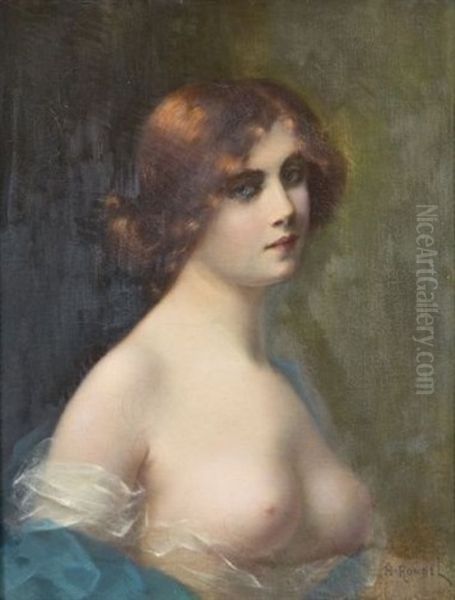
Henri Rondel was born in France in 1857 and passed away in 1919. His lifespan placed him squarely in the midst of this artistic ferment. While detailed biographical information about Rondel's early life and artistic training is not extensively documented in widely accessible sources, it is reasonable to assume he would have received a formal art education, likely in Paris, given his nationality and the period. Artists of his generation often sought training at institutions like the École des Beaux-Arts or in the ateliers of established masters.
Rondel's primary focus as a painter appears to have been on portraiture and still life. These genres, while having long traditions, offered artists of the late nineteenth century ample opportunity for innovation in technique, composition, and psychological insight. His works, such as Jeune femme rousse (Auburn-haired Young Woman) and Portrait de jeune femme (Portrait of a Young Woman), suggest a keen interest in capturing the likeness and character of his sitters. The very titles evoke a sense of intimacy and a focus on individual personality, hallmarks of successful portraiture.
Artistic Style and Influences: Navigating Tradition and Modernity
Henri Rondel's artistic style is generally characterized as belonging to the broader currents of late nineteenth-century French painting. Some descriptions suggest his work aligns with, or was influenced by, Impressionist or Post-Impressionist sensibilities. This is particularly noted in his "sensitive capture of color and light," a quality highly valued by the Impressionists.
The Impressionist movement, which had its first independent exhibition in 1874, revolutionized painting. Artists like Claude Monet, Pierre-Auguste Renoir, Edgar Degas, Camille Pissarro, and Berthe Morisot sought to capture the fleeting moments of contemporary life and the transient effects of light and atmosphere. They often painted en plein air (outdoors), using broken brushstrokes and a vibrant palette to convey their immediate sensory experience. If Rondel's work indeed shows a sensitivity to light and color, it indicates an awareness of and perhaps an engagement with these groundbreaking developments.
Following Impressionism, the Post-Impressionist period (roughly 1886 to 1905) saw artists like Paul Cézanne, Vincent van Gogh, Paul Gauguin, and Georges Seurat take Impressionist innovations in new directions. They were less concerned with naturalistic depiction and more interested in exploring structure, emotional expression, symbolism, and subjective experience. Cézanne's methodical analysis of form, Van Gogh's passionate use of color and brushwork, Gauguin's search for the primitive and symbolic, and Seurat's scientific pointillism all expanded the boundaries of art. Rondel, working through this period, would have been exposed to these diverse artistic explorations.
It is important to consider that many artists of this era did not fit neatly into a single "movement." Some, while absorbing lessons from the avant-garde, maintained a more traditional approach, perhaps blending academic skill with modern sensibilities. Rondel's focus on portraiture, a genre with deep academic roots, suggests he may have navigated this space, employing a refined technique while incorporating contemporary approaches to light, color, and psychological portrayal. His "delicate handling of light and shadow" and "ability to convey the personality of his sitters" point to a painter skilled in traditional representation but also attuned to the expressive potential of his medium.
Notable Works and Thematic Concerns
While a comprehensive catalogue raisonné of Henri Rondel's work might be elusive, several pieces provide insight into his artistic output.
Jeune femme rousse (Auburn-haired Young Woman): The title itself conjures an image of a portrait focused on a specific individual, likely highlighting the distinctive color of her hair. Such a work would have allowed Rondel to explore a particular color palette and to capture the sitter's expression and mood. Portraits of women were a popular subject, offering opportunities to depict contemporary fashion, social standing, and individual character.
Portrait de jeune femme (Portrait of a Young Woman): Similar to the above, this title indicates a focus on female portraiture. Without viewing the image, one can imagine a work that seeks to convey youth, perhaps a certain demeanor or social context, through the artist's handling of pose, costume, and facial expression. The success of such portraits often lay in the artist's ability to create a connection between the viewer and the sitter.
Camille de la Croix devant son établi (Camille de la Croix in front of his workbench), dated 1883: This is a particularly significant work as it is dated and its subject is identified. The painting depicts Camille de la Croix, a notable figure, possibly an archaeologist or historian given his association with the Musée Sainte-Croix in Poitiers, where the painting is now housed. A portrait of a figure "in front of his workbench" suggests an occupational portrait, one that aims to define the individual through their profession and intellectual pursuits. The 1883 date places this work firmly within the period when Impressionism was well-established and Post-Impressionist ideas were beginning to germinate. The painting's presence in the Musée Sainte-Croix also indicates Rondel's connection to specific regional centers and his recognition by public institutions.
The themes in Rondel's known works revolve around the human figure and, by implication from the genre of still life, the careful observation of objects. Portraiture in the late 19th century was not merely about capturing a likeness; it was also about conveying status, personality, and the inner life of the subject. Artists like John Singer Sargent, an American expatriate who achieved great fame in Paris and London, and the Italian Giovanni Boldini, known for his flamboyant portraits of high society, were masters of this. Rondel, in his own way, participated in this tradition, likely bringing his own nuanced approach to his sitters.
The Broader Artistic Landscape: Contemporaries and Movements
Henri Rondel's career (1857-1919) spanned a period of immense artistic diversity. Beyond the Impressionists and Post-Impressionists already mentioned, other significant movements and artists shaped the cultural landscape.
Symbolism, which emerged in the 1880s and 1890s, offered a counterpoint to the naturalism of Impressionism. Symbolist painters like Gustave Moreau, Odilon Redon, and Pierre Puvis de Chavannes sought to express ideas, emotions, and spiritual themes through suggestive imagery, often drawing on mythology, dreams, and literature. While Rondel's known work seems more grounded in direct observation, the pervasive influence of Symbolism, with its emphasis on subjective experience, would have been part of the artistic atmosphere.
The Nabis, a group of young Post-Impressionist artists active in Paris in the 1890s, including Pierre Bonnard, Édouard Vuillard, and Maurice Denis, emphasized the decorative qualities of painting, using flat planes of color and simplified forms. Their intimate interior scenes and decorative panels contributed another facet to the era's art.
As the 19th century turned into the 20th, new movements continued to emerge. Fauvism, led by Henri Matisse and André Derain, exploded onto the Parisian art scene in 1905 with its shockingly bold, non-naturalistic colors and expressive brushwork. Shortly thereafter, Pablo Picasso and Georges Braque began their revolutionary experiments with Cubism, fragmenting forms and challenging traditional notions of perspective. These radical developments marked the definitive arrival of modernism.
Rondel's artistic production would have overlapped with these later movements. While his style may have been more aligned with earlier trends, he would have witnessed these profound shifts in the art world. The Salon des Indépendants (founded in 1884) and the Salon d'Automne (founded in 1903) provided exhibition venues for artists outside the official Salon system, showcasing a wide range of innovative and often controversial art. It is plausible that Rondel, like many artists of his time, exhibited his work in one or more of these Salons.
Other notable painters active during parts of Rondel's career include Henri de Toulouse-Lautrec, famous for his depictions of Parisian nightlife and his striking poster designs; James McNeill Whistler, an American artist active in London and Paris, known for his aestheticism and subtle tonal harmonies; and Mary Cassatt, an American Impressionist who, like Berthe Morisot, played a crucial role in the movement and often depicted the lives of women and children. The German painter Ludwig Knaus and the Italian Vittorio Gambari, mentioned in some contexts alongside Rondel, represent the international character of the art world, though their specific interactions with Rondel are not detailed.
Rondel's Specific Contributions and Legacy
Henri Rondel's contribution to art history lies primarily in his skilled practice of portraiture and still life during a pivotal era. While he may not have been a radical innovator in the vein of Monet, Van Gogh, or Picasso, artists like Rondel played an essential role in the artistic ecosystem. They maintained and evolved established genres, often incorporating contemporary stylistic influences to create works of lasting quality and appeal.
His ability to capture "the personality of his sitters" suggests a psychological depth in his portraits, moving beyond mere surface likeness. The "delicate handling of light and shadow" indicates a technical proficiency and an understanding of how these elements contribute to form and mood. The existence of his work Camille de la Croix devant son établi in a public museum collection (Musée Sainte-Croix) attests to a degree of contemporary recognition and the perceived historical or artistic value of his work.
The art market also provides some indication of an artist's ongoing legacy. A watercolor by Henri Rondel titled Jeune femme (Young Woman), measuring 10.6 x 14.5 cm, was noted with an auction estimate of €200-300. While this is a modest sum compared to works by more famous names, it signifies that Rondel's works are still collected and traded, maintaining a presence in the art market. The auction house Christie's has also been associated with handling his work, further indicating a level of market interest.
It is important to distinguish Henri Rondel the painter from other uses of the name "Rondel." For instance, the "rondel" is also a poetic form, popular in medieval France, notably used by figures like Charles d'Orléans. This poetic form is distinct from the painter and his artistic output. Similarly, other individuals named Rondel may appear in historical records (e.g., a Frederick Rondel mentioned as a painter and teacher, or a David Rondel in academic fields), but these should not be confused with the specific artistic career of Henri Rondel (1857-1919).
Collections and Market Presence
The primary institutional holding mentioned for Henri Rondel's work is the Musée Sainte-Croix in Poitiers, which houses his 1883 portrait of Camille de la Croix. Public collections provide invaluable access to an artist's work for study and appreciation, and the inclusion of a piece in such an institution often reflects its perceived cultural or historical importance.
Beyond museum collections, Rondel's works, particularly paintings like Jeune femme rousse and the watercolor Jeune femme, appear in the art market, primarily through auction houses. The auction records, though perhaps not extensive, confirm that his art continues to be valued by collectors. The nature of his subjects – portraits and still lifes – often appeals to private collectors who appreciate the skill, aesthetic qualities, and historical context of such pieces.
Conclusion: Henri Rondel in the Pantheon of French Art
Henri Rondel was a French painter who navigated the rich and complex art world of the late nineteenth and early twentieth centuries. Active during the Belle Époque, he witnessed and responded to a period of unprecedented artistic experimentation, from the afterglow of Impressionism and the diverse explorations of Post-Impressionism to the rise of Symbolism and the dawn of Modernism.
While perhaps not a leading figure of the avant-garde, Rondel contributed to the artistic production of his time through his accomplished work in portraiture and still life. His paintings, characterized by a sensitivity to light and color and an ability to capture the essence of his subjects, reflect both a grounding in traditional artistic skills and an awareness of contemporary aesthetic currents. Works like Camille de la Croix devant son établi demonstrate his engagement with specific communities and his recognition by public institutions.
The continued presence of his art in museum collections and on the art market indicates an enduring, if modest, legacy. Henri Rondel stands as an example of the many talented artists who, while not always achieving household-name status, formed the vital substance of one of art history's most exciting periods. His work offers a glimpse into the artistic tastes and sensibilities of his era, reminding us that the story of art is composed not only of its most revolutionary figures but also of the skilled practitioners who enriched its traditions and reflected its evolving forms.