Henry Robert Morland stands as a fascinating, if somewhat overshadowed, figure in the bustling art world of 18th-century Britain. A painter of considerable skill, particularly in the delicate medium of pastel, he navigated a career marked by artistic recognition and persistent financial turmoil. His life and work offer a window into the tastes, social structures, and economic realities faced by artists of his time, distinct from, yet connected to, more celebrated contemporaries like Sir Joshua Reynolds or Thomas Gainsborough. This exploration seeks to illuminate Morland's biography, artistic contributions, the context in which he worked, and his enduring, albeit modest, legacy.
Early Life and Artistic Foundations
The precise birth year of Henry Robert Morland has been a subject of some scholarly debate, with dates ranging from approximately 1716 to 1730. However, the most widely accepted and corroborated evidence points to a birth year around 1716, likely in London. He was born into an environment steeped in art; his father, George Henry Morland (sometimes referred to as Morland Sr.), was himself a painter of genre scenes, providing young Henry with an early immersion in the visual arts and likely his initial instruction. This familial connection to the art world was not uncommon in the period, with artistic skills often passed down through generations, as seen with families like the Cotes, where Francis Cotes excelled in pastel portraiture, and his brother Samuel Cotes also worked as a miniaturist.
Formal training for Henry Robert Morland commenced in 1732 when he was apprenticed to Isaac Wood, a painter of whom less is known but who evidently provided a structured environment for the young artist to hone his craft. Apprenticeship was the standard route for artistic education before the widespread establishment of academies. During this period, Morland would have learned the fundamentals of drawing, paint preparation, and various techniques, laying the groundwork for his future specializations. The artistic milieu of London in the 1730s and 1740s was vibrant, with portraiture being particularly in demand, dominated by figures transitioning from the era of Sir Godfrey Kneller and looking towards a more distinctly British style.
Artistic Style, Techniques, and Subject Matter
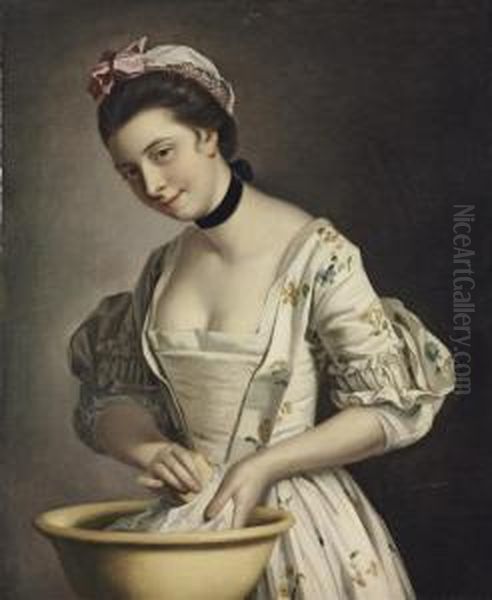
Henry Robert Morland developed a versatile practice, working in both oil and pastel, but it was for his pastel (or "crayon," as it was often termed) works that he gained particular acclaim. Pastels, composed of pure powdered pigment and a binder, allowed for a softness, immediacy, and brilliance of color that suited the refined tastes of the 18th century. Artists like the Venetian Rosalba Carriera had popularized the medium across Europe, and in Britain, figures such as Francis Cotes and later John Russell became renowned for their pastel portraits. Morland's handling of pastels was noted for its delicacy, his ability to render flesh tones with a subtle luminosity, and his clear, harmonious color palettes.
His subject matter was diverse, encompassing portraits, genre scenes, and "fancy pictures"—a category popular in the 18th century depicting sentimental or charming everyday scenes, often with a moralizing or anecdotal undertone. Morland's genre paintings frequently focused on domestic life, particularly scenes involving servants and working-class women. These subjects, while not as prestigious as historical or grand-manner portraiture, found a ready market and allowed for a degree of social observation. His approach was generally sympathetic, capturing his subjects with a quiet dignity rather than the satirical bite often found in the works of William Hogarth, a towering figure in British genre painting.
Among his most recognized works are those depicting laundry maids, such as A Lady's Maid Soaping Linen or The Laundress. These compositions, often repeated with variations, showcase his skill in rendering textures—the sheen of fabric, the softness of skin, the gleam of copper pots—and his ability to create intimate, well-observed vignettes. The figures are typically engaged in their tasks with a serene concentration, their faces often imbued with a gentle, almost melancholic beauty. These works can be seen as precursors to the more rustic and sometimes more overtly sentimental genre scenes that his son, George Morland, would later popularize.
Morland also undertook portrait commissions. While perhaps not reaching the fashionable heights of Sir Joshua Reynolds or Thomas Gainsborough, he produced competent and often charming likenesses. He is known to have painted a portrait of King George III, a significant commission, and also supposedly a portrait of the celebrated actor David Garrick, though the attributions of some portraits can be complex. His portrait style, particularly in pastel, emphasized a directness and a pleasing naturalism, often avoiding the grandiloquent rhetoric of some of his contemporaries.
An interesting, though perhaps apocryphal, anecdote sometimes associated with Morland or artists of his circle was the experimental use of unusual binders for pastels, with one account even mentioning gin. While the veracity of such specific claims is difficult to ascertain, it points to a period where artists were often personally involved in the preparation of their materials and might experiment to achieve desired effects or due to economic necessity.
Exhibitions, Recognition, and the London Art World
Henry Robert Morland was an active participant in the burgeoning public exhibition scene in London. He exhibited his works at several key institutions: the Society of Artists, the Free Society of Artists, and later, the prestigious Royal Academy of Arts, which was founded in 1768 with Sir Joshua Reynolds as its first president. These exhibitions were crucial for artists to gain visibility, attract patronage, and receive critical attention. Morland's contributions to these shows, spanning several decades, demonstrate his consistent productivity and his engagement with the evolving art market.
His works were generally well-received by contemporary critics, who often praised the quality of his draftsmanship, the pleasing nature of his colors, and the charm of his subjects. His skill in pastel was particularly noted, placing him among the respected practitioners of this medium in Britain. The ability to capture a "speaking likeness" in portraiture and to imbue genre scenes with a sense of naturalism and gentle sentiment appealed to the prevailing tastes of the era, which valued both verisimilitude and a certain Rococo-inflected grace, as also seen in the work of French contemporaries like Jean-Baptiste Greuze, whose sentimental genre scenes were highly popular.
The London art world of Morland's time was a competitive environment. The rise of a wealthy middle class created new markets for art, particularly for portraits and genre scenes. However, an artist's success often depended on a complex interplay of talent, social connections, business acumen, and sheer luck. While Morland achieved a degree of artistic recognition, this did not always translate into financial stability, a common plight for many artists of the period, even those with considerable talent, such as Richard Wilson, the landscape painter who died in poverty despite his foundational role in British landscape art.
The Morland Artistic Lineage
Artistic talent often ran in families during the 18th century, and the Morlands were a notable example. Henry Robert's father, George Henry Morland, as mentioned, was a painter, establishing an artistic environment from Henry's earliest years. This tradition continued with Henry Robert's own family. His wife, Maria Morland (née Ward, according to some sources, though this is sometimes debated and she is also referred to as Maria Friter), was herself an artist and an exhibitor at the Royal Academy, indicating a household where artistic pursuits were shared. The Ward family connection is significant, as William Ward and James Ward (Maria's brother, if the Ward connection is accurate) became highly successful engravers and, in James's case, a notable painter of animals and romantic landscapes, eventually becoming a Royal Academician.
The most famous artistic descendant, however, was Henry Robert Morland's son, George Morland (1763–1804). George became one of the most popular and prolific painters of his generation, specializing in rustic genre scenes, landscapes, and animal subjects. His picturesque depictions of rural life, often featuring charmingly disheveled peasants, smugglers, and sentimental domestic interiors, resonated deeply with contemporary tastes and were widely disseminated through engravings, many by his brothers-in-law William Ward and James Ward.
Henry Robert Morland played a crucial role in his son's early artistic development, providing initial instruction and guidance. George's prodigious talent was evident from a young age, and he quickly surpassed his father in terms of public fame and, for a time, financial success (though George, too, would suffer from chronic financial mismanagement and debt). While George developed his own distinct style, characterized by a looser brushwork and a more overtly romantic and sometimes dramatic sensibility than his father's more restrained classicism, the elder Morland's influence can be seen in George's choice of genre subjects and his observational skills. The relationship between father and son, master and pupil, adds another layer to Henry Robert Morland's story, positioning him as a vital link in a chain of artistic production. Other artists, like Benjamin West, an American who became President of the Royal Academy after Reynolds, also played significant roles as teachers to a new generation.
Financial Hardships and Later Years
Despite his artistic abilities and consistent exhibition record, Henry Robert Morland's life was plagued by financial difficulties. He experienced bankruptcy on more than one occasion, a recurring theme that suggests either a lack of business acumen, an art market that was not always supportive even of skilled practitioners, or perhaps personal extravagance. The 18th-century art market could be fickle; while portraitists at the top of their game, like Reynolds, Gainsborough, or George Romney, could command high prices, many other talented artists struggled to maintain a consistent income. The cost of materials, studio upkeep, and the general expenses of living in London could be considerable.
Morland's financial woes were not unique. Many artists, including his own son George, lived precariously, often at the mercy of dealers, patrons, and changing fashions. The elder Morland's struggles, however, seem to have been a persistent feature of his career. It is said that he sometimes had to work in obscurity to avoid creditors, which may have impacted his output or the consistency of his patronage. These financial pressures undoubtedly cast a shadow over his professional life and personal well-being.
Despite these challenges, Henry Robert Morland continued to paint and exhibit into his later years. His dedication to his art, even in the face of adversity, speaks to a deep-seated commitment. He passed away in London on November 30, 1797. At the time of his death, his son George was at the height of his popularity, though already beginning his own descent into debt and ill health.
The Broader Context: Art in 18th-Century Britain
To fully appreciate Henry Robert Morland's career, it is essential to consider the broader artistic and cultural landscape of 18th-century Britain. This was a period of significant transformation. The nation was growing in wealth and imperial power, leading to increased demand for art as a marker of status and cultural refinement. The Enlightenment fostered new ways of thinking about art, nature, and society.
The establishment of the Royal Academy of Arts in 1768 was a pivotal moment, providing a central institution for artistic training, exhibition, and the promotion of a British school of art. The Academy's annual exhibitions became major social and cultural events, shaping public taste and artists' careers. While Morland exhibited there, the Academy's emphasis, particularly under Reynolds, was often on "High Art"—history painting and grand-manner portraiture—which, while aspirational, did not always align with the market realities for many artists who found more consistent employment in less exalted genres.
Portraiture remained the most lucrative field for many artists. The demand for likenesses from the aristocracy, gentry, and increasingly, the prosperous middle class, was immense. Artists like Allan Ramsay, a Scot who became a favored painter of the royal family, and later, Sir Henry Raeburn in Scotland, catered to this demand with great success. In genre painting, Hogarth had set a high bar with his satirical "modern moral subjects." Later in the century, artists like Joseph Wright of Derby explored new themes related to science and industry, alongside his striking portraits and candlelit scenes. The taste for "fancy pictures," as practiced by Morland and Gainsborough (in works like his "Cottage Door" scenes), reflected a sentimental appreciation for idealized rural life and childhood innocence.
The print market also played a crucial role. Engravings and mezzotints allowed for the wide dissemination of popular paintings, making art accessible to a broader audience and providing an additional source of income for painters whose works were reproduced. The popularity of George Morland's paintings, for instance, was massively amplified by the numerous prints made after his work. Henry Robert Morland's genre scenes, with their clear narratives and appealing figures, were also suitable for reproduction, though perhaps not to the same extent as his son's.
Legacy and Art Historical Assessment
In the grand narrative of British art history, Henry Robert Morland is often a secondary figure, frequently mentioned in relation to his more famous son, George. However, to dismiss him merely as a precursor would be an injustice. He was an artist of genuine talent and sensitivity, particularly in his handling of pastels and his sympathetic portrayal of domestic subjects. His "laundress" scenes, for example, hold a distinct place in British genre painting, offering a glimpse into the lives of working women with a grace and quietude that is all his own. These works stand in contrast to, say, the more robust and theatrical genre scenes of an artist like Francis Hayman, who was also a significant figure in the development of British narrative painting.
His contribution to the art of pastel in Britain is noteworthy. While Francis Cotes and John Russell are perhaps more celebrated in this medium, Morland's consistent production and exhibition of high-quality pastel works helped to sustain its popularity and demonstrate its versatility for both portraiture and genre. His ability to capture subtle expressions and create a soft, atmospheric effect in pastel was considerable.
The financial difficulties that marked his career are also instructive, highlighting the precarious economic position of many artists in the 18th century. His story underscores the fact that artistic merit alone did not guarantee prosperity or lasting fame. The art world, then as now, was a complex ecosystem of talent, patronage, market forces, and personal fortune.
While extensive scholarly monographs on Henry Robert Morland are rare, his works are represented in several public collections, and they continue to appear on the art market. When viewed on their own merits, his paintings and pastels reveal an artist with a refined aesthetic, a keen eye for observation, and a gentle humanism. He may not have possessed the innovative genius of a Hogarth, the dazzling virtuosity of a Gainsborough, or the academic authority of a Reynolds, but Henry Robert Morland carved out a distinctive niche in the rich tapestry of 18th-century British art. His legacy lies in his charming and skillfully executed works, his role in an artistic dynasty, and his representation of a particular strand of 18th-century sensibility that valued intimacy, domesticity, and the quiet dignity of everyday life. He remains a testament to the dedicated artist who perseveres in their craft, contributing to the cultural fabric of their time even amidst personal and professional challenges.