Ignacio León y Escosura: A Cosmopolitan Life in Art, Collection, and Commerce
Ignacio León y Escosura (1834-1901) stands as a fascinating, if sometimes overlooked, figure in the landscape of 19th-century European art. A Spanish painter by birth and training, he evolved into a quintessential cosmopolitan artist, dealer, and collector, primarily based in Paris, the undisputed art capital of the era. His career navigated the currents of historicism, the burgeoning international art market, and the intricate world of antique collecting, leaving behind a legacy embodied not only in his canvases but also in significant museum collections. This exploration delves into his multifaceted life, examining his artistic development, his influential role as a connoisseur and merchant, his connections within the vibrant art world, and the intriguing narratives that surround his persona.
Early Life and Artistic Formation in Spain
Born in Oviedo, Asturias, in 1834, Ignacio León y Escosura's artistic journey began in his homeland. His initial training in painting took place in Oviedo, laying the groundwork for a career that would soon take him to more prominent artistic centers. He furthered his studies at the Fine Arts School in La Coruña, a common stepping stone for aspiring artists in Spain during that period.
The pivotal phase of his Spanish education occurred in Madrid, where he enrolled at the prestigious Real Academia de Bellas Artes de San Fernando. This institution was the heart of academic art training in Spain, and here, León y Escosura had the distinct advantage of studying under Federico de Madrazo y Kuntz (1815-1894). Madrazo was a towering figure in Spanish art, a renowned portraitist, historical painter, and the director of the Prado Museum. His influence, steeped in Romanticism and academic precision, would have provided León y Escosura with a strong foundation in draughtsmanship, composition, and the grand traditions of Spanish painting, particularly the legacy of masters like Diego Velázquez. The academic environment of the Real Academia would have also exposed him to the prevailing taste for historical subjects, a genre that would become central to his own artistic output.
The Parisian Nexus: A New Horizon
Like many ambitious artists of his generation, León y Escosura recognized that Paris was the ultimate destination for artistic growth and career advancement. Around 1865, he made the significant move to the French capital. In Paris, he sought further refinement of his skills, studying for a year in the studio of Hippolyte Lazerges (1817-1887). Lazerges, himself a painter known for his Orientalist scenes and religious compositions, would have offered a different perspective, perhaps broadening León y Escosura's stylistic vocabulary and exposing him to the diverse artistic currents flowing through Paris.
Paris was not merely a place for study; it became his primary residence and the hub of his professional life. He successfully integrated into the city's vibrant art scene, becoming a part of what was known as "le beau monde" – the fashionable high society that included artists, writers, collectors, and patrons. This network was crucial for an artist's success, providing opportunities for commissions, sales, and the exchange of ideas. His studio in Paris was reportedly a marvel, filled with the antiques and historical artifacts he collected, serving both as a creative environment and a showcase of his taste. This immersion in Parisian life shaped his artistic sensibilities and his business acumen, positioning him at the crossroads of European art and commerce.
Artistic Style: Historicism and the "Pintura de Casacón"
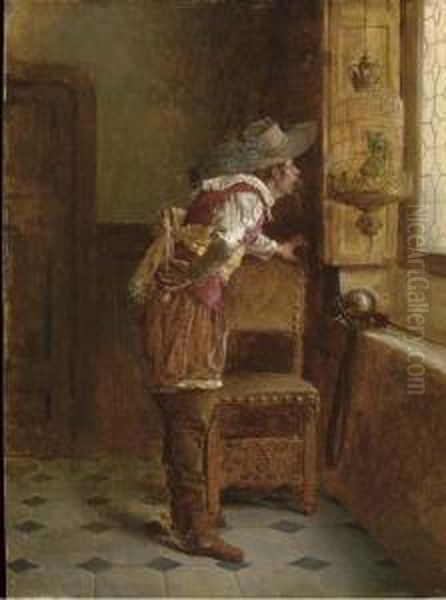
Ignacio León y Escosura is best known for his historical genre paintings, often referred to in Spanish as "pintura de casacón" (literally, "frock coat painting"). This subgenre specialized in depicting scenes, often intimate or anecdotal, set in the 17th and 18th centuries, characterized by meticulous attention to period costume, furnishings, and architectural details. His works were not grand historical narratives in the manner of Jacques-Louis David, but rather more intimate, often charming, evocations of a bygone era, appealing to a bourgeois clientele fascinated by the past.
A defining characteristic of León y Escosura's style was his profound admiration for the Spanish Golden Age master, Diego Velázquez (1599-1660). He consciously emulated Velázquez's approach, particularly in the rendering of figures, the dignity of their bearing, and the rich textures of their attire. This Velázquezian influence is evident in the naturalism, the subtle use of light and shadow, and the psychological presence he sought to imbue in his characters, even within highly staged compositions. His paintings are marked by a refined technique, careful draughtsmanship, and a vibrant palette, often showcasing luxurious fabrics like silks, satins, and velvets with remarkable skill.
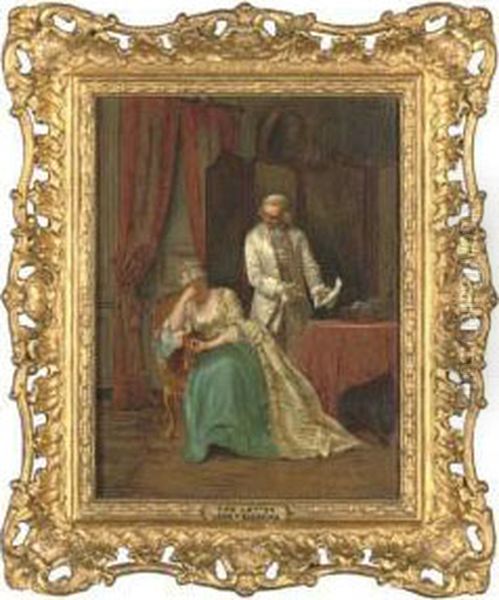
While Velázquez was a primary inspiration, León y Escosura's style also absorbed other influences. The detailed realism and intimate domesticity found in Dutch Golden Age painting, by artists such as Johannes Vermeer or Gerard ter Borch, likely resonated with his preference for carefully constructed interior scenes. There are also suggestions that, like many artists in Paris during the late 19th century, he may have been aware of or influenced by Japanese Ukiyo-e prints, particularly in terms of compositional strategies or decorative elements, though this is less overtly prominent in his core body of work compared to the Spanish and Dutch traditions. His paintings were, above all, decorative and highly finished, designed to appeal to the tastes of collectors who appreciated technical skill and historical romance.
Representative Works: Glimpses into the Past
Among Ignacio León y Escosura's notable works, "A Man in 17th-Century Spanish Costume" (Un hombre con traje español del siglo XVII) stands out as a quintessential example of his artistic concerns. This painting, likely one of several variations on the theme, showcases his mastery in rendering historical attire with precision and flair. The subject, often a solitary figure or a small group, is presented with a quiet dignity, their costume – perhaps a ruff collar, a doublet, breeches, and a cape – becoming a central focus of the artwork. These works are not merely fashion plates but attempts to capture the spirit and aesthetic of a specific historical period, filtered through a 19th-century sensibility.
Another known work, "Teasing the Parrot" (Molestando al loro), exemplifies the anecdotal and charming nature of many of his genre scenes. Such paintings often depicted leisurely moments in opulent interiors, featuring elegantly dressed figures interacting with pets, playing musical instruments, or engaged in quiet conversation. These scenes provided ample opportunity for León y Escosura to display his skill in rendering diverse textures, intricate patterns, and the interplay of light on surfaces, all while telling a subtle story that would engage the viewer. His oeuvre also included depictions of artists in their studios, scenes from literature, and moments of gallantry, all set within meticulously recreated historical environments. The success of these works lay in their ability to transport the viewer to a romanticized past, offering an escape from the rapidly industrializing modern world.
The Collector and Art Dealer: A Parallel Passion
Beyond his identity as a painter, Ignacio León y Escosura was an avid and knowledgeable collector of antiques and objets d'art, primarily focusing on pieces from the 16th and 17th centuries. This passion was not merely a hobby but an integral part of his artistic practice and his business ventures. His collection, which included furniture, textiles, weaponry, ceramics, and other decorative arts, served as a rich repository of props and inspiration for his historical paintings. By surrounding himself with authentic artifacts, he could imbue his canvases with a greater sense of historical accuracy and atmosphere.
His activities as a collector naturally evolved into art dealing. He established connections with a network of suppliers and clients, leveraging his expertise and his prominent position in the Parisian art world. A significant aspect of this was his association with the Marcy family, who were known for their art handicrafts. His wife, Blanche, was reportedly the niece of Marie Thérèse Filleul Marcy. It appears León y Escosura played a role, perhaps even a financial one, in the operations of Maison Marcy, an establishment that dealt in antiques and high-quality reproductions, with outlets in Paris and London. This enterprise catered to the strong contemporary demand for historical artifacts and decorative items, often blurring the lines between authentic antiques and skillful pastiches.
One of the most intriguing and consequential relationships in León y Escosura's life as a dealer and collector was with Luigi Parmeggiani (1860-1945). Parmeggiani was an Italian antiquarian with a colorful and controversial past, including alleged involvement in anarchist activities that led him to flee Italy for London. It was in London that he encountered León y Escosura. The two men formed a close association, with Parmeggiani becoming deeply involved in the art and antiques trade, likely under Escosura's mentorship and in connection with Maison Marcy. A substantial portion of León y Escosura's vast collection, along with items acquired through Maison Marcy and Parmeggiani's own dealings, eventually formed the core of the Galleria Parmeggiani in Reggio Emilia, Italy. This museum, housed in a striking Gothic-Revival building designed by Parmeggiani himself, stands as a testament to their shared passion for collecting and the complex world of 19th-century art dealing.
Connections, Contemporaries, and the Art World Milieu
Ignacio León y Escosura operated within a rich network of artists, dealers, and collectors. His teacher, Federico de Madrazo, remained an influential figure in Spanish art, and his son, Raimundo de Madrazo y Garreta (1841-1920), also achieved international fame as a portraitist and genre painter, often working in Paris and sharing a similar taste for elegant, refined subjects.
In Paris, León y Escosura would have been aware of, and likely interacted with, leading figures of the French academic and historical genre schools, such as Jean-Léon Gérôme (1824-1904) and Ernest Meissonier (1815-1891). These artists were masters of meticulous detail and historical reconstruction, achieving immense popularity and commanding high prices. Their success set a benchmark for painters working in similar veins.
Among his Spanish contemporaries, Mariano Fortuny y Marsal (1838-1874) was a phenomenon. Fortuny's dazzling technique, his vibrant depictions of Orientalist and historical genre scenes (often termed "preciosismo" for their jewel-like quality), captivated the international market. Though Fortuny's career was tragically short, his impact was immense, and artists like León y Escosura, while perhaps not direct imitators, certainly operated in a market shaped by Fortuny's success. Francisco Domingo Marqués (1842-1920) was another Spanish painter who, like Escosura, found success in Paris, specializing in historical genre scenes and portraits, often catering to an international clientele. They shared a common ground in their subject matter and their engagement with the commercial art world.
The rise of Realism, championed in Spain by artists like Eduardo Rosales (1836-1873) with works such as "The Testament of Isabella the Catholic," presented a different artistic direction, focusing on more somber and monumental interpretations of history. While this represented a form of "competition" in terms of artistic trends, the market for decorative historical genre paintings like those produced by León y Escosura remained robust throughout much of his career. He also maintained ties with the Spanish art establishment, evidenced by his participation in National Exhibitions in Madrid, where he received a second-class medal in 1884 at the Real Academia de Bellas Artes de San Fernando.
International Recognition and Exhibitions
León y Escosura's appeal extended beyond France and Spain. He actively participated in international exhibitions, which were crucial platforms for artists to gain visibility and attract patrons. His presence at the Great Exhibition in London in 1874 and an exhibition in Berlin in 1886 underscores his international standing. These events brought his work to the attention of a wider European audience and to collectors from the United States, where there was a growing appetite for European academic and historical genre painting. American art galleries and dealers played a role in introducing his works to this burgeoning market, further solidifying his international reputation. His paintings, with their accessible narratives, technical polish, and decorative qualities, were well-suited to the tastes of the newly wealthy industrialists and financiers of the Gilded Age.
Controversies and Unanswered Questions
The world of 19th-century art dealing and antique collecting was not without its ambiguities, and Ignacio León y Escosura's career was touched by some of these complexities. Accusations arose, particularly in relation to the activities of Maison Marcy and the collections associated with Luigi Parmeggiani, concerning the authenticity of certain items. There were claims that the workshop produced and sold skillful forgeries or pastiches of medieval and Renaissance objects, which subsequently found their way into private and even museum collections. While León y Escosura himself was implicated by association, no definitive evidence has conclusively proven his direct involvement in deliberate forgery. The era was rife with the production of high-quality reproductions, and the line between a legitimate copy, a piece "in the style of," and an outright fake could often be blurred, intentionally or otherwise.
The relationship with Luigi Parmeggiani itself adds a layer of intrigue. Parmeggiani's anarchist past and his later reinvention as a distinguished collector and museum founder make for a compelling narrative. A portrait of Parmeggiani, reportedly painted at Escosura's request, is said to depict him as older than he was at the time, perhaps an attempt to lend him an air of greater gravitas and experience in the world of antiquities.
The precise motivations and full extent of León y Escosura's own collecting and dealing activities, particularly the sourcing and vetting of objects, remain areas where art historical research continues to shed light. The very nature of his historical paintings, relying on an abundance of period props, meant that his studio was a treasure trove, but the provenance and exact nature of every item within it would be a monumental task to ascertain fully.
Legacy and Enduring Influence
Ignacio León y Escosura passed away in Toledo in 1901, leaving behind a complex legacy. As a painter, he was a skilled practitioner of the historical genre, contributing to the 19th-century fascination with the past. His works, while perhaps not groundbreaking in terms of artistic innovation when compared to the avant-garde movements of his time like Impressionism (led by artists like Claude Monet and Edgar Degas) or Post-Impressionism (with figures such as Vincent van Gogh and Paul Cézanne), were highly accomplished within their own academic and historicist framework. They catered to a significant market demand and are valuable today for their technical execution and as cultural documents of 19th-century taste.
His most tangible and perhaps most significant legacy lies in the realm of collecting. The collections he amassed, and those he influenced through his association with Parmeggiani and Maison Marcy, have had a lasting impact. The Galleria Parmeggiani in Reggio Emilia remains a unique institution, a "house-museum" that reflects the eclectic tastes and collecting practices of the late 19th and early 20th centuries. It contains a diverse array of objects, from paintings and sculptures to arms, armor, textiles, and furniture, including works attributed to masters like El Greco, alongside many pieces whose attributions and origins continue to be debated by scholars – a testament to the complex world Escosura inhabited.
His career also highlights the increasingly international nature of the art world in the 19th century, with artists, dealers, and collectors moving fluidly between national borders. He exemplified the artist-entrepreneur, successfully navigating both the creative and commercial aspects of his profession.
Conclusion: A Man of His Time
Ignacio León y Escosura was, in many ways, a quintessential man of his time. His art reflected the 19th-century historicist vogue, his business dealings the burgeoning international art market, and his collections the era's passion for antiques. He moved with ease between the studios of Madrid and Paris, the exhibition halls of London and Berlin, and the intricate networks of dealers and collectors that spanned Europe. While his name may not be as widely recognized today as some of his avant-garde contemporaries or the grand masters he admired, his career offers a rich insight into the artistic, social, and commercial dynamics of the 19th-century art world. From his early training under Federico de Madrazo to his Parisian success and his enduring legacy through collections like the Galleria Parmeggiani, Ignacio León y Escosura remains a figure worthy of continued study and appreciation for his multifaceted contributions to the rich tapestry of art history. His life and work serve as a reminder that the art world is composed not only of revolutionary innovators but also of skilled practitioners, discerning connoisseurs, and astute entrepreneurs who collectively shape its course.