Jean-Paul Haag stands as a notable figure in the landscape of 19th-century European art, a painter whose canvases meticulously captured the nuances of everyday life, particularly the intimate worlds of domestic interiors, the innocence of childhood, and the idealized charm of rural existence. Though perhaps not as globally renowned as some of his revolutionary contemporaries, Haag's dedication to his craft, his keen observational skills, and his ability to imbue ordinary scenes with warmth and gentle sentiment have secured him a respected place among the genre painters of his era. His work offers a valuable window into the social and cultural fabric of his time, reflecting prevailing tastes and an appreciation for finely rendered narratives.
Bavarian Roots and Parisian Aspirations
Born on November 5, 1842, in the Kingdom of Bavaria, now part of modern-day Germany, Jean-Pierre Haag, who would become known professionally as Jean-Paul Haag, embarked on an artistic journey that would primarily unfold in France. While his origins were Germanic, his artistic soul found its true home and development in the vibrant cultural milieu of Paris. The French capital, then the undisputed center of the Western art world, drew aspiring artists from across Europe and beyond, offering unparalleled opportunities for training, exhibition, and engagement with cutting-edge artistic discourse.
It was in Paris, during the 1860s, that Haag received his formal artistic training. This period was a dynamic one in French art, with the established academic tradition, championed by institutions like the École des Beaux-Arts, still holding considerable sway, even as new movements like Realism and the nascent Impressionism were beginning to challenge its hegemony. Haag's education would have immersed him in the foundational principles of drawing, composition, and oil painting techniques, emphasizing anatomical accuracy, perspective, and a polished finish – hallmarks of the academic style that remained popular with the public and the influential Salon juries.
Debut at the Salon and Early Career
The Paris Salon, the official art exhibition of the Académie des Beaux-Arts, was the paramount venue for artists seeking recognition and patronage in 19th-century France. Acceptance into the Salon was a critical step for any ambitious painter, and Haag achieved this milestone in 1870. His debut marked his formal entry into the professional art world, signaling that his skills had reached a level deemed worthy of public display alongside the works of established masters and promising newcomers.
Haag's early career developed within this competitive yet stimulating environment. He focused on genre painting, a category that encompasses scenes of everyday life, often featuring ordinary people engaged in common activities. This was a popular and commercially viable field, appealing to a growing bourgeois clientele who appreciated relatable subjects rendered with skill and charm. His works often centered on interior scenes, depicting family activities, moments of quiet domesticity, and the world of children. These themes resonated with contemporary tastes, which often idealized family life and the perceived innocence and simplicity of childhood.
Thematic Focus: The Poetry of the Everyday
Jean-Paul Haag's artistic vision was deeply rooted in the observation and depiction of daily life. He possessed a remarkable ability to find the picturesque and the poignant in the seemingly mundane. His canvases frequently transport viewers into cozy, well-lit interiors, where families gather, individuals engage in quiet pursuits, or children are absorbed in their play. These scenes are rendered with a meticulous attention to detail, from the textures of fabrics and the play of light on surfaces to the subtle expressions on his figures' faces.
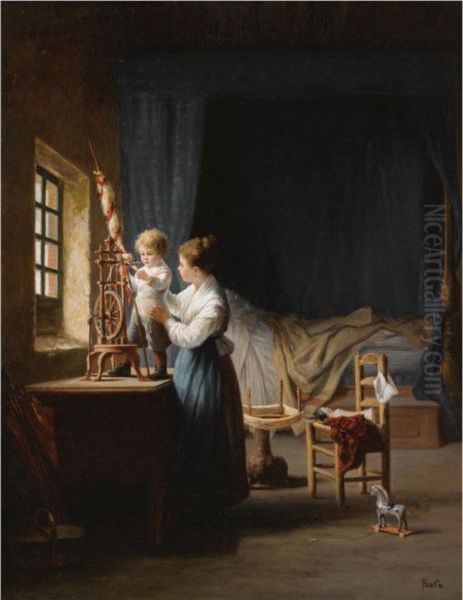
Children were a particularly favored subject for Haag. He portrayed them with a gentle empathy, capturing their naturalness and the charm of their youthful activities. Whether depicting them at play, like in his Salon-exhibited work Les Boules de neige (The Snowballs), or engaged in simple tasks, such as in Le petit fileur (The Little Spinner) or The Little Seamstress, Haag avoided excessive sentimentality, instead focusing on a tender realism. These works reflect a societal idealization of childhood as a period of innocence and simplicity, a theme that found widespread appeal.
Rural life also held a significant attraction for Haag. Like many artists of his time, he was drawn to the perceived authenticity and tranquility of the countryside, a stark contrast to the rapidly industrializing urban centers. His depictions of rural scenes often carry an idealized quality, emphasizing harmony, simple virtues, and a connection to nature. These were not typically scenes of harsh agricultural labor in the vein of Jean-François Millet, but rather more idyllic portrayals of village life and pastoral charm, akin to the gentler visions of artists like Jules Breton or Léon Augustin Lhermitte, though often on a more intimate scale.
Artistic Associations: The Painters' Colonies of Normandy and Ecouen
A significant aspect of Jean-Paul Haag's artistic life was his involvement with painters' colonies. These communities, which flourished in the 19th century, offered artists opportunities to live and work in picturesque rural settings, often sharing camaraderie, exchanging ideas, and finding inspiration in the local landscape and populace. Haag was a member of two notable colonies: the Normandy Painters' Colony and the Ecouen Painters' Colony.
His association with the Normandy Painters' Colony spanned a considerable period, from 1870 until his death in 1921. Normandy, with its varied coastline, lush countryside, and historic towns, had long attracted artists, including figures like Gustave Courbet and later, Impressionists such as Claude Monet and Eugène Boudin. For Haag, the region provided a rich source of subjects, from its rustic interiors to its village scenes, aligning perfectly with his thematic interests. His time in Normandy undoubtedly deepened his appreciation for rural life and informed his depictions of its character.
Haag was also a member of the Ecouen Painters' Colony, located in a village just north of Paris. Ecouen became a significant center for genre painting, particularly known for its focus on scenes of peasant life and childhood. The colony was notably influenced by Pierre Édouard Frère, an artist celebrated for his sympathetic portrayals of children and humble domestic scenes. It was within this environment that Haag further honed his skills. Sources indicate he learned from artists such as Pierre Édouard Pichon and Marie Constantineau Lemaire while associated with Ecouen. The influence of figures like Frère and Léon Marie Constant Dansaert, also active in such circles, would have reinforced Haag's inclination towards detailed, narrative genre scenes. The shared ethos of these colonies, emphasizing direct observation and a focus on everyday subjects, was clearly compatible with Haag's artistic temperament.
Notable Works and Artistic Style
Jean-Paul Haag's body of work is characterized by its consistent quality, refined technique, and thematic coherence. Among his representative paintings, Woman at the Window (circa 1880s) is particularly noteworthy. This piece showcases his skill in composition and his ability to create a sense of depth and atmosphere. The work is described as combining elements reminiscent of Renaissance and medieval art, along with trompe-l'oeil techniques, particularly in its use of an arched frame to enhance the illusion of space. Such a painting demonstrates Haag's awareness of art historical traditions and his capacity to integrate them into his own distinct style.
His Salon entries of 1879, Les Boules de neige (The Snowballs) and Le petit fileur (The Little Spinner), further exemplify his preferred subjects and artistic approach. The Snowballs likely captured a lively outdoor scene of children at play, a subject that allowed for dynamic composition and the expression of youthful energy. The Little Spinner, and a similarly titled or related work, The Little Seamstress, would have focused on more contemplative indoor scenes, highlighting youthful diligence or the quiet absorption of a child engaged in a traditional craft. These works underscore his focus on detail, the careful rendering of figures and their environments, and the creation of a gentle, narrative mood.
Haag primarily worked in oils, a medium that allowed for rich colors, smooth blending, and the meticulous depiction of texture and light that characterized his style. His paintings exhibit a high degree of finish, a quality valued in the academic tradition and appreciated by the Salon-going public. While his work generally aligns with the broader trends of 19th-century realism in its attention to observable detail, it often carries an idealized or sentimental inflection, distinguishing it from the more socially critical or starkly objective realism of artists like Gustave Courbet or Honoré Daumier.
An interesting aspect noted in some descriptions of Haag's work is a "subjective humor," characterized by the juxtaposition of seemingly unrelated elements to emphasize the artist's imaginative faculty. While his primary output appears to be more straightforwardly narrative, this suggests a capacity for more whimsical or subtly playful compositions, adding another layer to his artistic personality. There is also a mention of an innovative watercolor technique, suggesting a versatility beyond his more commonly known oil paintings, and perhaps an engagement with trends seen in British art where watercolor flourished.
Contextualizing Haag: The Broader Artistic Landscape of the 19th Century
To fully appreciate Jean-Paul Haag's contribution, it is essential to view his work within the rich and diverse artistic landscape of the 19th century. He operated during a period of profound artistic change and stylistic plurality. The dominant force for much of the century, particularly in France, was Academic art, exemplified by masters like Jean-Léon Gérôme and William-Adolphe Bouguereau. These artists produced highly polished, often large-scale works depicting historical, mythological, or allegorical subjects, as well as idealized genre scenes, setting a standard for technical excellence that Haag, in his own sphere, clearly respected.
Running parallel to and often challenging the academic tradition was the Realist movement. Artists like Jean-François Millet, with his dignified portrayals of peasant labor in works like The Gleaners, and Gustave Courbet, with his provocative and unvarnished depictions of rural life and contemporary society, sought to represent the world with a new level of truthfulness, often focusing on the lives of ordinary people. While Haag shared their interest in everyday subjects, his approach was generally less rugged and more polished, aligning more with a sentimental or picturesque realism than with the often starker visions of Millet or Courbet.
Other notable genre painters of the era included Jules Breton, whose depictions of rural French life, such as The Song of the Lark, combined realism with a poetic sensibility, and Léon Augustin Lhermitte, known for his masterful charcoal drawings and paintings of agricultural workers. In Belgium, Alfred Stevens gained fame for his elegant portrayals of fashionable women in luxurious interiors, while James Tissot, a Frenchman who spent much of his career in England, captured the nuances of Victorian society with wit and precision. These artists, each with their distinct focus, illustrate the breadth and popularity of genre painting during this period.
Haag's work, with its emphasis on domesticity, childhood, and idealized rural scenes, found a comfortable niche within this landscape. He was not an avant-garde revolutionary like the Impressionists – Claude Monet, Edgar Degas, Camille Pissarro, or Berthe Morisot – who were challenging the very conventions of representation with their focus on light, color, and fleeting moments, often painted en plein air. Haag remained more firmly rooted in traditional modes of representation and narrative, catering to a taste for well-crafted, emotionally accessible art. His connection to painters' colonies like Ecouen, with its emphasis on detailed and often sentimental genre scenes under the influence of figures like Pierre Édouard Frère, further situates him within a specific and popular current of 19th-century art.
Personal Life and Final Years
Information regarding Jean-Paul Haag's personal life, beyond his artistic endeavors, is somewhat limited, as is often the case for artists who did not achieve the highest echelons of fame or court public notoriety. It is known that he was married to Ernestine Confais, and together they had several children. This domestic aspect of his life likely provided firsthand inspiration for his many depictions of family and childhood, lending an authentic warmth to these scenes.
Haag continued to be an active artist throughout his life. His long-standing membership in the Normandy Painters' Colony, extending to 1921, suggests a sustained commitment to his art and to the communal artistic life that such colonies fostered. He passed away on March 5, 1921, leaving behind a body of work that consistently reflected his artistic vision and technical skill. His lifespan covered a period of immense artistic, social, and technological transformation, yet his art remained largely focused on timeless themes of human connection, domestic peace, and the gentle rhythms of everyday existence.
Legacy and Art Historical Position
In the grand narrative of art history, Jean-Paul Haag is recognized as a skilled and dedicated practitioner of genre painting. He did not forge new artistic paths in the manner of the Impressionists or Post-Impressionists, nor did he achieve the monumental status of the leading academic painters of his day. However, his contribution lies in the consistent quality of his work, his sensitive portrayal of his chosen subjects, and his ability to capture a particular sensibility of his era.
His paintings offer a valuable glimpse into the tastes and values of the 19th-century bourgeoisie, who appreciated art that was both technically accomplished and emotionally resonant. The focus on idealized rural life and the sanctity of the family unit were themes that held considerable appeal in an age of rapid industrialization and social change. Haag's work provided a comforting vision of stability, innocence, and simple virtues.
His association with artists' colonies like Ecouen and Normandy places him within an important movement that saw artists seeking inspiration and a more authentic way of life outside the bustling urban centers. These colonies played a crucial role in the development of landscape and genre painting in the 19th century.
Today, Jean-Paul Haag's paintings are appreciated for their charm, their meticulous execution, and their historical value as documents of a bygone era. They may not shout for attention with bold innovations, but they speak with a quiet eloquence of the enduring human interest in stories of everyday life, rendered with skill, empathy, and a gentle touch. He remains a respected figure among the many talented artists who contributed to the rich tapestry of 19th-century European art, a chronicler of intimate moments and idealized sentiments that continue to engage viewers.